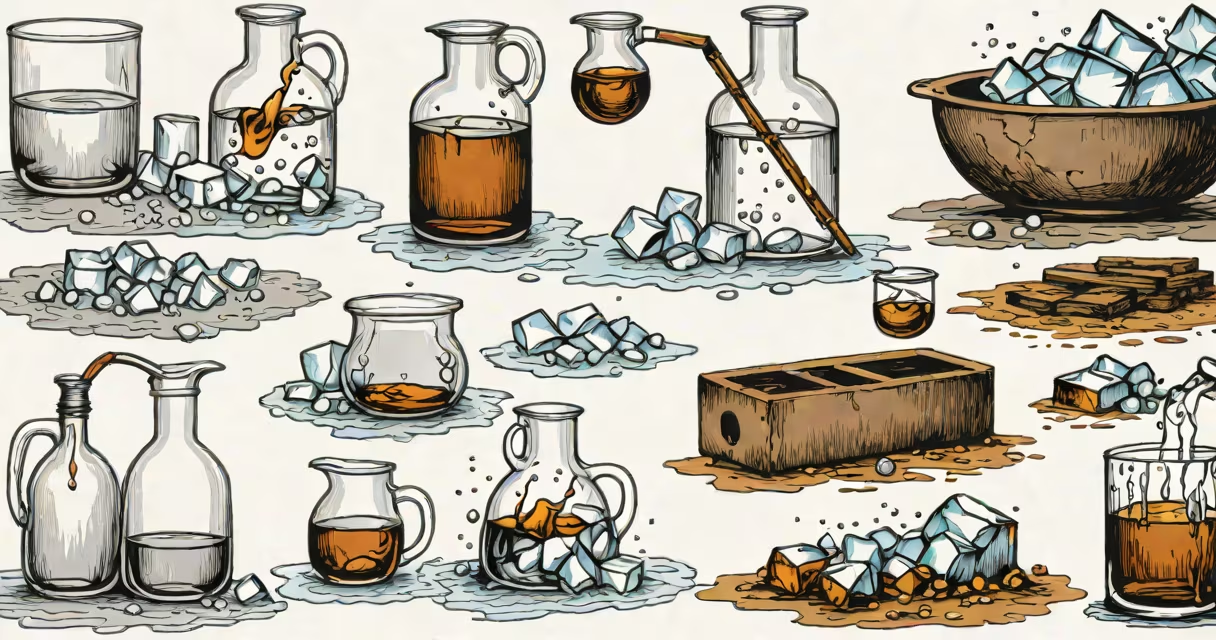
Chemical and physical changes describe how matter alters its form or composition. Physical changes affect appearance without altering molecular structure; chemical changes produce new substances through irreversible reactions. These transformations are central to understanding material behavior in everyday life and scientific processes.
Physical changes involve shifts in state, shape, or size without changing a substance's chemical identity. Melting ice into water or tearing paper are physical changes because H₂O remains H₂O and cellulose stays cellulose. The molecules retain their original bonds and identities.
Chemical changes occur when atoms rearrange to form new substances. Burning wood produces CO₂, H₂O vapor, and ash-each chemically distinct from the original cellulose and lignin. The process is irreversible under normal conditions and involves bond breaking and forming.
Energy transfer distinguishes the two. Physical changes often absorb or release heat during phase transitions-like boiling water at 100°C at sea level. Chemical changes require activation energy to start and may release or absorb significant energy afterward, such as in combustion or photosynthesis.
Physical changes include changes of state (melting, freezing, evaporation, condensation), deformation (bending metal), dissolution (salt in water), and separation (filtering sand from water). These are reversible and do not alter molecular composition.
Chemical changes include combustion, oxidation, decomposition, acid-base reactions, and synthesis. They result in new compounds with different properties. For example, baking soda reacting with vinegar produces carbon dioxide gas-a clear sign of a chemical reaction.
A key distinction lies in reversibility. While you can freeze melted ice back into solid water, you cannot reverse rusting iron back to pure iron without industrial processes. This irreversibility signals a chemical transformation.
Melting chocolate is a physical change-its texture and shape alter, but the cocoa butter and sugar remain unchanged. However, burning chocolate creates smoke and ash: a chemical change due to combustion.
Boiling water appears to change dramatically, but it's still H₂O. The phase shift from liquid to gas is physical. Confusion arises when people equate visible change with chemical transformation. A color change, gas production, temperature shift, or precipitate formation are better indicators of chemical change.
One non-obvious fact: dissolving salt in water is a physical change despite the solution conducting electricity. Ion dissociation doesn't create new compounds-it separates Na⁺ and Cl⁻ ions. The original NaCl remains intact at the molecular level.
| Feature | Physical Change | Chemical Change |
|---|---|---|
| Molecular Identity | Unchanged | Altered |
| Reversibility | Often reversible | Usually irreversible |
| Energy Use | Phase transitions (e.g., melting) | Activation energy, heat release/absorption |
| Examples | Ice melting, glass breaking | Rusting iron, digesting food |
Exothermic chemical reactions release energy-like fire or hand warmers. Endothermic reactions absorb energy, such as photosynthesis or baking bread. These energy flows define whether a reaction sustains itself or requires continuous input.
In industry, controlling these changes ensures safety and efficiency. For example, in steel manufacturing, physical shaping occurs at high temperatures, but the actual alloying relies on chemical reactions between iron, carbon, and additives.
I once observed a lab experiment where a student heated copper sulfate crystals. The blue powder turned white-the loss of water molecules was a physical change. But when they added water back, the color returned. This demonstrated that dehydration and hydration are physical processes, not chemical.
Understanding types of chemical and physical changes is essential in cooking, medicine, environmental science, and engineering. Baking bread involves both: yeast fermentation (chemical) and dough rising due to gas expansion (physical).
Environmental impact hinges on these principles. When plastic degrades in sunlight, UV radiation causes chain scission-physical breakdown-but eventual oxidation leads to chemical degradation, releasing microplastics and toxins.
Some assume that all reactions involving heat are chemical. But heating a metal rod expands it physically-thermal expansion. Only when the metal oxidizes (forms scale) does a chemical change occur.
Another misconception: mixing substances always causes chemical change. Stirring oil and water creates a heterogeneous mixture-physical separation. No new compounds form.
Even in biological systems, digestion includes both types. Chewing breaks food into smaller pieces (physical), while enzymes catalyze hydrolysis of proteins into amino acids (chemical).
Types of chemical and physical changes govern how materials behave across science, nature, and daily life. Recognizing the difference-especially through observable signs like gas evolution, color change, or energy flow-ensures accurate interpretation of phenomena. Whether in a kitchen, lab, or system, these changes define transformation at the molecular level.