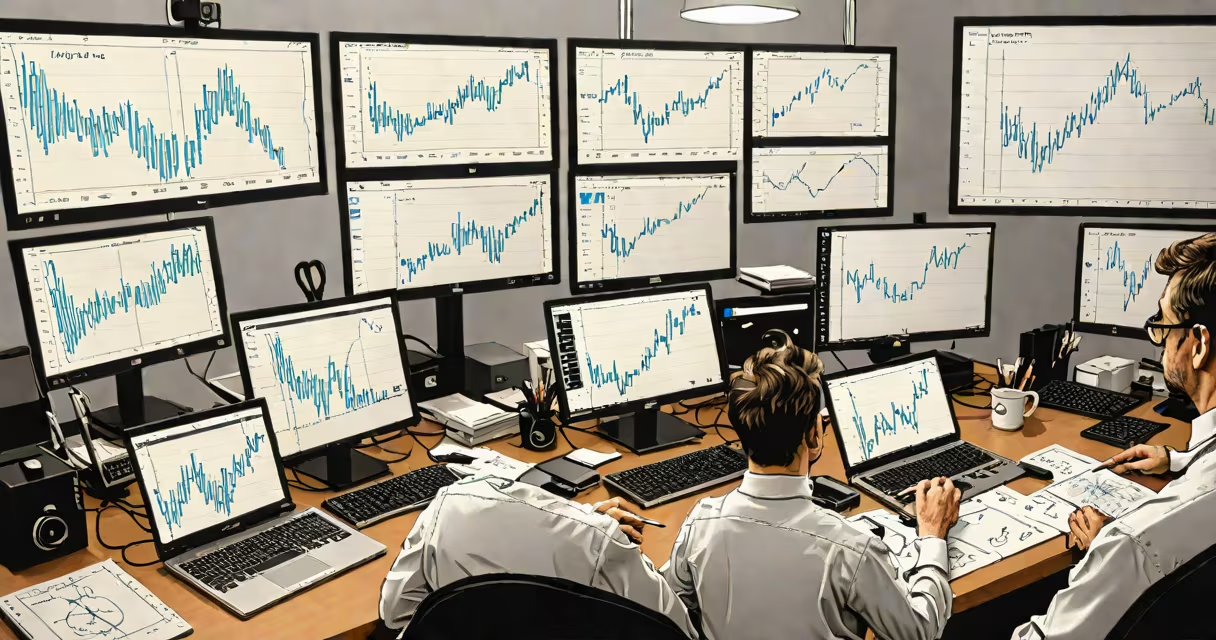
Trade in foreign currency means buying or selling one country's money for another's, typically through the global foreign exchange market. This activity enables individuals, businesses, and governments to manage risk, fund international operations, or profit from price changes in currency values.
The foreign exchange market operates 24 hours a day, five days a week, connecting banks, brokers, institutions, and retail traders across time zones. Exchange rates fluctuate constantly based on economic data, interest rates, political stability, and market sentiment. Traders buy a currency expecting its value to rise relative to another, then sell it later at a higher price.
For example, a U.S.-based company importing electronics from Japan may need to pay in Japanese yen. To do so, it trades U.S. dollars for yen through a bank or online broker. If the dollar weakens against the yen during the transaction window, the company pays more in dollar terms. By locking in a rate early, it reduces financial exposure.
Exchange rates are set by supply and demand. When many people want to buy euros using U.S. dollars, the euro's value rises. When demand drops, the euro falls. These movements happen in real time across global markets.
Most trades occur electronically via platforms like MetaTrader 4 or proprietary systems used by investment banks. A standard trade involves a currency pair-such as EUR/USD-where the first currency is the base and the second is the quote. If EUR/USD is 1.10, one euro buys 1.10 U.S. dollars.
Trades settle within two business days (T+2) in most cases. For spot transactions, funds transfer between accounts after confirmation. Larger institutions may use forward contracts to lock in rates months ahead, hedging against volatility.
Three main groups engage in trade in foreign currency:
For instance, when Turkey's central bank raised interest rates in 2023 to combat inflation, the lira strengthened briefly. Traders who bet on this move gained quickly. Conversely, those who didn't hedge saw losses when the lira reversed course.
According to the Bank for International Settlements (BIS), daily turnover in the global foreign exchange market reached $7.5 trillion in 2022-up from $6.6 trillion in 2019. This volume reflects high liquidity and low spreads for major currencies.
Many assume forex trading is like gambling. While speculation exists, institutional players use complex models and macroeconomic analysis. The BIS reports that 80% of daily forex volume comes from hedging and commercial needs, not pure speculation.
Another error is thinking all currencies trade equally. In reality, the top eight currency pairs account for over 75% of global volume. The most traded is EUR/USD, followed by USD/JPY, GBP/USD, and USD/CAD.
A lesser-known fact: central banks don't just react-they proactively manage currency levels. In 2022, the Swiss National Bank intervened multiple times to cap the Swiss franc's strength, which threatened exports. They sold francs and bought euros to prevent appreciation.
Currency pairs are grouped into majors, minors, and exotics:
| Type | Examples | Characteristics |
|---|---|---|
| Majors | EUR/USD, USD/JPY, GBP/USD | High liquidity, tight spreads, low volatility |
| Minors | EUR/GBP, AUD/CAD | Limited liquidity, wider spreads, less frequent trading |
| Exotics | USD/TRY, EUR/ZAR, JPY/SGD | Low liquidity, high volatility, risky for beginners |
Trading exotic pairs requires deeper research. For example, the Turkish lira (TRY) has historically been volatile due to political uncertainty and inflation. In 2021, it lost nearly 40% of its value against the dollar in six months-a sharp drop that caught many traders off guard.
I once monitored a client's portfolio that included USD/SEK (U.S. dollar/Swedish krona). The client had assumed the krona was stable because Sweden has a strong economy. But when the Riksbank delayed rate hikes in 2022, the krona dropped 12% in three weeks. That loss wasn't due to bad fundamentals-it was timing and expectations.
Businesses use trade in foreign currency to manage costs. A U.S. retailer sourcing from China may lock in a yuan-to-dollar rate to avoid losses if the yuan appreciates. Without this, a 10% rise in the yuan could increase import prices by 10%, squeezing margins.
Individuals trade for travel, remittances, or investing. A person sending money to family in Mexico can save 2-3% by using a service with better exchange rates than a bank's standard fee. Some apps offer mid-market rates-closer to the actual wholesale price-without hidden markups.
Profits come from accurate forecasting. A trader who predicted the British pound would fall after Brexit votes in 2016 could have profited by selling GBP/USD before the drop. The pound fell 15% in the following month. Those who acted early saw gains.
However, losses can be swift. In 2022, the Japanese yen weakened sharply after the Bank of Japan maintained ultra-low rates while others raised them. Traders betting on a stronger yen lost heavily. The yen dropped 20% against the dollar in six months.
Beginners should start with major pairs and use demo accounts to test strategies. Most brokers offer free simulations with real-time data. This lets users learn without risking capital.
Understanding economic indicators is essential. Data such as employment numbers, inflation reports (like the U.S. CPI), and central bank decisions drive currency moves. For example, when the Federal Reserve signals rate hikes, the dollar tends to strengthen.
Trade in foreign currency is not a single action-it's a continuous process shaped by global economics, policy decisions, and human behavior. Success depends on understanding both mechanics and context.