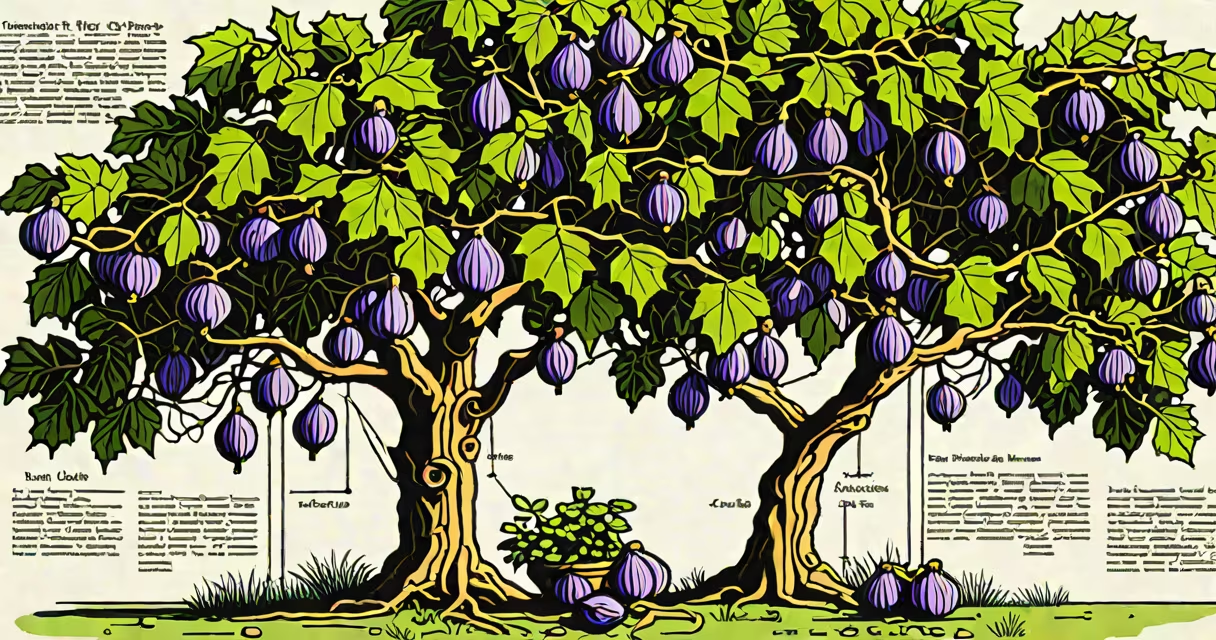
The fig tree (Ficus carica) is a deciduous shrub or small tree native to the Mediterranean region and western Asia, cultivated for its sweet, fleshy fruit and ornamental foliage. It grows 10-30 feet tall, depending on climate and pruning, and produces inedible male flowers internally before the fruit matures.
Fig trees thrive in USDA zones 6-10, where they tolerate mild winters and hot summers. They require full sun, well-drained soil, and minimal pruning. The fruit develops from a specialized inflorescence called a syconium, which houses tiny internal flowers. Pollination occurs via fig wasps (Blastophaga psenes), a mutualistic relationship essential for fruit set in wild populations. Domesticated varieties often produce seedless fruit through parthenocarpy-fruit development without fertilization.
Common cultivars include 'Brown Turkey', 'Celeste', and 'Mission'. 'Brown Turkey' ripens in late summer and yields large, dark-purple figs with sweet, honey-like flesh. 'Celeste' bears small, light-green figs with a delicate flavor and is cold-hardy to zone 6. 'Mission' produces large, dusky-red figs prized for drying and culinary use. These varieties differ in harvest timing, size, and sugar content, affecting their suitability for fresh eating, preserves, or baking.
Fig trees grow through a combination of vegetative expansion and seasonal dormancy. In spring, leaf buds emerge from dormant nodes along woody stems. As temperatures rise above 50°F (10°C), photosynthesis resumes, and sap flow increases. Flowers develop within the syconium-a hollow, urn-shaped structure lined with hundreds of tiny florets. After pollination by female fig wasps, ovules mature into seeds, and the syconium swells into a fleshy fruit.
Parthenocarpic figs, such as 'Brown Turkey', skip pollination entirely. Hormonal signals trigger fruit development from unfertilized ovules, resulting in seedless fruit. This trait allows commercial growers to produce consistent yields without relying on wasp populations. However, parthenocarpy reduces genetic diversity and may increase susceptibility to pests like the fig scale insect (Diaspidiotus juglans). Monitoring for infestations is critical during the growing season.
Harvest occurs when the fruit softens and droops slightly from the stem. Figs do not ripen further after picking. A ripe fig yields gently under thumb pressure and exudes sticky sap. Overripe figs attract wasps and ants, requiring daily inspection in orchards. Commercial producers use mechanical harvesters in regions like California's Central Valley, where fig production exceeds 20 million pounds annually.
The fig tree's structure includes a lignified trunk, compound leaves with three to five lobes, and a fibrous root system adapted to shallow, rocky soils. The bark is grayish-brown and fissured, especially on older specimens. Leaves measure 3-6 inches long and feature a waxy cuticle that reduces water loss-critical in dry climates.
Fruit composition varies by variety. 'Celeste' contains 14 grams of sugar per 100 grams of flesh, while 'Mission' averages 18 grams. Both provide 2 grams of fiber and 10% of the daily recommended intake of potassium per serving. The fruit also contains calcium, magnesium, and antioxidants like flavonoids and phenolic acids. These compounds contribute to anti-inflammatory effects observed in animal studies, though human clinical trials remain limited.
Root systems extend horizontally up to twice the tree's canopy width. In container-grown figs, roots may circle the pot, restricting nutrient uptake. Repotting every 2-3 years prevents stunting. Soil pH should remain between 6.0 and 6.5. Excess nitrogen promotes leafy growth at the expense of fruiting. Balanced fertilizers with low nitrogen (e.g., 5-10-10) support flowering and fruit development.
Fig trees are planted in home gardens, orchards, and urban landscapes. In California, they are grown commercially on 12,000 acres, producing 80% of U.S. dried figs. Fresh figs are sold locally in farmers' markets and specialty grocers. Dried figs are used in baked goods, trail mixes, and health bars.
Culturally, the fig tree appears in religious texts, including the Bible and Quran. In the New Proof, Jesus curses a barren fig tree, symbolizing divine judgment. In Islamic tradition, the fig is mentioned in Surah Al-Balad as a sign of God's provision. These references reflect the tree's historical role as a food source and spiritual symbol.
Ornamental uses include bonsai, espalier training, and hedgerows. Bonsai figs are shaped using wire and pruning to mimic ancient forms. Espalier figs grow flat against walls, maximizing sunlight exposure in small spaces. In Mediterranean cities like Barcelona and Athens, fig trees line city streets, providing shade and reducing urban heat island effects.
Many assume fig trees require constant watering. In reality, established trees survive droughts by shedding leaves and entering dormancy. Overwatering causes root rot, especially in clay soils. A single irrigation every 10 days during dry spells suffices for mature trees.
Another error is believing all figs are edible. Wild figs (Ficus carica var. sylvestris) have bitter latex and can cause allergic reactions. Domesticated varieties are safe when ripe. Unripe figs contain high levels of ficin, a proteolytic enzyme that irritates mucous membranes. Handling raw figs with gloves prevents skin irritation in sensitive individuals.
A lesser-known fact: fig trees can reproduce vegetatively. Root cuttings from mature trees sprout new shoots within weeks. This method bypasses the need for seed germination, which takes 2-4 months and results in variable traits. Gardeners use this technique to clone high-yielding varieties.
| Variety | Color at Ripeness | Size (inches) | Flavor Profile | Hardiness Zone |
|---|---|---|---|---|
| Brown Turkey | Dull purple | 1.5-2.5 | Honey-sweet, floral notes | 6-9 |
| Celeste | Light green | 1-1.5 | Mild, citrus hint | 6-9 |
| Mission | Dusky red | 2-3 | Rich, molasses-like sweetness | 7-10 |
Each variety differs in harvest window. 'Brown Turkey' fruits in August and September. 'Celeste' ripens in July. 'Mission' peaks in late September. Timing affects storage and market availability. Early-harvest varieties are less prone to bird damage but may lack full sweetness.
I grew a 'Celeste' fig tree in a 24-inch pot on my Brooklyn balcony. After two years, it produced 15 figs in early August. I harvested them daily, checking for softness. One fig attracted a wasp, which I removed with a spoon. The fruit tasted like apricot and lemon zest-unexpectedly complex. I shared the surplus with neighbors. The tree survived winter indoors near a south-facing window, losing half its leaves but regrowing in spring.