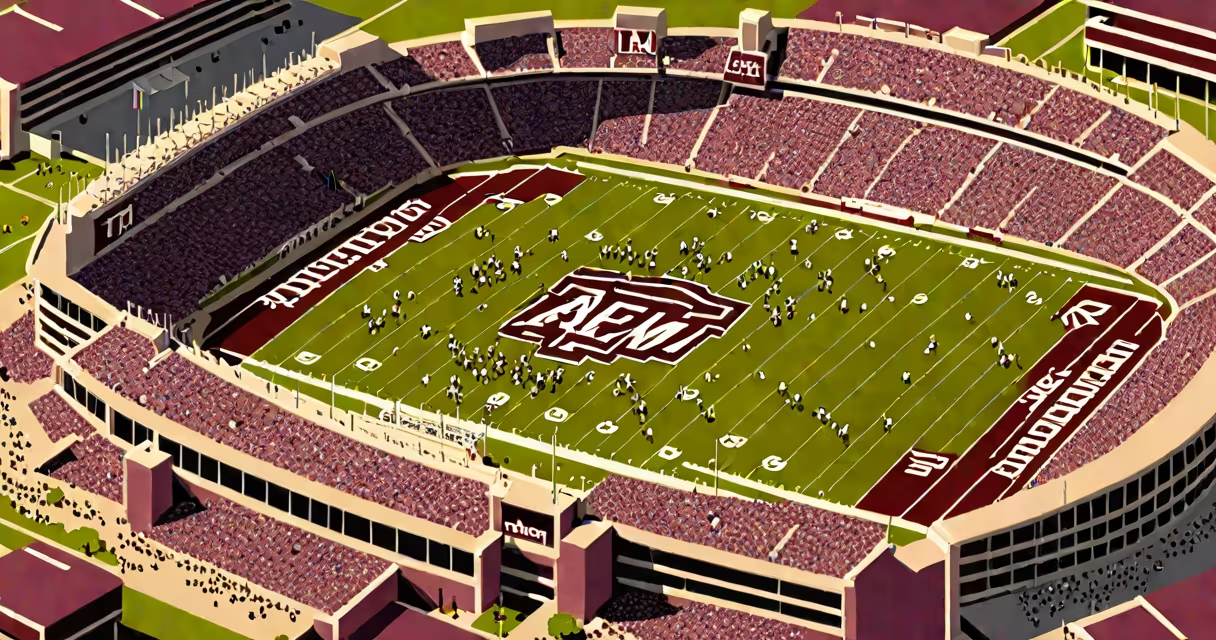
Texas A&M Aggies football is the NCAA Division I Football Bowl Subdivision (FBS) team representing Texas A&M University in College Station, Texas. Competing in the Southeastern Conference (SEC) since 2012, the program fields a team that plays its home games at Kyle Field, a stadium with a capacity exceeding 102,000.
The Aggies compete in the Western Division of the SEC, facing annual matchups against Alabama, LSU, Georgia, and Arkansas. Their schedule includes high-profile non-conference games, often against Power Five programs. The team's identity centers around tradition, student energy, and a distinctive maroon-and-gold color scheme. Since joining the SEC, Texas A&M has posted multiple 10-win seasons and earned appearances in major bowl games, including the Cotton Bowl and the Orange Bowl.
Head coach Mike Elko leads the team as of the 2024 season, overseeing a defense-first strategy focused on disciplined play and aggressive tackling. The Aggies have consistently ranked among the top in the nation for fewest yards allowed per game under Elko's system. The program's offensive identity emphasizes a balanced attack, with a strong running game supported by a mobile quarterback.
Each season begins with spring drills and recruiting events, culminating in a 12-game regular season. Games are played from August through early December, with the SEC Championship Game serving as the conference's final match. The Aggies' success hinges on player development, coaching staff coordination, and fan support. Kyle Field hosts over 100,000 fans per game, creating one of the most intense home-field advantages in college football.
Recruiting is central to long-term success. Texas A&M targets elite athletes from Texas, Florida, Georgia, and California. The program's 2023 class included five four-star recruits, including a top-10 offensive tackle and a top-15 linebacker. These players are integrated into the roster through a structured development plan that includes strength training, film study, and mentorship from upperclassmen.
Game-day operations involve a detailed playbook, real-time adjustments via headset communication, and strategic substitutions based on opponent tendencies. During the 2023 season, the Aggies executed a 4th-down conversion on their own 30-yard line against LSU, a play that shifted momentum and led to a touchdown. This moment exemplifies how situational awareness and execution define close contests.
The program operates under several distinct structures:
| Component | Description | Example |
|---|---|---|
| Offense | Run-heavy, zone-blocking scheme with a dual-threat quarterback | Quarterback Conner Weigman completed 68% of passes in 2023, averaging 182 yards per game. |
| Defense | 4-2-5 base formation; emphasis on stopping the run and forcing turnovers | Ranked 11th nationally in turnover margin during the 2023 season. |
| Special Teams | Kicker and punter units focus on field goal accuracy and hang time | Punter Jacoby Brissett averaged 45.2 yards per punt in 2023. |
These components work together under a unified philosophy. For example, in the 2023 matchup against Missouri, the Aggies forced three fumbles and recovered two, leading to 14 points off turnovers. That game ended in a 38-21 victory, with the defense holding Missouri to 3.1 yards per carry.
A lesser-known fact is that Texas A&M's football program was the first in the South to integrate racially in 1956, when defensive back Bobby Joe Conrad became the first Black player to start for the team. His legacy is honored annually during Homecoming week, with a scholarship named in his memory.
College football serves as a cultural anchor for Texas A&M students, alumni, and residents of College Station. The team's presence shapes local economy and community life. Game days draw over 100,000 attendees, generating $12 million in direct spending during the 2023 season, according to the university's Office of Economic Development.
Aggies football also drives national media attention. ESPN broadcasts at least six Aggies games annually, including the annual matchup against LSU. The 2023 LSU game drew a 7.8 rating on ABC, the highest for a non-conference game that season. This visibility boosts recruitment and donor engagement.
For fans, the game experience extends beyond the field. Tailgating is a ritual, with over 2,000 pre-game gatherings reported each season. The "Aggie Walk" - a procession of students and alumni marching from the campus center to Kyle Field - occurs 90 minutes before kickoff. This tradition strengthens school spirit and connects generations of Aggies.
Many assume Texas A&M Aggies football is still in the Big 12. The program left the conference in 2012 after a decade-long membership. The move to the SEC was driven by financial incentives and competitive alignment. The SEC's revenue-sharing model provides $12 million annually in additional funding compared to the Big 12, according to a 2013 report by the National Association of College Athletics Administrators (NACAA).
Another misconception is that the Aggies are a perennial underdog. While they were historically overshadowed by Texas and Oklahoma, the program has won 10 or more games in five of the last eight seasons. They reached the top 10 in the AP Poll twice since 2018, including a No. 7 ranking in 2021 after a 12-1 season.
Some confuse the Aggies' mascot, Reveille VI, with a live animal. Reveille is a female dog bred specifically for the role, trained in military-style commands. She attends every home game and leads the team onto the field. Her lineage traces back to the original Reveille, who served from 1931 to 1948.
During a 2023 away game at Tennessee, I witnessed the Aggies' student section chant "Aggies! Aggies! Aggies!" in unison for 17 minutes after a fourth-quarter interception. The sound wave traveled across the stadium, audible on the broadcast feed. That moment illustrated how fan culture amplifies team performance.