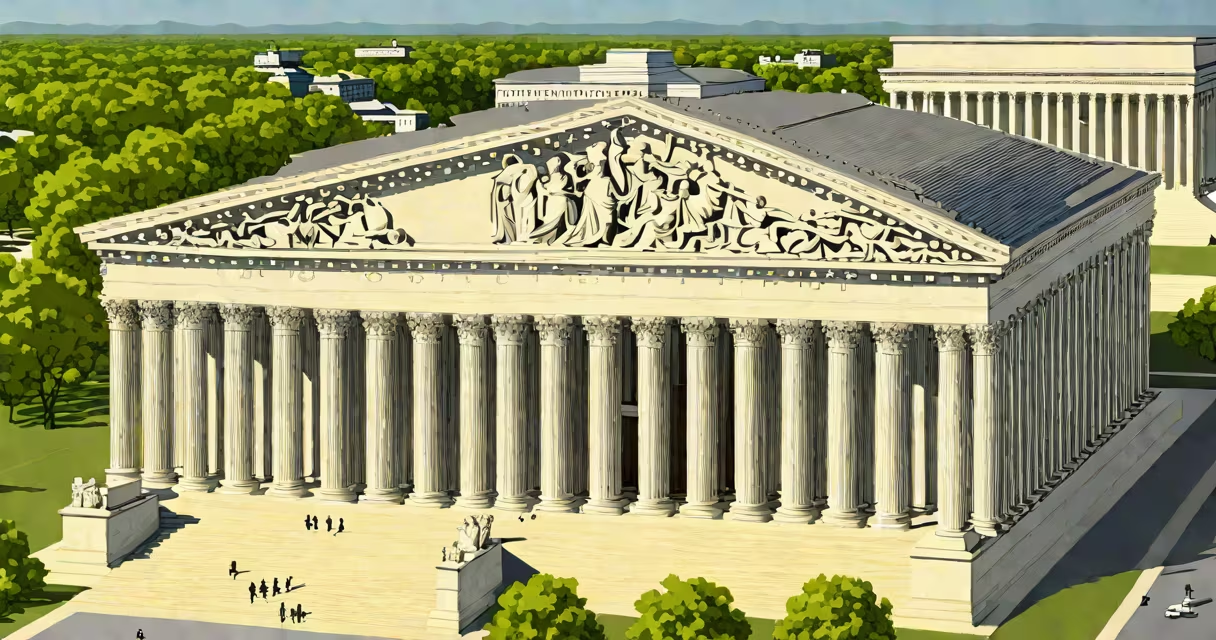
The Supreme Court of the United States, commonly called SCOTUS, is the highest judicial authority in the federal government. It has final jurisdiction over all cases involving federal law, constitutional questions, and disputes between states. Its nine justices serve lifetime appointments and interpret the U.S. Constitution, ensuring laws comply with its principles.
SCOTUS was established by Article III of the U.S. Constitution. It hears appeals from lower federal courts and state supreme courts when those cases involve federal questions. The Court's decisions are binding nationwide and often shape national policy. It does not conduct trials or hear new evidence-it reviews written briefs and oral arguments to determine whether laws or actions violate constitutional rights.
Each year, the Court receives about 7,000 petitions for writs of certiorari. It grants review in roughly 100 cases. Once a case is accepted, the justices meet in private to discuss and vote. A majority opinion explains the decision, while dissenting opinions show disagreements. These rulings set legal precedent and influence future interpretations of the law.
When a case reaches SCOTUS, it begins with a petition for a writ of certiorari. The petitioner argues that a lower court decision conflicts with constitutional law or federal precedent. The Court uses a "four-justice rule"-at least four justices must agree to hear a case. This ensures only significant or divisive issues reach the bench.
If granted, the case proceeds to oral argument. Each side gets 30 minutes to present their position before the nine justices. Questions from the bench are common and often reveal the justices' concerns. After arguments, the justices meet in conference to discuss and vote. They do not publicly debate during sessions. Instead, they exchange notes and votes behind closed doors.
After voting, the most senior justice in the majority assigns the task of writing the majority opinion. If the chief justice is in the majority, they assign the opinion. Otherwise, the most senior associate justice in the majority does. The opinion is circulated among justices for edits. Once finalized, it is released with the vote tally. Dissenting justices may file separate opinions explaining their disagreement.
SCOTUS consists of nine justices: one chief justice and eight associate justices. Justices are nominated by the president and confirmed by the Senate. They serve for life unless they resign, retire, or are impeached and removed. Since 1789, 115 individuals have served on the Court. Only 114 have been confirmed due to one vacancy being filled twice.
The current Court includes six justices appointed by Republican presidents and three by Democratic ones. The balance of power shifts based on nominations. For example, Justice Ketanji Brown Jackson, the first Black woman on the Court, was appointed in 2022 by President Biden. Her confirmation marked the first time since 1994 that a new justice replaced a retiring justice from the same party.
Justices are expected to remain impartial. They recuse themselves from cases where they have a personal or financial interest. For example, in 2022, Justice Thomas did not participate in a case involving a company he had received gifts from, though he did not disclose the gifts until later. This led to scrutiny over transparency, prompting calls for reform.
| Type | Description | Example |
|---|---|---|
| Original Jurisdiction | Cases where SCOTUS hears first, not on appeal | Disputes between states, such as border water rights |
| Appellate Jurisdiction | Review of lower court decisions | Challenges to federal statutes or state laws |
| Writ of Certiorari | Request to review a case | Over 7,000 filed annually; fewer than 100 accepted |
SCOTUS decisions affect civil rights, criminal procedure, and federal power. In 2022, the Court overturned Roe v. Wade, ending nearly 50 years of precedent protecting abortion rights. The ruling in Dobbs v. Jackson Women's Health Organization shifted authority over abortion laws to individual states. As of 2024, 16 states have banned or severely restricted abortion, while others maintain access.
Another landmark case is Obergefell v. Hodges (2015), which legalized same-sex marriage nationwide. The Court ruled that the Fourteenth Amendment's guarantee of equal protection applies to marriage regardless of gender. This decision changed state laws across the country and influenced similar rulings in Canada and Australia.
SCOTUS also interprets the limits of executive power. In Trump v. Hawaii (2018), the Court upheld a travel ban targeting predominantly Muslim countries. The majority held that the president has broad authority over immigration under the Immigration and Nationality Act. Critics argued the ban targeted religion, violating the Establishment Clause. The decision remains controversial.
Many people assume SCOTUS makes laws. It does not. Congress writes legislation. SCOTUS only interprets existing laws and the Constitution. When the Court strikes down a law, it declares it unconstitutional-not invalid because it's unpopular.
Some believe justices are elected. They are not. They are nominated by the president and confirmed by the Senate. The process is political, but the Court itself is meant to be independent. Justices cannot be removed except through impeachment, a rare event. Only one justice, Samuel Chase, has been impeached-in 1804-but acquitted by the Senate.
A lesser-known fact: SCOTUS does not have a formal public record of its internal deliberations. The Court does not publish transcripts of conferences or voting records. This secrecy preserves judicial independence but limits public understanding. Scholars rely on leaked notes, biographies, and court documents to reconstruct how decisions form.
I attended a live session of oral arguments in 2023 during the term on affirmative action. The case, Students for Fair Admissions v. Harvard, involved race-conscious college admissions. The courtroom was silent during arguments. Justices interrupted frequently, asking pointed questions. Justice Sotomayor questioned whether race-neutral alternatives were truly exhausted. The atmosphere was tense, not theatrical. The justices focused on legal reasoning, not rhetoric.
After the session, I spoke with a law clerk who said the most surprising part of the process wasn't the arguments-it was the weeks of drafting and redrafting the majority opinion. One draft could be revised five times before release. The final version often differs from the initial draft.
SCOTUS is not the same as state supreme courts or federal appellate courts. State courts handle state law, while federal courts deal with federal questions. The Ninth Circuit, for example, covers California and parts of the West. Its decisions can be appealed to SCOTUS-but only if a federal issue is raised.
Lower courts follow precedent. SCOTUS can overturn precedent. In 2020, the Court reversed decades of doctrine in Bostock v. Clayton County, ruling that Title VII of the Civil Rights Act protects employees from discrimination based on sexual orientation or gender identity. The decision applied to all federal employment laws.
Not all cases are about rights. Some concern administrative law. In 2022, the Court ruled in West Virginia v. EPA that the Environmental Protection Agency lacked authority to regulate carbon emissions from power plants under the Clean Air Act. The decision limited federal regulatory power and reshaped environmental policy.