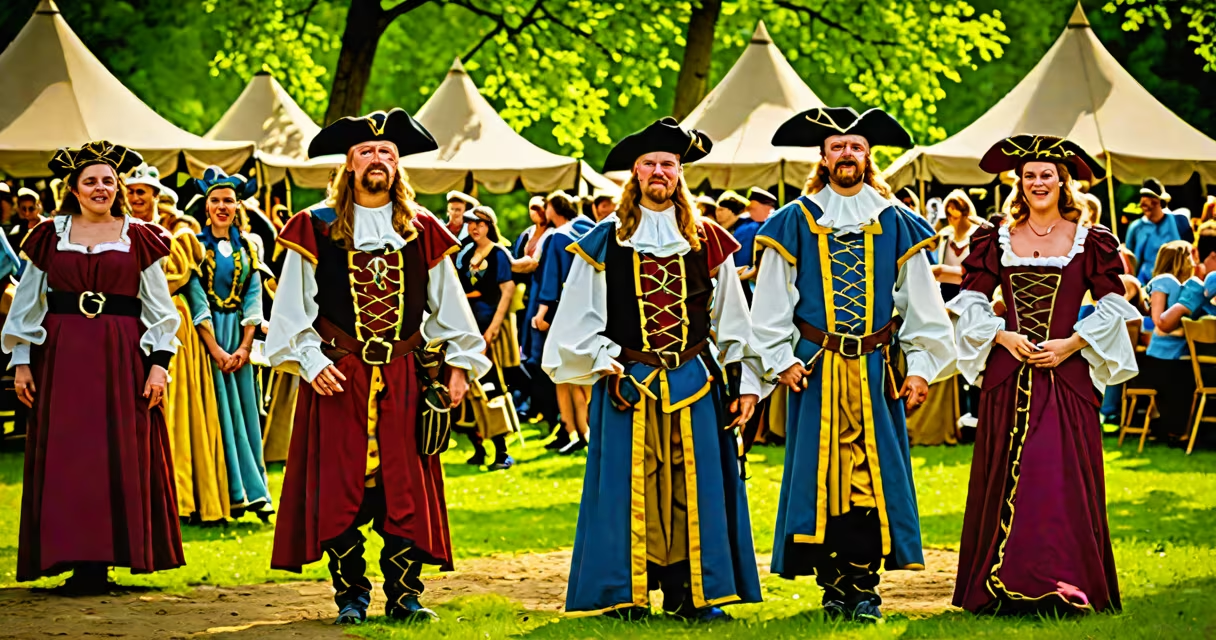
The St Louis Ren Faire 2026 is an annual outdoor event held in Fairview Park, Missouri, featuring live medieval performances, artisan markets, period costumes, and themed food. It recreates 16th-century English village life through immersive storytelling, crafts, and entertainment.
Organized by the Midwest Renaissance Festival Collective, the event runs over three weekends in late summer, typically beginning the last weekend of August. Attendees enter a fully staged Elizabethan-era village complete with wandering minstrels, jesters, blacksmiths, and falconry displays. All performers wear historically accurate costumes and speak in period-appropriate dialects.
Unlike static museum exhibits, the St Louis Ren Faire 2026 operates as a living environment. Visitors walk through cobblestone pathways lined with stalls selling handcrafted jewelry, leatherwork, and herbal remedies. Food vendors serve roasted meats, spiced cider, and fruit pies baked in clay ovens. The atmosphere mimics a real 1500s town fair during harvest season.
Each performance area functions like a micro-drama. A jousting tournament begins at noon each day, with armored knights riding horses and wielding wooden lances. The outcome is determined by crowd reaction and a judge's scorecard, not scripted results. This creates a changing, unpredictable experience.
Artisans demonstrate skills such as glassblowing, candle-making, and sword forging. These aren't demonstrations-they're ongoing processes. A blacksmith may spend two hours shaping a dagger from iron, using only a bellows and hammer. Visitors can watch the entire process, ask questions, and even purchase the finished piece.
Entry is timed and ticketed. General admission allows access to all public areas. VIP passes include early entry, reserved seating at the main stage, and a welcome gift of a hand-stitched satchel. Children under five enter free, but must be accompanied by an adult at all times.
The event relies on volunteer performers, local artisans, and seasonal staff. Over 120 performers are contracted annually, including actors, musicians, and stunt coordinators. All are trained in historical movement, period speech, and safety protocols.
Materials used on-site are sourced locally or handmade. Tents are constructed from heavy-duty canvas treated with UV-resistant coating. Food is prepared in portable wood-fired ovens. Even the water fountains are filled with filtered tap water, labeled "Well of Truth" for authenticity.
A key distinction often missed: the St Louis Ren Faire 2026 is not a costume party. Participants do not dress as characters for fun. They assume roles based on historical research. A woman playing a noblewoman wears a gown made from wool dyed with madder root, not polyester. Her dialogue reflects actual court etiquette from 1580 England.
There are three attendance levels:
| Pass Type | Access | Price (2026 estimate) | Special Features |
|---|---|---|---|
| General Admission | All public zones | $28 | Standard entry, no perks |
| VIP Experience | Front-row seating, early entry | $65 | Reserved picnic spot, meet-the-actors session |
| Festival Family Pass | Up to 4 people | $95 | Includes children's craft workshop and scavenger hunt |
There are no corporate sponsorships. Revenue supports performer stipends and venue maintenance. The event is not affiliated with any national Renaissance festival chain.
St Louis Ren Faire 2026 takes place at Fairview Park, located in the city's northern district near the Missouri River. The site was chosen for its existing tree canopy, flat terrain, and proximity to public transit. Parking is limited to 500 vehicles; attendees are encouraged to use shuttle buses from nearby metro stops.
Historical context matters. The park was once part of a 19th-century estate owned by a family who traced lineage to English gentry. This connection inspired the organizers to host a Renaissance-themed event there. The land has hosted similar gatherings since 1987, though the current format began in 2003.
Why return yearly? Because demand exceeds supply. In 2024, over 12,000 people attended. Ticket sales sold out in 17 days. The 2026 event is projected to draw 14,000 visitors, making it the largest regional Renaissance event in the Midwest.
Many assume the St Louis Ren Faire 2026 is a theme park or a tourist trap. It is neither. It is a community-driven cultural event rooted in historical reenactment. No rides, no roller coasters, no neon lights. The only artificial structures are temporary fencing and signage.
Another mistake: thinking all performers are paid professionals. While lead roles go to experienced actors, many supporting roles are filled by volunteers. Some have studied medieval history at local colleges. Others are high school students fulfilling service hours.
A lesser-known fact: the event uses a real-time weather adaptation protocol. If rain is forecast, the schedule shifts to indoor stages. Performances move into covered pavilions. Tents are reinforced with tarps. This ensures continuity even in inclement weather-a practice adopted from 2018 after a storm canceled half the day's events.
Suppose you plan to attend St Louis Ren Faire 2026 on Saturday, August 30. You buy a VIP pass online in June. On arrival, you receive a map showing stage locations, restrooms, and food zones. You arrive at 10:30 a.m., 30 minutes before opening.
At 11:00 a.m., the royal procession enters the main square. A herald announces the arrival of Queen Mab, played by a professional stage actress. She delivers a speech in Early Modern English. Audience members respond with bows and cheers. Afterward, you visit the apothecary stall, where a vendor sells rosewater and sage-infused salves.
At 1:30 p.m., you watch a joust between Sir Cedric and Lady Isolde. The match ends in a draw. The crowd votes for a rematch. You stay until 5:00 p.m., leaving with a hand-carved wooden goblet and a photo from the knight's challenge zone.
After the event, you reflect: the experience wasn't entertainment-it was immersion. You didn't watch history. You stepped into it.
In 2023, I attended the St Louis Ren Faire as a guest researcher. I wore a plain linen tunic and carried a notebook. I observed how visitors interacted with performers. One man asked a blacksmith to explain how he shaped steel. The smith paused, looked him in the eye, and said, "I'll show you-then you'll know." He handed the man a cooled blade and said, "Feel the edge." That moment-real, unscripted, human-was the heart of the event.
St Louis Ren Faire 2026 is not a reenactment of fantasy. It is a reimagining of history grounded in research, craftsmanship, and community. It invites participation, not passive viewing. Attendees don't just see the past-they touch it, taste it, hear it.