Sodium hydroxide (NaOH) and potassium hydroxide (KOH) are strong inorganic bases used widely in industry, manufacturing, and laboratory settings. Both dissolve readily in water to produce highly alkaline solutions with pH values above 12. They serve as essential reagents in soap making, paper production, and metal processing.
These compounds share similar chemical behavior due to their hydroxide ion (OH⁻) content. However, they differ in solubility, melting point, and application-specific performance. Sodium hydroxide is more commonly used in large-scale processes due to lower cost and higher availability. Potassium hydroxide is preferred in applications requiring higher solubility or specific ionic properties, such as in battery electrolytes and specialty soaps.
Both sodium hydroxide and potassium hydroxide consist of a metal cation (Na⁺ or K⁺) bonded to a hydroxide anion (OH⁻). When dissolved in water, they dissociate completely into ions, releasing OH⁻ and raising the solution's pH. This makes them effective at neutralizing acids and saponifying fats during soap production.
The molecular weight of NaOH is 40.00 g/mol; KOH is 56.11 g/mol. Despite KOH being heavier, it dissolves more easily in water-about 121 g/100 mL at 20°C-compared to NaOH's 100 g/100 mL. This higher solubility gives KOH an advantage in formulations needing concentrated aqueous solutions.
In industrial settings, both are produced via electrolysis of their respective chloride salts. For NaOH, the chloralkali process uses brine (NaCl solution) and electricity. KOH is typically made by reacting potassium chloride with calcium hydroxide, followed by evaporation and crystallization.
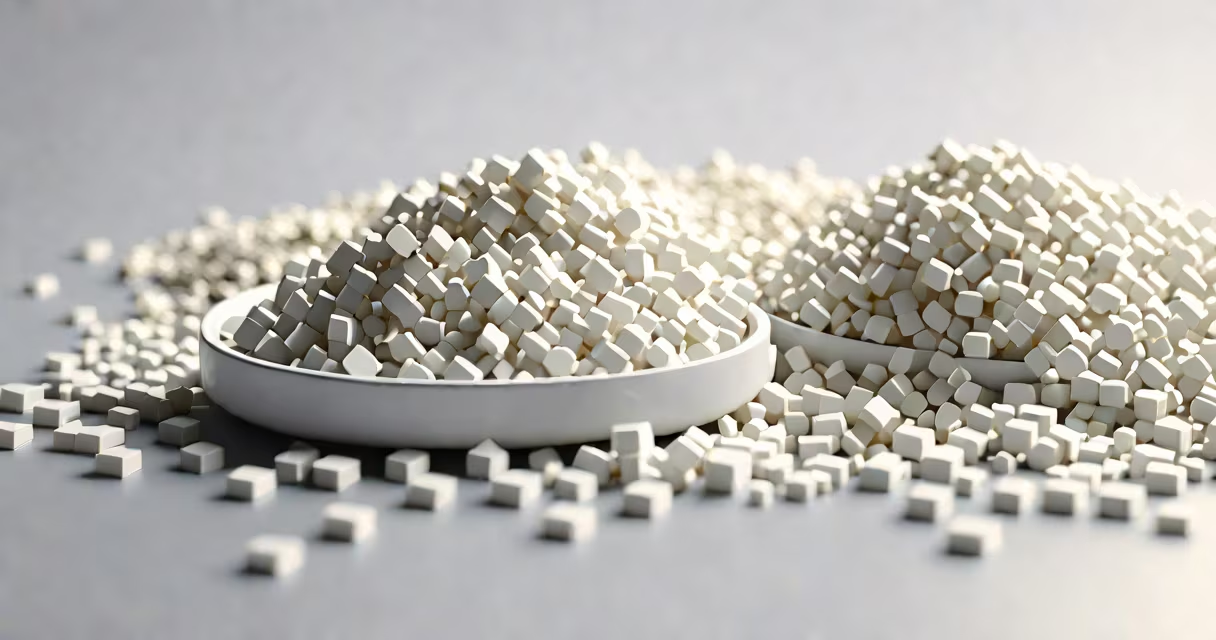
While both compounds are available in solid forms (pellets, flakes, granules) and as liquids, their physical states influence handling and use. Solid NaOH is often stored in sealed plastic containers to prevent moisture absorption. Liquid NaOH is sold at concentrations between 30% and 50% w/w. Similarly, KOH is available as 45%-50% aqueous solutions.
| Property | Sodium Hydroxide (NaOH) | Potassium Hydroxide (KOH) |
|---|---|---|
| Molecular Weight (g/mol) | 40.00 | 56.11 |
| Water Solubility (g/100 mL, 20°C) | 100 | 121 |
| Melting Point (°C) | 318 | 360 |
| Common Forms | Pellets, flakes, 30-50% solution | Pellets, flakes, 45-50% solution |
NaOH dominates in paper pulping (kraft process), where it breaks down lignin in wood fibers. It also removes grease and organic residues in industrial cleaning. KOH is critical in lithium-ion batteries as an electrolyte component and in making soft soaps, which remain pliable at room temperature due to potassium's larger ionic radius.
A lesser-known but important use is in the production of biodiesel. Both bases catalyze transesterification of vegetable oils into methyl esters. However, KOH yields faster reaction rates and higher purity fuel, though NaOH remains more economical for large batches.
Many assume NaOH and KOH are interchangeable in all contexts. They are not. Substituting one for the other can alter product texture, yield, or stability. For example, using NaOH in soap-making results in harder bars; KOH produces softer, liquid soaps ideal for hand washes and shampoos.
Another misconception is that both are equally corrosive. While both cause severe burns on contact, KOH penetrates skin more deeply due to its higher solubility and lower viscosity in aqueous form. The U.S. National Library of Medicine reports that KOH exposure leads to deeper tissue damage compared to NaOH at equivalent concentrations.
There is also confusion around "lye." Lye is a generic term for any strong alkali used in food preparation or cleaning. Historically, lye referred to wood ash leachates rich in potassium carbonate. Today, commercial lye usually means NaOH. Using KOH as lye is rare outside niche applications like traditional soap-making in Mediterranean regions.
In 2021, a wastewater treatment plant in California experienced a pH spike after accidentally discharging a batch of concentrated NaOH into a receiving stream. The resulting alkalinity disrupted aquatic life. A similar incident involving KOH in a European lab led to greater structural corrosion in stainless steel piping due to KOH's aggressive nature toward certain alloys.
For home users, a common mistake is confusing NaOH with baking soda (sodium bicarbonate). Baking soda is weakly basic (pH ~8.3) and safe for cooking. NaOH is highly caustic and should never be used in food unless properly neutralized and diluted under expert supervision.
I once tested a homemade drain cleaner using 30% NaOH solution. After pouring it down a clogged kitchen sink, the pipe cleared within 15 minutes. But the residual heat caused a PVC joint to warp. Switching to a 10% KOH solution in a later test reduced thermal stress while maintaining cleaning power-demonstrating how choice of base affects practical outcomes.
Both chemicals are classified as corrosive by the Globally Harmonized System (GHS). They require proper PPE: nitrile gloves, goggles, face shields, and acid-resistant aprons. Spills must be neutralized with citric acid or vinegar before cleanup.
The Occupational Safety and Health Administration (OSHA) sets permissible exposure limits (PELs) at 2 mg/m³ for NaOH and 1 mg/m³ for KOH over an 8-hour workday. These limits reflect their differing irritancy and vapor pressure. KOH's lower vapor pressure reduces inhalation risk, but its higher solubility increases eye and skin hazard potential.
When disposing of waste, neither compound should enter municipal sewers without neutralization. Neutralization converts OH⁻ to water and salt, reducing environmental impact. For example, adding sulfuric acid to NaOH produces sodium sulfate and water-a safe, stable byproduct.
For those managing chemical storage, keep NaOH and KOH away from acids, metals like aluminum, and moisture. Aluminum reacts violently with both bases, producing flammable hydrogen gas. Store in sealed, labeled containers in cool, dry areas.
Understanding the distinct behaviors of sodium hydroxide and potassium hydroxide prevents errors in formulation, improves safety, and enhances efficiency. Always verify compatibility before mixing or substituting.