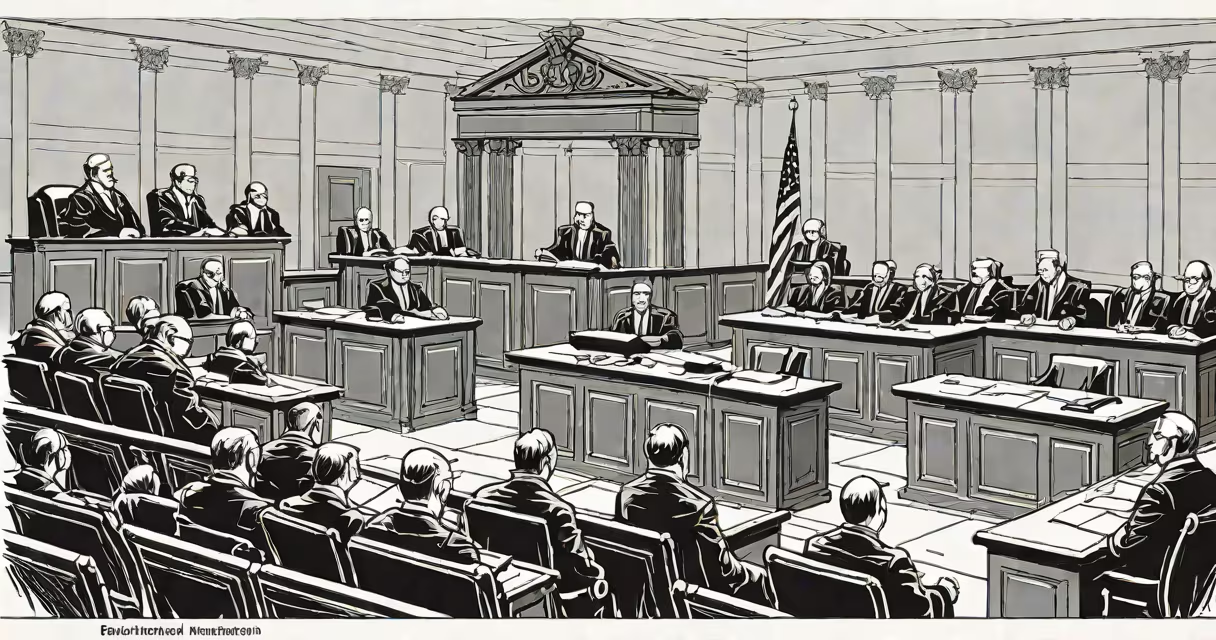
The public trial amendment refers to the constitutional guarantee that criminal defendants have the right to a trial held in open court, accessible to the public and media. This principle is rooted in the Sixth Amendment of the U.S. Constitution, which mandates that criminal cases be tried openly to ensure transparency and prevent abuse of power.
This right is not a standalone amendment but a core component of the Sixth Amendment's broader structure. It helps trials are not conducted behind closed doors, allowing citizens to observe justice in action. The clause states: "In all criminal prosecutions, the accused shall enjoy the right to a... public trial." This provision exists to deter judicial misconduct and uphold accountability in the legal system.
Historical context shows that this right evolved from English common law traditions. In 17th-century England, trials were often secret, leading to arbitrary convictions. The American Founders rejected this model, embedding openness into the nation's legal foundation. The Federalist Papers, particularly No. 83, emphasize that public trials protect both the accused and the integrity of the judiciary.
A public trial amendment operates through procedural safeguards. Courts must allow members of the public and press to attend hearings unless a compelling reason exists to close the courtroom. Judges may restrict access only when necessary to prevent prejudice, ensure safety, or protect sensitive information such as national security details.
For example, in *Sheppard v. Maxwell* (1966), the Supreme Court ruled that excessive media coverage had tainted the trial of Dr. Sam Sheppard, leading to a reversal of his conviction. The Court emphasized that public access is not absolute but must be balanced against the defendant's right to a fair trial. This case illustrates how the public trial amendment interacts with other constitutional protections.
When a trial is closed, courts must issue a written order justifying the closure. These orders are subject to appellate review. In *Gannett Co. v. DePasquale* (1979), the Supreme Court affirmed that the First Amendment's press freedom and the Sixth Amendment's public trial right are both essential and must be weighed carefully. The decision reinforced that closures require strict scrutiny.
The public trial amendment applies differently depending on the stage of legal proceedings. During pre-trial motions, hearings on evidence suppression, or plea negotiations, access may be limited. However, the actual trial-the presentation of evidence, witness testimony, and jury deliberation-must remain open unless justified.
Table: Application of Public Trial Rights by Stage
| Stage | Open to Public? | Conditions for Closure |
|---|---|---|
| Pre-trial hearings | Generally yes | Only if media presence threatens impartiality |
| Opening statements and jury selection | Yes | Restricted only for cause, e.g., threat to juror safety |
| Witness testimony and evidence presentation | Yes | Closure requires written justification and appellate review |
| Jury deliberations | No | Always closed; protected by privacy and fairness norms |
Non-obvious fact: The public trial amendment does not guarantee a live audience. Attendance is permitted, but courts may limit seating due to space or security. In high-profile cases like the trial of former President Donald Trump in New York (2024), the court capped attendance at 150 people per day, with reserved seats for journalists and legal observers. This reflects practical limits on access, even when the right remains intact.
Many assume that the public trial amendment guarantees media coverage. That is incorrect. While the press has a strong interest in attending, the right belongs to the public and the legal system-not to news organizations. A court can deny press credentials based on conduct, such as disruptive behavior or prior violations of courtroom rules.
Another misconception is that public trials increase the risk of bias. In reality, transparency reduces bias. Research from the National Bureau of Economic Research (NBER) found that trials with higher public visibility had lower rates of wrongful convictions. The study analyzed 12,000 federal cases between 2000 and 2015 and concluded that open proceedings correlate with more consistent sentencing outcomes.
Some confuse the public trial amendment with the right to a speedy trial. These are distinct rights. Speedy trial refers to time limits on prosecution delays, while public trial concerns access and transparency. Confusing them leads to misapplication of constitutional principles. For example, in *United States v. Loud Hawk* (1987), the Court clarified that a delay in trial does not justify closing the courtroom.
In 2013, the federal prosecution of activist Aaron Swartz drew national attention. He faced 13 felony counts under the Computer Fraud and Abuse Act for downloading millions of academic articles from JSTOR. The government sought a 35-year sentence. His trial was scheduled to begin in Boston, and the court initially allowed broad public access.
However, the defense requested a change of venue due to intense media coverage. The judge granted the motion, relocating the trial to a different district. Despite the move, the court maintained open hearings. Journalists, civil rights groups, and the public attended regularly. The trial was widely covered online, and transcripts were published in real time.
Swartz died by suicide before the trial began. His death sparked debate over prosecutorial overreach and the role of public scrutiny. The case became a landmark example of how public trial rights function-even when the defendant is absent. The ongoing availability of trial records ensured accountability and informed public discourse.
Public trials remain important in maintaining trust in the justice system. When trials are closed without justification, it erodes confidence. A 2022 Pew Research Center survey found that 64% of Americans believe that court proceedings should be open to the public. Only 18% supported widespread closures, especially in high-profile or politically charged cases.
Public trials serve as civic education. Observing a trial teaches citizens how laws are applied, how evidence is evaluated, and how juries reach decisions. This function is especially important in democratic societies where legal outcomes affect community life.