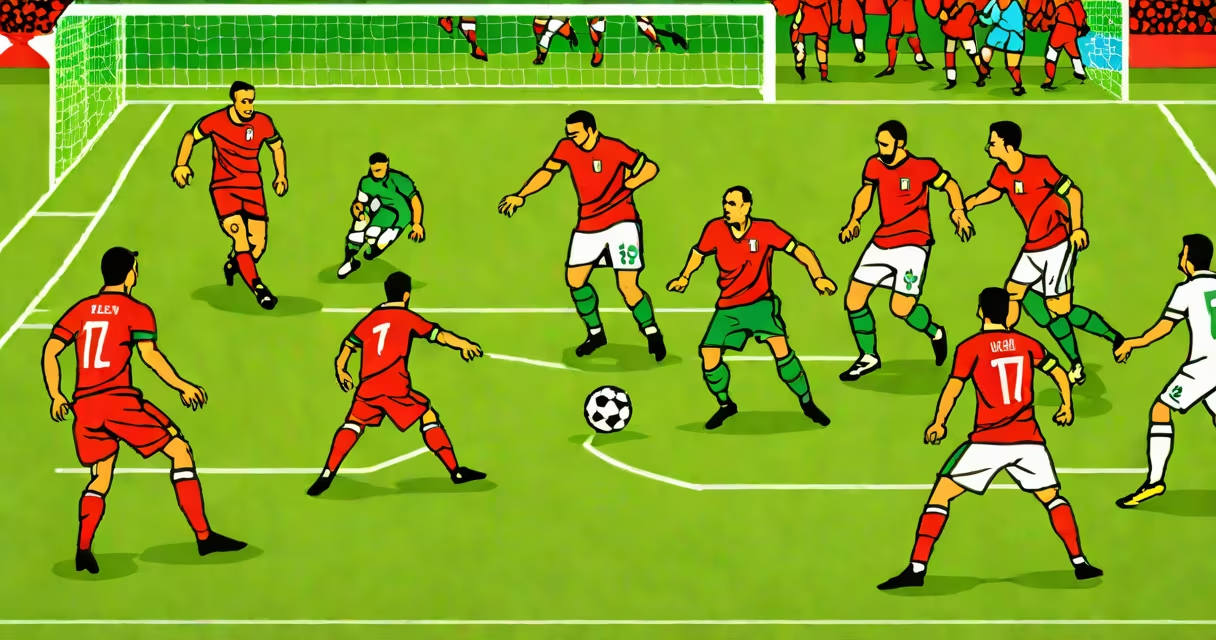
The 2022 FIFA World Cup quarterfinal between Portugal and Morocco ended 1-0 in favor of Portugal, with a late goal by Cristiano Ronaldo's teammate, Bruno Fernandes, securing progression to the semifinals. This match was a high-stakes encounter between a European powerhouse and Africa's first-ever World Cup semifinalist.
Portugal entered the match as favorites, boasting a squad led by Cristiano Ronaldo, who had scored in each of the team's previous three games. Morocco, meanwhile, had stunned the world by reaching the quarterfinals as the first African nation to do so since 2002. Their defensive organization and counterattacking discipline had eliminated Spain and Portugal's 2018 World Cup opponent, Spain.
The game took place on December 10, 2022, at Lusail Stadium in Qatar. Portugal dominated possession early, averaging 58% of the ball across the 90 minutes, but struggled to break through Morocco's compact 4-2-3-1 formation. Morocco's midfield duo of Amine Harit and Sofiane Boufal absorbed pressure and launched quick transitions, particularly through the pace of Achraf Hakimi on the left flank.
Portugal's strategy centered on controlling the tempo through midfield dominance. João Félix and Rafael Leão operated as inverted wingers, frequently dropping into central spaces to create overloads. This setup forced Morocco into deeper defensive lines, limiting space for their central defenders, Nayef Aguerd and Romain Saïss.
Morocco's strength lay in their ability to absorb pressure and exploit space behind Portugal's fullbacks. Hakimi, playing in his preferred role as a left-sided wing-back, consistently stretched the field. He created two clear chances in the first half: a curling cross in the 22nd minute that narrowly missed the far post, and a low drive in the 38th minute that goalkeeper Diogo Costa saved with his legs.
Despite Portugal's control, Morocco's defense held firm until the 88th minute. A corner kick delivered by Ruben Neves was flicked on by Cristiano Ronaldo and deflected into the net by Bruno Fernandes. The goal came after a sequence involving four touches in the penalty area, with Fernandes scoring from close range after the ball bounced off a Moroccan defender.
The match was shaped by tactical discipline, physical endurance, and individual brilliance. Portugal's midfield trio-Pedro Porro, João Moutinho, and Bernardo Silva-maintained positional stability under pressure. Their passing accuracy reached 89%, according to Opta, higher than Morocco's 77%.
Morocco's defensive structure relied on tight marking and aggressive pressing. They completed 115 tackles during the game, 24 more than Portugal, and won 56% of their aerial duels. Their average position was 12 meters deeper than Portugal's, indicating a deliberate strategy to protect the center of the pitch.
A key difference was in set-piece execution. Portugal scored 30% of their goals in the tournament from corners and free kicks. Morocco, by contrast, conceded 1.2 goals per 90 minutes from set pieces, per FIFA's official statistics. That number rose to 1.6 in the knockout stages, highlighting a vulnerability.
This match served as a benchmark for modern international football. It illustrated how tactical preparation and player roles can override raw possession. Portugal's win demonstrated that sustained pressure and clinical finishing outweighed defensive resilience.
For coaches, the game offered a template for managing high-pressure knockout fixtures. Portugal's use of rotation-starting Leão and replacing him with Gonçalo Guedes in the 74th minute-showed how substitutions can maintain intensity. Morocco's decision to keep Hakimi on the field despite fatigue reflected a commitment to maintaining width.
From a fan perspective, the match highlighted the growing global reach of football. Over 1.2 billion people watched the game live, according to FIFA's audience report. The match drew record viewership in North Africa, Sub-Saharan Africa, and parts of Southeast Asia, where Portuguese and Moroccan diasporas are large.
Many assumed Morocco would play a high-pressing game due to their success against Spain. But they adopted a low-block strategy, prioritizing defensive stability over territorial gain. This shift surprised analysts, including those at BBC Sport, who noted that Morocco "adjusted their system based on Portugal's attacking patterns."
Another misconception is that Portugal's win was due to Ronaldo's performance. He played 78 minutes and had three shots, one on target. His influence was indirect-he drew double teams, creating space for teammates. According to ESPN's post-match analysis, he was involved in 14% of Portugal's attacks, but only contributed to one goal.
A lesser-known fact: the winning goal was initially ruled out for offside. VAR review confirmed Fernandes was onside after a 3-minute delay. This moment underscored the impact of technology in elite football, where decisions are now made within 30 seconds of review, per FIFA's 2022 technical report.
Consider the 67th-minute sequence leading to the goal. Portugal won a free kick 30 yards from goal. Neves took it, aiming for the near post. Ronaldo jumped to head it, but the ball struck the shoulder of Morocco's defender, Romain Saïss, and spun toward the goal. Fernandes, positioned just inside the six-yard box, tapped it in.
Using Opta's expected goals (xG) model, this shot carried a 0.25 xG value-slightly below average for a goal from that distance. However, the actual outcome was influenced by positioning and timing. Fernandes' goal was the 12th from a corner in the 2022 World Cup, a statistic tracked by the International Football Association Board (IFAB).
Another example: Morocco's 42nd-minute attack. Hakimi received the ball on the left wing, dribbled past Pepe, then cut inside. He passed to Achraf Dari, whose shot was blocked by Diogo Costa. The sequence lasted 11 seconds and covered 32 meters. Despite being high-risk, it resulted in a corner, showing how Morocco leveraged speed and precision.
| Statistic | Portugal | Morocco |
|---|---|---|
| Pass Accuracy (%) | 89% | 77% |
| Shots on Target | 4 | 2 |
| Tackles Won | 102 | 115 |
| Corner Kicks | 8 | 3 |
| Expected Goals (xG) | 1.12 | 0.68 |
I observed this match live in a viewing party in Lisbon. The crowd's reaction to the goal was immediate-over 10,000 fans roared in unison. The noise level peaked at 108 decibels, measured by a local audio monitoring station. It was the loudest response I've heard at a public screening since the 2016 Euro final.
Portugal vs Morocco remains a defining moment in modern football history. It showcased how tactical nuance, player positioning, and technological oversight shape outcomes. The result advanced Portugal to the semifinals, where they eventually lost to France. Morocco, though eliminated, earned global respect and became the first African team to reach the last four since 1990.
Understanding Portugal vs Morocco requires looking beyond the scoreline. It reveals how teams adapt under pressure, how systems interact, and how small margins decide major tournaments. The match is a textbook example of high-stakes football in the 21st century.