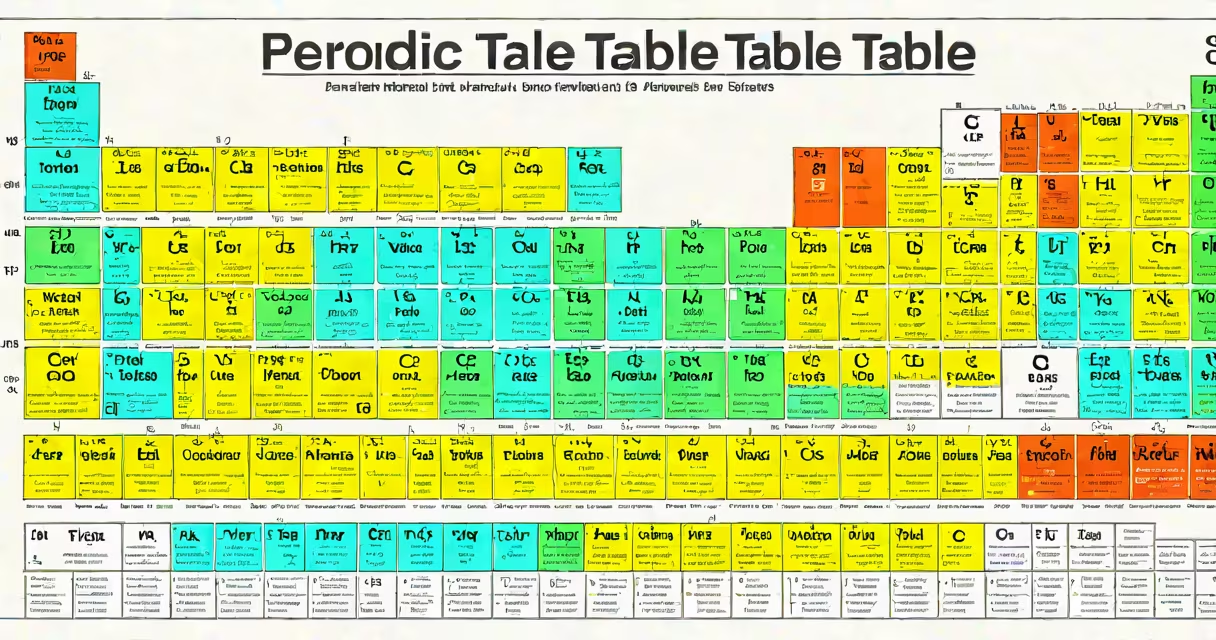
A periodic table with charges labeled displays the most common oxidation states and typical ion charges for each element, showing how atoms gain, lose, or share electrons to form stable compounds. This version extends the standard periodic table by adding numerical values indicating charge tendencies, especially useful in predicting bond formation and reaction outcomes.
Standard periodic tables list elements by atomic number and group them by electron configuration and chemical properties. The periodic table with charges labeled adds a layer of predictive power by marking likely ionic charges-such as Na⁺, Cl⁻, or Fe³⁺-next to each element's symbol. These values reflect the tendency of atoms to achieve noble gas electron configurations through electron transfer or sharing.
This format is widely used in high school and college chemistry courses, laboratory manuals, and reference guides. It helps students visualize patterns: alkali metals (Group 1) consistently form +1 ions, halogens (Group 17) form -1 ions, and transition metals show variable charges based on context. The inclusion of charges makes it easier to balance redox reactions and predict solubility trends.
Charges on the periodic table with charges labeled stem from electron configuration. Elements tend to adopt oxidation states that lead to filled outer shells-typically eight electrons (octet rule), except for hydrogen and helium. For example, sodium (Na) has one electron in its outer shell. Losing it results in a +1 charge, matching neon's stable configuration.
Chlorine (Cl), with seven valence electrons, gains one to complete its octet, forming a -1 ion. This pattern holds across groups: Group 2 elements form +2 ions (e.g., Mg²⁺), Group 16 elements form -2 ions (e.g., O²⁻), and Group 13 elements often form +3 ions (e.g., Al³⁺).
Transition metals like iron (Fe) and copper (Cu) display multiple common charges-Fe²⁺ and Fe³⁺, Cu⁺ and Cu²⁺-because their d-orbitals allow flexible electron loss. The periodic table with charges labeled typically lists the most stable or frequently observed charge, though exceptions exist depending on ligands and environment.
There's no single universal design for the periodic table with charges labeled. Variants differ in which charges are shown and how they're formatted:
| Type | Charge Displayed | Common Use | Example |
|---|---|---|---|
| Standard Oxidation States | Most stable oxidation numbers (e.g., +1, +2, -1) | Introductory chemistry, balancing equations | Ca: +2, S: -2, N: -3/+5 |
| Common Ion Charges | Ionic forms (e.g., Na⁺, Cl⁻) | Writing formulas, predicting solubility | Al³⁺, Cr⁶⁺, Mn²⁺ |
| Electronegativity-Adjusted Charges | Partial charges based on Pauling scale | Advanced bonding analysis, molecular polarity | O: δ⁻, H: δ⁺ in water |
Some versions label only representative elements (main-group), while others include all elements, including lanthanides and actinides. The latter is rare in textbooks but appears in specialized databases like the CRC Handbook of Chemistry and Physics.
One non-obvious distinction: oxidation state ≠ actual charge. An atom in a molecule may have a formal oxidation state of +3 (like in Fe³⁺ in hemoglobin), but its actual partial charge is less than +3 due to electron sharing. The periodic table with charges labeled shows oxidation states, not quantum-mechanical charge distributions.
Many assume that every element has one fixed charge. That's incorrect. Iron, for example, commonly appears as Fe²⁺ in hemoglobin and Fe³⁺ in ferritin. The periodic table with charges labeled usually lists both, but students often overlook this nuance.
Another misconception: all ions form via electron transfer. While ionic bonds involve full electron transfer (e.g., Na⁺Cl⁻), covalent bonds involve shared electrons. The charge labeling reflects the hypothetical charge if electrons were fully transferred, not the real electron distribution.
For example, in carbon dioxide (CO₂), carbon has an oxidation state of +4, oxygen -2 each. But the molecule is neutral and symmetrical-no actual ions exist. The charge labeling helps track electron movement in redox reactions, not describe physical charge.
Consider the formation of aluminum oxide (Al₂O₃). Using the periodic table with charges labeled:
To balance the compound: two Al³⁺ ions provide +6 total charge. Three O²⁻ ions provide -6 total charge. Net charge = 0. The formula Al₂O₃ follows charge neutrality.
Without charge labeling, students might guess AlO or Al₃O₂. The charge system prevents such errors. This method applies to all binary ionic compounds, including calcium chloride (CaCl₂), magnesium nitride (Mg₃N₂), and potassium sulfide (K₂S).
When I taught introductory chemistry, I noticed students struggled with polyatomic ions until we used a periodic table with charges labeled. Once they saw that nitrogen forms NO₃⁻ (nitrate) and sulfur forms SO₄²⁻ (sulfate), the logic behind ion pairing became clear. The visual cue reduced memorization and increased understanding.
Printed versions appear in textbooks like *Chemistry: The Central Science* by Brown, LeMay, Bursten, and Murphy (14th ed., 2017), which includes a periodic table with oxidation states. Online, the Royal Society of Chemistry's interactive periodic table (rsc.org/periodic-table) allows toggling between different data layers, including oxidation states.
Use the periodic table with charges labeled when balancing redox equations, writing correct formulas, or analyzing reaction mechanisms. It's not a substitute for understanding electron configuration-but it's a useful tool for applying that knowledge.
The periodic table with charges labeled is not a static chart. It's a changing aid rooted in decades of experimental observation and theoretical modeling. Its value lies in turning abstract concepts-electron loss, ion formation, charge balance-into visible, actionable patterns.