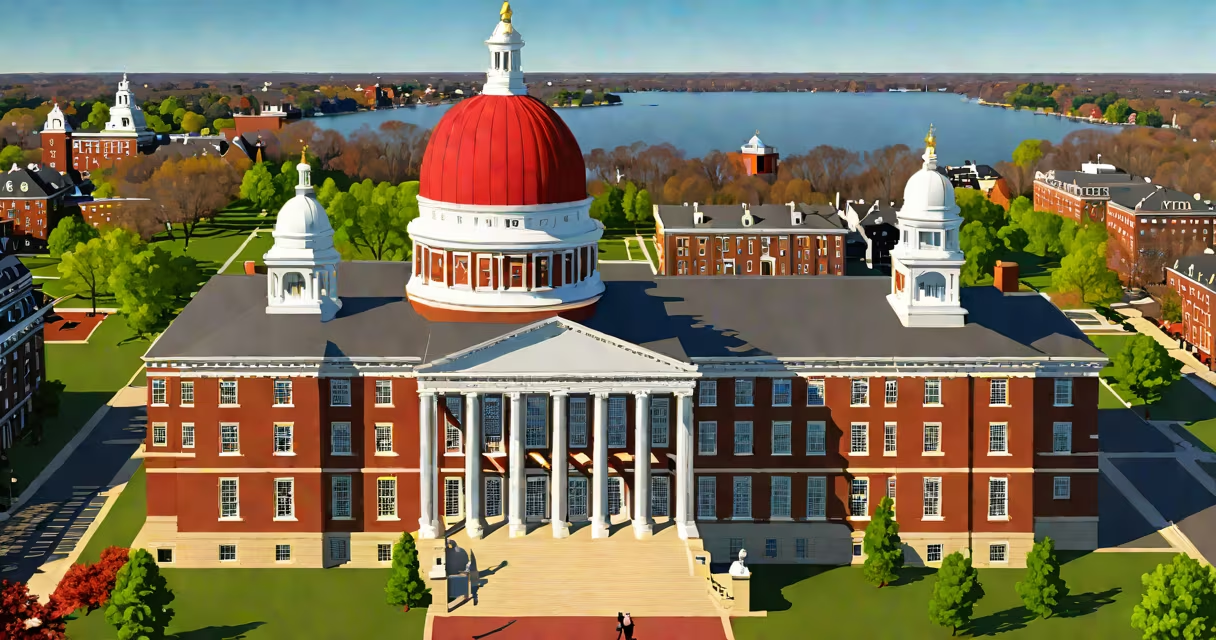
The Maryland State House in Annapolis is the oldest state capitol in continuous legislative use in the United States, serving as the seat of Maryland's government since 1772. It is a surviving example of 18th-century colonial architecture and a site of major historical events, including the signing of the Articles of Confederation.
Located in Annapolis, the capital city of Maryland, the building was originally constructed between 1672 and 1676. It underwent significant renovations in the late 1700s to accommodate the growing state government. The current structure retains its original red brick walls and wooden roof, with a distinctive central dome added during the 1800s. The building sits on a 12-acre plot near the Severn River, surrounded by landscaped grounds and historic monuments.
As the meeting place for the Maryland General Assembly, the State House hosts both the Senate and the House of Delegates. It also serves as the official residence of the Governor of Maryland, though the governor typically resides in the nearby Government House. The building's interior features restored chambers, including the Senate Chamber with its ornate woodwork and the House Chamber with its original mahogany desks and flag displays.
The Maryland State House operates as the central hub for legislative activity in the state. Lawmakers convene here during the annual legislative session, which begins in January and lasts approximately 90 days. During this time, bills are debated, amended, and voted on in both chambers. The process is governed by the Maryland Constitution, which mandates that all legislation originate in the House of Delegates.
Each chamber has a distinct layout. The House of Delegates occupies the east wing, with members seated facing each other across a central aisle. The Senate meets in the west wing, where senators sit in a semi-circular arrangement around a central dais. Both chambers feature original furnishings, including hand-carved desks and period-appropriate lighting fixtures. The building's air conditioning system was installed in the 1950s, but heating and cooling remain minimal to preserve historical integrity.
Security protocols are managed by the Maryland State Police, who provide access control and emergency response services. Visitors must pass through metal detectors and show photo ID to enter. Public tours are available daily from 9 a.m. to 4 p.m., except on holidays and during legislative sessions. Tour guides explain the building's role in shaping state policy and its significance in early American democracy.
The Maryland State House is constructed primarily from locally quarried red sandstone and handmade bricks. The bricks were fired in kilns located near the construction site and laid using traditional mortar techniques. The roof is covered in copper sheeting, which has developed a green patina over time due to oxidation. The dome, added in 1875, is made of cast iron and topped with a weather vane shaped like a ship's figurehead.
Interior materials include oak, walnut, and pine. The floors in the legislative chambers are made of wide-plank pine, sanded and waxed annually to maintain their original finish. Windows are double-hung with leaded glass panes, many of which date back to the 1700s. Replacement windows are custom-made to match the original dimensions and glazing patterns.
| Feature | Material | Historical Note |
|---|---|---|
| Walls | Red brick, sandstone foundation | Original 1672 construction; repaired after 1776 fire |
| Dome | Cast iron, copper roofing | Added 1875; replaced damaged sections in 1999 |
| Floors | Wide-plank pine | Replaced twice since 1772; last refinished 2018 |
| Windows | Leaded glass, wood frames | Original 1700s panes preserved; modern storm windows added |
A lesser-known fact: the State House basement contains a network of tunnels and storage rooms used during the Civil War. These underground passages were repurposed from earlier colonial cellars and served as temporary storage for military supplies. They are not open to the public but were documented in a 2003 report by the Maryland Historical Trust.
The Maryland State House is used exclusively for state government functions. It hosts the biennial legislative sessions, gubernatorial inaugurations, and ceremonial events such as the swearing-in of new legislators. The building also serves as a venue for educational programs, including the annual "Students in the State House" initiative, where high school students participate in mock legislative debates.
Its location in Annapolis makes it a symbol of democratic tradition. The city's compact size and historic district allow easy access to the building for residents and tourists alike. The State House is frequently cited in academic studies on American political institutions. According to the National Park Service, it is one of only five state capitols still operating in their original buildings.
During the Revolutionary War, the State House hosted the Continental Congress in 1783. That year, delegates signed the Treaty of Paris, officially ending hostilities with Great Britain. The building also hosted the 1786 Constitutional Convention, where delegates discussed amendments to the Articles of Confederation. These events show its role as a foundational site in U.S. governance.
Many assume the Maryland State House is a replica or a museum. It is not. It remains an active government building, with lawmakers conducting business in the same chambers used since the 1700s. Unlike state houses in other states, such as Pennsylvania's, which were rebuilt in the 19th century, Maryland's structure has survived intact through multiple renovations.
Another misconception is that the building is owned by the federal government. It is not. The State House is maintained by the Maryland Department of General Services and funded through the state budget. Federal agencies do not have jurisdiction over its operations or upkeep.
Some visitors confuse the State House with the nearby Government House, the official residence of the governor. While both are located on the same campus, they serve different purposes. Government House is a private residence and not open to the public, whereas the State House welcomes thousands of visitors annually.
In 2019, I attended a session of the Maryland General Assembly while volunteering for a civic education program. I sat in the gallery above the House of Delegates chamber, where the sound of debate echoed through the high ceilings. A bill on renewable energy was being discussed, and the speaker referenced the State House's own solar panel installation on the east wing roof-a project completed in 2016 to reduce energy costs. The building's blend of historical preservation and modern sustainability measures stood out.
For context, the State House currently uses 42 solar panels generating approximately 12,000 kilowatt-hours annually. This accounts for about 15% of the building's electricity needs. The project was funded through a state grant and monitored by the University of Maryland's Center for Environmental Science.