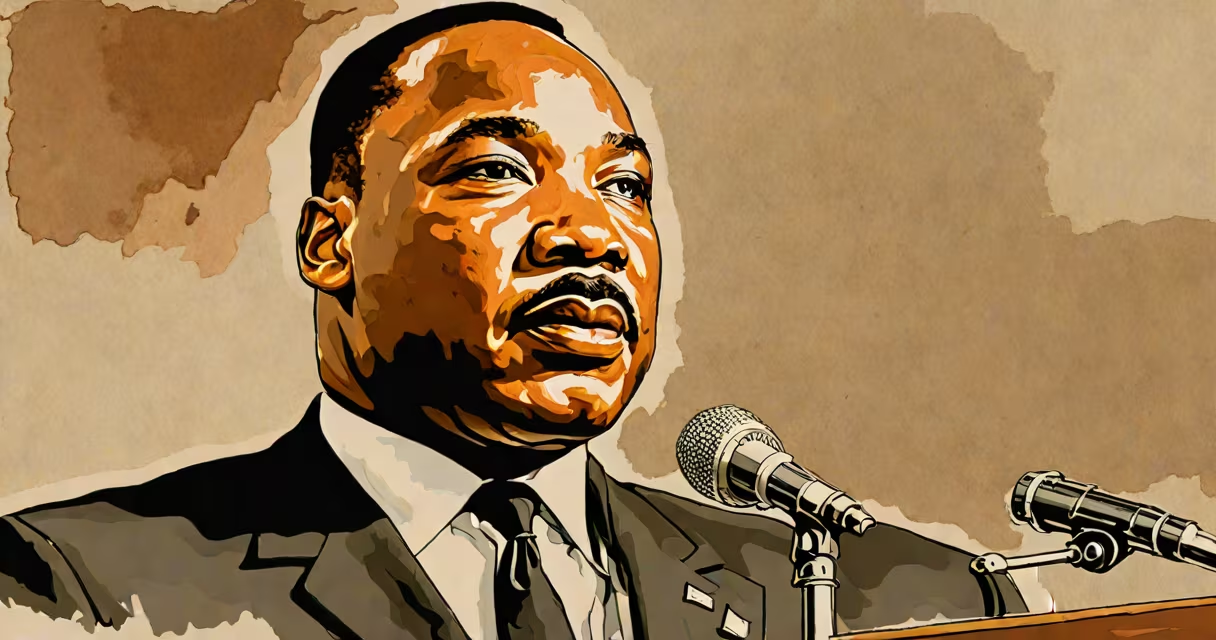
Martin Luther King Jr. was an American Baptist minister and activist who became the most visible spokesperson and leader in the civil rights movement from 1955 until his assassination in 1968. He championed nonviolent resistance to racial injustice, delivering useful speeches that reshaped national discourse on equality.
King's leadership emerged during the Montgomery Bus Boycott in 1955, following Rosa Parks' arrest. He organized mass protests that lasted 381 days, resulting in the U.S. Supreme Court ruling that segregated buses were unconstitutional. This early success established his reputation as a strategic and moral leader in the fight against systemic racism.
His most famous address, "I Have a Dream," delivered during the 1963 March on Washington for Jobs and Freedom, drew over 250,000 people. In it, he called for an end to racial discrimination and envisioned a nation where individuals were judged by character, not skin color. The speech remains one of the most cited in American history.
King based his activism on Christian ethics and the teachings of Mahatma Gandhi. He believed that nonviolent protest could expose injustice while maintaining moral high ground. His philosophy emphasized love, forgiveness, and disciplined resistance-even in the face of violence.
He founded the Southern Christian Leadership Conference (SCLC) in 1957 to coordinate civil rights efforts across southern states. The SCLC led campaigns in cities like Birmingham and Selma, using marches, sit-ins, and boycotts to pressure lawmakers into passing legislation.
King's commitment to nonviolence was tested repeatedly. During the 1965 Selma to Montgomery marches, state troopers attacked peaceful demonstrators with clubs and dogs. Footage of the violence shocked the nation and helped pass the Voting Rights Act of 1965, which outlawed discriminatory voting practices.
King received the Nobel Peace Prize in 1964 at age 35, making him the youngest recipient at the time. He donated the $54,000 prize money to civil rights causes, including the Student Nonviolent Coordinating Committee (SNCC).
His influence extended beyond race. In 1968, he shifted focus to economic justice, organizing the Poor People's Campaign to demand fair wages and housing. He was assassinated on April 4, 1968, in Memphis, Tennessee, while supporting striking sanitation workers.
By 1986, Martin Luther King Jr. Day became a federal holiday, observed on the third Monday of January each year. The date was chosen to honor his birthday, January 15, 1929. The holiday is the only one in the U.S. named after a private individual.
| Event | Date | Significance |
|---|---|---|
| Montgomery Bus Boycott | 1955-1956 | First major success of nonviolent protest; led to desegregation of city buses. |
| March on Washington | August 28, 1963 | "I Have a Dream" speech; catalyzed passage of Civil Rights Act of 1964. |
| Voting Rights Act Signed | August 6, 1965 | Outlawed literacy tests and poll taxes; protected African American voting access. |
| Assassination | April 4, 1968 | Occurred in Memphis; sparked nationwide riots and mourning. |
Many assume King's work focused solely on ending segregation. In reality, he expanded his mission to oppose poverty and the Vietnam War. His 1967 speech "Beyond Vietnam" criticized U.S. military involvement and linked racial and economic justice to foreign policy.
Another misconception is that King's methods were universally accepted within the Black community. Some activists, including Malcolm X and Stokely Carmichael, rejected nonviolence as ineffective. King acknowledged these differences but maintained that nonviolence remained the most ethical path forward.
A lesser-known fact: King wrote more than 30 books and articles, including "Stride Toward Freedom" (1958), which detailed the Montgomery campaign. His sermons and speeches were later compiled into collections such as "The Speeches of Martin Luther King Jr." and "Where Do We Go from Here: Chaos or Community?"
King was born in Atlanta, Georgia, to Reverend Martin Luther King Sr. and Alberta Williams King. He graduated from Morehouse College at 19, earned a doctorate in systematic theology from Boston University in 1955, and married Coretta Scott King in 1955. They had four children.
I once attended a reenactment of the 1965 Selma march at the Edmund Pettus Bridge. The crowd stood silent at the spot where King and others were beaten. A local historian pointed out that the bridge's name honors a Confederate general and former Grand Wizard of the Ku Klux Klan-a detail often omitted in textbooks.
Today, the Martin Luther King Jr. National Historical Park in Atlanta preserves his birth home, Ebenezer Baptist Church, and the King Center. The site includes his personal papers, speeches, and the bullet-riddled robe he wore during the 1968 assassination attempt.
His legacy continues through organizations like the Southern Poverty Law Center and the NAACP Legal Defense Fund. The annual MLK Day celebration includes service projects, educational programs, and civic engagement events across the country.
Martin Luther King facts show a man whose life was defined by principle, sacrifice, and unwavering belief in justice. His impact persists in laws, monuments, and everyday acts of courage inspired by his vision.