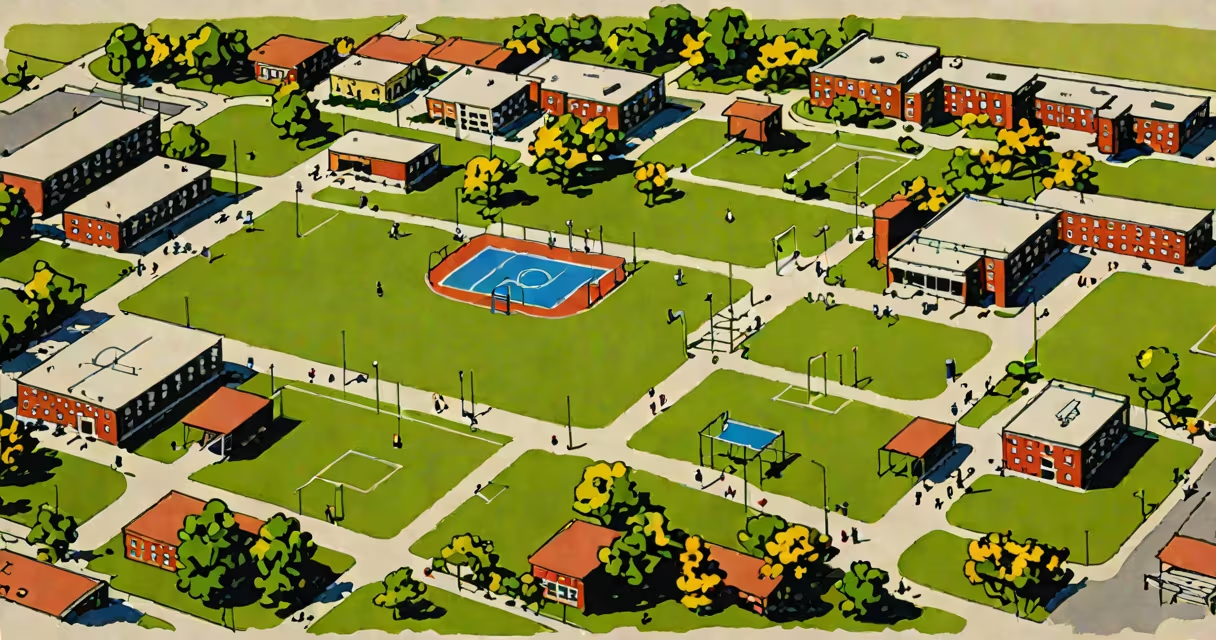
Langdon Park School is a public elementary school located in the Greater Houston area, serving students from Pre-Kindergarten through Grade 5 within Houston Independent School District (HISD) Region 46. It operates under Texas Education Agency standards and serves a diverse student population in a neighborhood-based learning environment.
The school opened in 1958 and was named after the nearby Langdon Park neighborhood, which itself derives from early 20th-century land grants. It is situated on a 12-acre campus at 4700 S. Main Street, Houston, TX 77009. As of the 2022-2023 academic year, it reported 587 enrolled students, with 64% identifying as Hispanic, 22% as Black, 10% as White, and 4% as Asian or multiracial. Student enrollment reflects the demographic makeup of southeast Houston's urban core.
Academic instruction follows the Texas Essential Knowledge and Skills (TEKS) curriculum. Students take state-mandated assessments in math, reading, and science annually. In 2023, Langdon Park School earned a "B" rating from the Texas Education Agency, placing it in the top 30% of elementary schools in the state based on student performance and growth metrics. The school offers bilingual instruction in Spanish and English for Pre-K through Grade 3, supporting language acquisition and equity in access.
Classes run from 7:45 a.m. to 3:15 p.m., Monday through Friday. Core subjects include math, reading, science, and social studies, taught by certified teachers in multi-grade classrooms during the primary cycle (Grades K-2). Specialized instruction occurs in art, music, physical education, and library services twice weekly. A full-day kindergarten program includes literacy development, phonemic awareness, and foundational numeracy skills.
Students receive targeted support through the Response to Intervention (RTI) structure. Those identified as needing additional academic assistance are placed in small-group interventions during designated pull-out periods. For English Language Learners (ELLs), the school uses Sheltered Instruction Observation Protocol (SIOP) methods, integrating language objectives into content lessons. Data from the 2022-2023 school year shows 78% of ELL students met or exceeded grade-level benchmarks in reading, compared to 65% statewide.
After-school programs include homework help, STEM clubs, and a free breakfast and lunch service funded by the USDA National School Lunch Program. Parents may access student progress reports via the HISD Parent Portal, which updates grades and attendance weekly. The school maintains a policy of no punitive discipline for minor infractions, focusing instead on restorative practices and conflict resolution training for staff and students.
Langdon Park School offers three distinct instructional pathways:
| Program Type | Grade Levels | Language Focus | Special Features |
|---|---|---|---|
| Regular Education | Pre-K to Grade 5 | English | Standard TEKS-aligned curriculum |
| Bilingual Education | Pre-K to Grade 3 | Spanish/English | Two-way immersion model; dual-language certification for teachers |
| Gifted & Talented (GT) | Grade 2-5 | English | Advanced project-based learning; access to district-wide GT resources |
Admission to the GT program requires a qualifying score on the Cognitive Abilities Test (CogAT), teacher nomination, and parental consent. In 2023, 12% of eligible students were accepted, with 85% of participants scoring in the 90th percentile or higher on state assessments. The bilingual program serves 140 students annually, with 80% maintaining proficiency in both languages by Grade 3.
A non-obvious distinction: Langdon Park School does not offer a formal gifted program for Grades K-1. Instead, advanced learners in those grades are supported through differentiated instruction in mixed-ability classrooms. This design prevents early tracking and aligns with research from the National Association for Gifted Children, which cautions against labeling young children prematurely.
Langdon Park School is often mistaken for a charter or private institution due to its consistent academic ratings and community engagement. It is a traditional public school, funded entirely through local property taxes and state allocations. It does not charge tuition, accept private donations for operations, or operate independently of HISD oversight.
Another frequent error is confusing it with Cy Park High School, located approximately 10 miles west in Cypress. While both schools are in Harris County and serve adjacent communities, they are operated by different districts-Langdon Park by HISD, Cy Park by Cy-Fair ISD. The campuses differ in size, structure, and student demographics. Cy Park High School serves grades 9-12 with over 3,000 students, while Langdon Park serves fewer than 600 students in elementary grades.
Parents sometimes assume that because Langdon Park School is rated "B," it lacks challenges. In reality, the school faces persistent achievement gaps between socioeconomic groups. In 2023, 42% of economically disadvantaged students scored below grade level in math, compared to 18% of their peers from higher-income households. The school addressed this through a targeted tutoring initiative using trained paraprofessionals, resulting in a 12-point increase in average math scores among low-income students by spring.
Consider Maria Lopez, a mother of two children enrolled at Langdon Park School. Her daughter, Sofia, is in Grade 3 and qualifies for the bilingual program. Her son, Diego, is in Grade 1 and receives RTI support in reading. Maria logs into the HISD Parent Portal each week to track assignments, grades, and attendance. She received a notification in October about Sofia's upcoming parent-teacher conference, scheduled for November 15.
At the meeting, the teacher discussed Sofia's progress in Spanish reading fluency. She had improved from 30 words per minute in September to 65 words per minute by mid-November. The teacher recommended daily 15-minute reading practice at home using bilingual storybooks provided by the school. Maria also learned that Diego had shown improvement in decoding single-syllable words, moving from 12 correct responses per minute to 24. He was transitioning out of the intervention group and would continue with small-group instruction for six more weeks.
After the meeting, Maria accessed the school's online resource hub and downloaded a printable reading log and a list of approved bilingual books. She also signed up for a monthly virtual workshop on supporting early literacy at home, hosted by the school's literacy coach. These tools helped her reinforce classroom learning and maintain consistent communication with educators.
As a parent, I've seen how structured feedback and accessible tools reduce anxiety and improve outcomes. When my daughter struggled with sight words, the teacher sent a customized flashcard set via email. Within two weeks, she recognized 90% of the words on the list. That kind of responsiveness makes a tangible difference in learning.