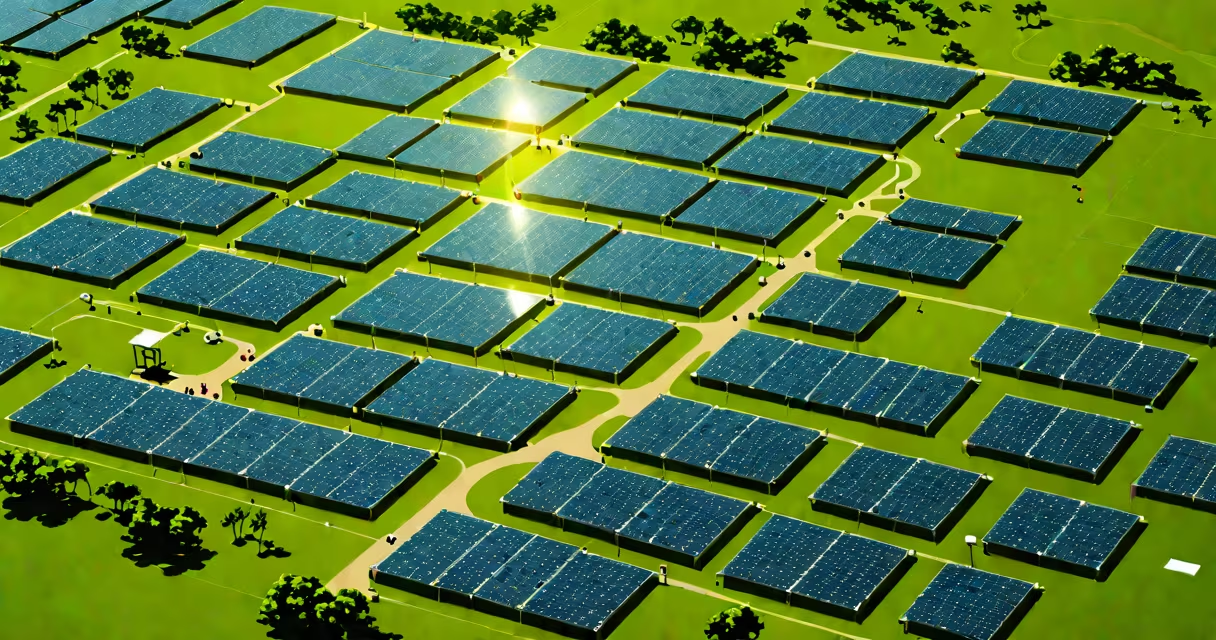
Green energy is not inherently expensive; in fact, wind and solar power are now among the cheapest sources of electricity globally. Levelized costs for utility-scale solar and onshore wind have fallen below those of coal and gas in most markets since 2020.
The term "green energy" refers to electricity generated from renewable sources like solar, wind, hydro, and geothermal. These sources produce little to no greenhouse gas emissions during operation. While early installations required high upfront investment, recent technological advances and economies of scale have dramatically reduced long-term costs.
According to the International Renewable Energy Agency (IRENA), the global weighted average cost of electricity from utility-scale solar photovoltaic (PV) projects dropped 85% between 2010 and 2022. Onshore wind fell by 56%. These reductions make green energy not only environmentally preferable but economically competitive.
Electricity cost comparisons rely on the levelized cost of electricity (LCOE), which calculates the average net present cost of building and operating a power plant over its lifetime. LCOE accounts for capital expenses, fuel, operations, maintenance, and financing.
For example, in 2023, the LCOE for new solar PV installations ranged from $0.03 to $0.06 per kilowatt-hour (kWh) in the United States. Onshore wind averaged $0.02 to $0.05/kWh. In contrast, new natural gas plants were $0.04 to $0.07/kWh, and new coal plants cost $0.06 to $0.10/kWh.
These figures come from IRENA's 2023 Renewable Power Generation Costs report and the U.S. Energy Information Administration (EIA) Annual Energy Outlook. They show that green energy is not just viable-it's often cheaper than fossil-based alternatives.
Several factors contribute to lower green energy costs. First, manufacturing improvements have increased solar panel efficiency while reducing material use. Second, supply chains for wind turbines and batteries have matured, lowering production time and failure rates.
Third, government policies such as tax credits and feed-in tariffs reduce initial project risk. The U.S. Inflation Reduction Act (IRA) of 2022, for instance, provides up to 30% investment tax credits for solar and wind projects. This incentive has spurred over $100 billion in announced clean energy investments since its passage.
A fourth factor is declining battery storage prices. Since 2010, lithium-ion battery pack prices have fallen 89%, according to BloombergNEF. Lower storage costs allow solar and wind to provide stable power even when the sun isn't shining or the wind isn't blowing.
Many people still believe green energy is too costly because they're comparing current electricity bills to outdated data. In 2010, solar was more expensive than fossil fuels. Today, that gap has reversed.
Another misconception is that green energy requires constant backup from fossil fuels. Modern grids integrate renewables using smart inverters, demand-response systems, and regional interconnections. California, for example, met 30% of its electricity demand with solar alone during peak summer hours in 2023, without blackouts.
Some assume that offshore wind is prohibitively expensive. While it remains costlier than onshore wind, offshore wind LCOE has dropped 48% since 2010. Projects like Vineyard Wind in Massachusetts are now bidding at $0.04/kWh-lower than many existing gas plants.
| Energy Source | LCOE (2023, USD/kWh) | Change Since 2010 |
|---|---|---|
| Utility-scale solar PV | $0.03 - $0.06 | ↓ 85% |
| Onshore wind | $0.02 - $0.05 | ↓ 56% |
| New natural gas | $0.04 - $0.07 | ↑ 10% (adjusted for inflation) |
| New coal | $0.06 - $0.10 | ↑ 15% |
| Offshore wind | $0.05 - $0.10 | ↓ 48% |
Data sourced from IRENA (2023) and EIA (2023). All values represent median ranges across major markets.
In 2022, the city of Austin, Texas, signed a 20-year power purchase agreement (PPA) for 100 MW of solar energy at $0.025/kWh. That rate was lower than the city's previous average retail electricity price of $0.045/kWh.
The project included battery storage to cover nighttime demand. Over 20 years, the city expects to save $120 million compared to continuing with conventional sources. The savings came from both lower generation costs and reduced transmission losses due to localized generation.
This case demonstrates that green energy isn't just affordable-it can generate direct financial returns when integrated into municipal planning.
Green energy isn't uniformly low-cost everywhere. Remote locations with poor infrastructure face higher installation and maintenance costs. Island nations like Hawaii or the Maldives may pay more per kWh due to shipping and limited grid access.
Residential rooftop solar also varies widely. A homeowner in rural Montana might pay $20,000 for a 10-kW system, while someone in suburban Florida could install the same size for $15,000 due to better labor availability and higher solar irradiance.
Integrating green energy into aging grids requires upgrades. The U.S. Department of Energy estimates that modernizing the national grid could cost $100 billion over ten years-but this investment avoids $1 trillion in avoided climate damages and outage-related losses.
I installed a 7.2 kW solar system on my family's home in northern New Mexico in 2021. After federal tax credits and state rebates, the net cost was $18,000. With an average daily output of 28 kWh and local electricity rates at $0.14/kWh, the system pays for itself in about 11 years.
After the payback period, the household generates free electricity. Over 25 years, we expect to save $65,000 in utility bills. The system also reduced our carbon footprint by 12 metric tons annually-equivalent to planting 280 trees each year.
One overlooked point is that "expensive" depends on whether you measure upfront cost or lifetime cost. A solar panel system may require a $20,000 outlay, but it produces electricity for 25 years at near-zero marginal cost. Fossil fuel plants, meanwhile, face ongoing fuel costs and carbon pricing risks.
Another distinction: green energy isn't a single product. Solar, wind, hydro, and geothermal differ in location requirements, scalability, and dispatchability. What's cheap in Arizona may not work in Alaska due to seasonal light variation.
Finally, the cost of inaction matters. The World Bank estimates that climate change could cost the global economy $23 trillion annually by 2050 if warming exceeds 2°C. Investing in green energy now reduces future adaptation and disaster recovery costs.
If you're evaluating whether green energy fits your budget, start with a site-specific assessment. Tools like the National Renewable Energy Laboratory's PVWatts Calculator estimate solar potential based on roof angle, shading, and local weather patterns.
For larger decisions, such as community solar programs or commercial installations, assessing solar energy affordability is essential. Compare local utility rates, available incentives, and long-term forecasts.
Understanding the full picture of green energy economics helps avoid outdated assumptions. As technology continues to improve, the economic case for switching to renewables strengthens.
Green energy is not expensive. It is increasingly the most cost-effective way to generate electricity. The challenge lies not in price, but in deployment speed, policy alignment, and grid modernization. With accurate data and targeted investment, transitioning to green energy is both feasible and financially sound.