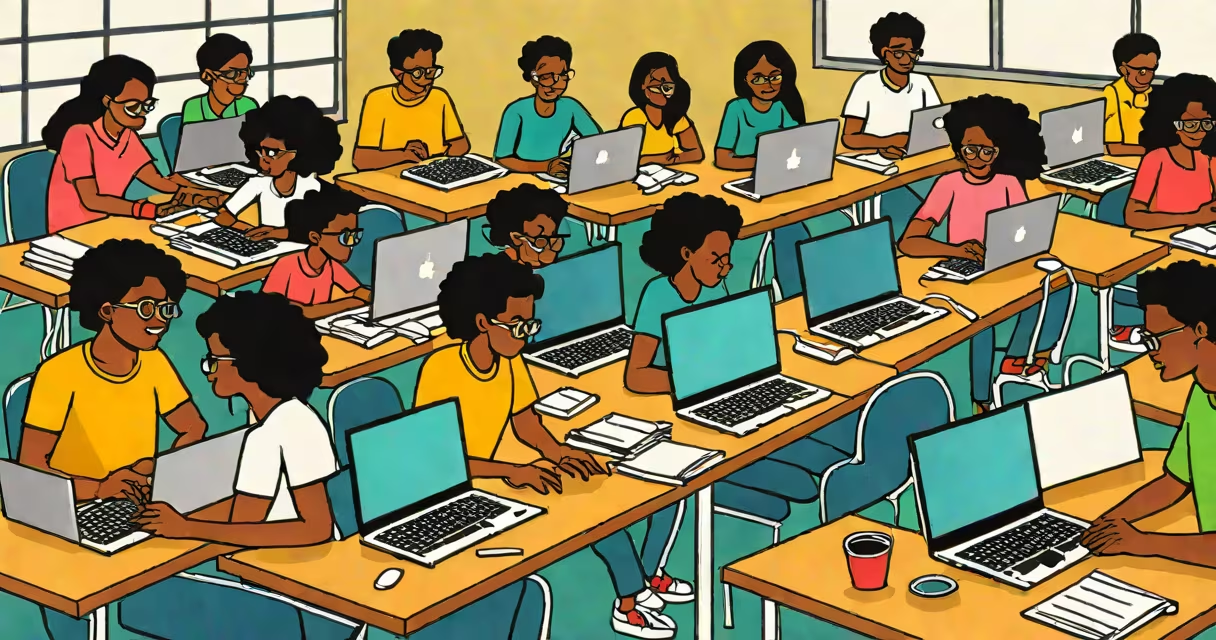
The importance of computer in education stems from its role in delivering personalized learning, expanding access to global knowledge, and developing digital skills essential for future employment. Computers enable interactive lessons, real-time feedback, and data-driven instruction, making education more effective and inclusive.
Computers function as tools for content delivery, research, collaboration, and assessment. They allow students to access textbooks, videos, simulations, and databases instantly. Teachers use them to track progress, tailor assignments, and engage learners through multimedia. In classrooms from elementary to university level, computers support both teaching and learning processes.
According to the National Center for Education Statistics (NCES), 94% of U.S. public schools had internet access in 2021, and 92% had instructional computers available. These numbers reflect how deeply embedded computers are in formal education systems. Without them, many curriculum standards-especially in STEM subjects-would be difficult to meet.
Computers help active learning by enabling simulations, coding exercises, and virtual labs. For example, a biology student can explore a 3D model of the human heart, rotating it to study valves and blood flow. This hands-on interaction improves retention compared to static diagrams in textbooks.
Learning management systems (LMS) like Google Classroom or Canvas rely on computers to organize assignments, share materials, and provide grading tools. A high school teacher can assign a math worksheet via LMS, receive completed work within hours, and give automated feedback on multiple-choice questions. This reduces administrative time and increases responsiveness.
One study by the U.S. Department of Education found that students using computers for instruction scored 15% higher on average in standardized tests than those relying solely on traditional methods. The effect was strongest in science and math, where visual and interactive content improved conceptual understanding.
Computers serve different roles depending on context. Below is a breakdown of common applications:
| Use Case | Common Tools | Example Application |
|---|---|---|
| Instructional Delivery | LMS, video platforms | A history teacher streams a documentary on the Civil Rights Movement and follows it with a quiz on key events. |
| Research & Information Access | Web browsers, academic databases | A college student uses JSTOR to find peer-reviewed articles on climate change policy. |
| Project Creation | Word processors, presentation software | Elementary students create a slideshow about endangered animals using images and voice narration. |
| Assessment & Feedback | Online quizzes, plagiarism detectors | A teacher assigns a timed test on Quizizz; results appear immediately with explanations for incorrect answers. |
Each use case supports different learning objectives. Instructional delivery builds foundational knowledge. Research develops critical thinking. Project creation encourages creativity. Assessment provides measurable outcomes.
Many assume that computers replace teachers. That's false. Computers are tools, not substitutes. A 2022 report from the RAND Corporation found that technology integration works best when paired with strong pedagogy. In classrooms where teachers used computers to supplement lessons-not replace them-student performance improved by 20% over control groups.
Another myth is that all students have equal access. In reality, the digital divide persists. The Pew Research Center reported in 2023 that 15% of U.S. households with school-aged children lack consistent internet access at home. Schools must bridge this gap through device lending programs and after-school tech hubs.
A lesser-known issue is screen fatigue. Overuse of computers without breaks leads to reduced attention spans. The American Academy of Pediatrics recommends limiting screen time to 1-2 hours per day for K-12 students during school hours. Educators balance computer use with hands-on activities, group discussions, and outdoor learning.
In a suburban high school physics class, the teacher uses the importance of computer in education to redesign her syllabus. Instead of lecturing during class, she records 10-minute video lessons on Newton's laws and posts them to the LMS.
Students watch the videos at home and complete a short quiz. The system flags incorrect answers and sends them to the teacher. During class, students work in pairs to solve problems using a simulation tool that models forces and motion.
One student struggled with friction calculations. The teacher pulled him aside and used a physical ramp and toy car to demonstrate the concept. He then returned to the computer to adjust variables in the simulation. His test score improved from 62% to 88% in one month.
This approach-called "flipped learning"-is backed by research. A meta-analysis published in the Journal of Educational Psychology found that flipped classrooms increased student engagement by 37% and test scores by 12% compared to traditional lectures.
Computer literacy is now a core skill, much like reading and arithmetic. The World Economic Forum identifies digital fluency as one of the top ten job skills needed by 2025. Students who grow up using computers effectively are better prepared for internships, college, and careers in fields ranging from healthcare to engineering.
Even in non-tech jobs, basic computer use is expected. A retail employee may need to update inventory in a database. A nurse must enter patient data into an electronic health record system. These tasks require familiarity with software interfaces, file management, and online security.
When schools integrate computers thoughtfully, they don't just teach content-they build confidence and problem-solving habits. A student who learns to troubleshoot a frozen program gains resilience. One who collaborates on a shared document learns communication and accountability.
For educators, understanding the importance of computer in education isn't optional. It's central to meeting modern learning goals. Schools that invest in training, infrastructure, and equitable access see long-term benefits in graduation rates, college enrollment, and workforce readiness.