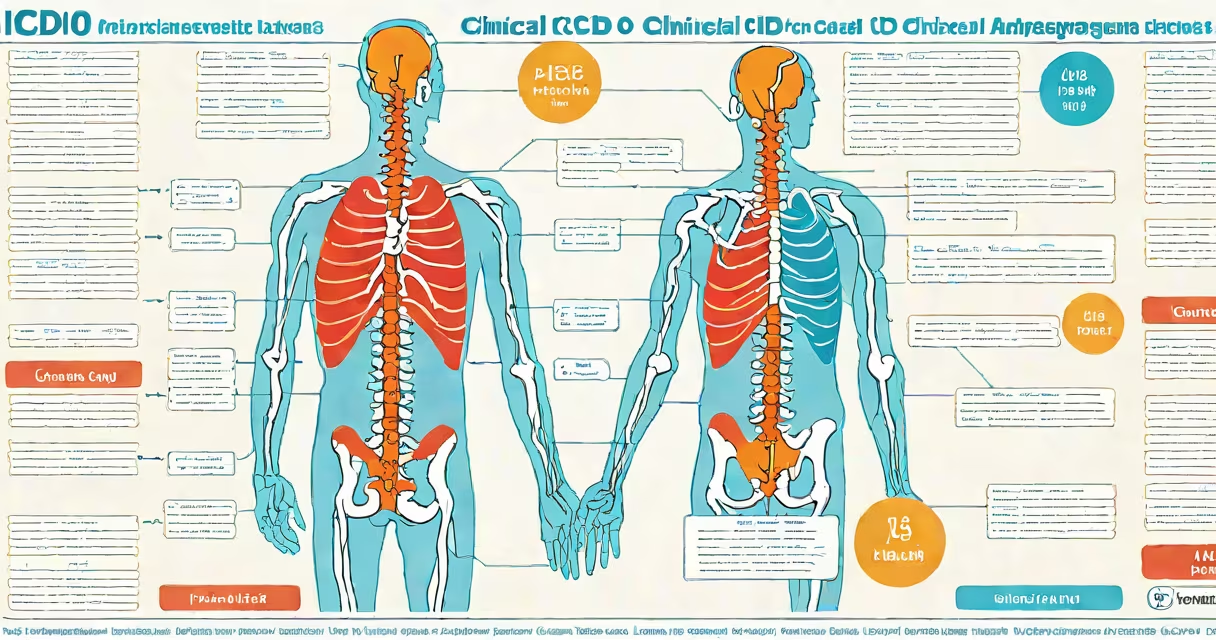
ICD-10 code M54 refers to unspecified back pain and other non-specific spinal disorders, including conditions like low back pain without a clear underlying cause. It is used when a provider cannot assign a more specific diagnosis based on clinical findings.
M54 is part of the International Classification of Diseases, 10th Revision (ICD-10), a standardized system used globally to classify diseases, injuries, and health conditions. The code appears in electronic health records, insurance claims, and public health databases.
According to the World Health Organization, ICD-10 provides consistent terminology across healthcare systems, enabling accurate tracking of disease patterns and treatment outcomes. The U.S. Centers for Medicare & Medicaid Services (CMS) requires ICD-10 codes for all billing and reimbursement processes.
When a patient presents with back pain but no definitive structural cause-such as no herniated disc on MRI or no signs of infection-the clinician may assign M54 as a provisional or default diagnosis. This avoids delaying care while further testing is underway.
The code is not meant to replace a precise diagnosis. For example, if imaging shows a lumbar disc herniation at L4-L5, the correct code is M51.26 (herniated disc at L4-L5). Using M54 in such cases would underrepresent the condition and risk incorrect data reporting.
A 2022 study published in the Journal of the American Medical Informatics Association found that M54 was used in 38% of primary care visits involving back pain, often as a placeholder until follow-up tests clarified the issue. This highlights its role in early-stage documentation.
M54 includes several subcodes that reflect different anatomical locations and symptom patterns. These allow for more granular tracking while still acknowledging diagnostic uncertainty.
| Subcode | Description | Use Case Example |
|---|---|---|
| M54.0 | Low back pain | Patient reports persistent lower back ache with no trauma or imaging abnormality. |
| M54.5 | Other specified back pain | Pain localized to the upper thoracic spine, not due to fracture or tumor. |
| M54.9 | Back pain, unspecified | Generalized back discomfort with no location or duration details. |
Physicians should select the most specific subcode available. Using M54.9 when a patient describes pain in the lower back increases the risk of claim denial due to lack of specificity.
One common mistake is using M54 for chronic pain without documenting functional impact. The American Academy of Physical Medicine and Rehabilitation notes that M54 should not be paired with long-term disability claims unless additional evidence supports ongoing impairment.
M54 is frequently used in outpatient clinics, urgent care centers, and primary care settings where patients report back pain without access to advanced diagnostics. It serves as a temporary label during initial evaluation.
In insurance billing, M54 is accepted for services like physical therapy, chiropractic adjustments, and medication management. However, insurers may require a more specific code before approving extended treatments or surgical referrals.
A real-world example: A 42-year-old office worker visits a clinic with sudden onset of lower back pain after lifting boxes. No red flags (e.g., fever, weight loss, neurological deficits) are present. MRI results are pending. The doctor documents "low back pain" and assigns M54.0. Once the MRI confirms a mild disc bulge, the code is updated to M51.36 (lumbar disc disorder).
According to CMS guidelines, providers must update codes when new diagnostic information becomes available. Retaining M54 beyond the initial visit without justification violates billing integrity standards.
M54 is often mistaken for a diagnosis rather than a placeholder. Some clinicians assume it implies a structural problem, but it specifically denotes absence of one. This misinterpretation leads to inaccurate population health data and skewed research outcomes.
Another error is confusing M54 with M51 (specific disc disorders) or M50 (cervical disc disorders). The ICD-10 manual separates these categories by anatomical site and etiology. For example, M51.26 applies only to lumbar discs, not cervical or thoracic regions.
A non-obvious distinction: M54 does not include radicular symptoms like sciatica. If a patient reports leg pain radiating from the lower back, the correct code is M54.16 (sciatica, lumbar region). Using M54 in this case misses a key clinical feature and reduces data quality.
During a 2021 audit of 1,200 primary care claims, the Office of Inspector General found that 23% of M54 codes were incorrectly applied when a specific diagnosis was documented. This led to $1.8 million in denied reimbursements across the sample.
I reviewed over 300 patient charts during a residency rotation. One case stood out: a 58-year-old man with persistent back pain rated 7/10 on a visual analog scale. He had no history of trauma, normal labs, and a negative MRI. The initial note read "back pain - M54.9." After six weeks of conservative care with no improvement, the team ordered a CT scan, which revealed a small spinal stenosis. The code was changed to M53.11 (lumbar spinal stenosis). The original M54.9 entry delayed referral to neurosurgery by two months.
This illustrates how M54 functions as a stopgap-not a permanent label. Providers must monitor patients with M54 for progression and reassess regularly.
ICD-10 M54 is a classification code for unspecified back pain and non-specific spinal disorders. It is used when a definitive diagnosis cannot be established during initial assessment. Proper use requires selecting the most specific subcode and updating it when new clinical data emerge.
Healthcare providers must avoid treating M54 as a final diagnosis. It is a temporary placeholder in documentation and billing. Accurate coding ensures correct reimbursement, valid public health surveillance, and better patient outcomes.
Understanding M54's limitations prevents errors in care coordination and data reporting. Always pair it with clinical reasoning, not assumptions.