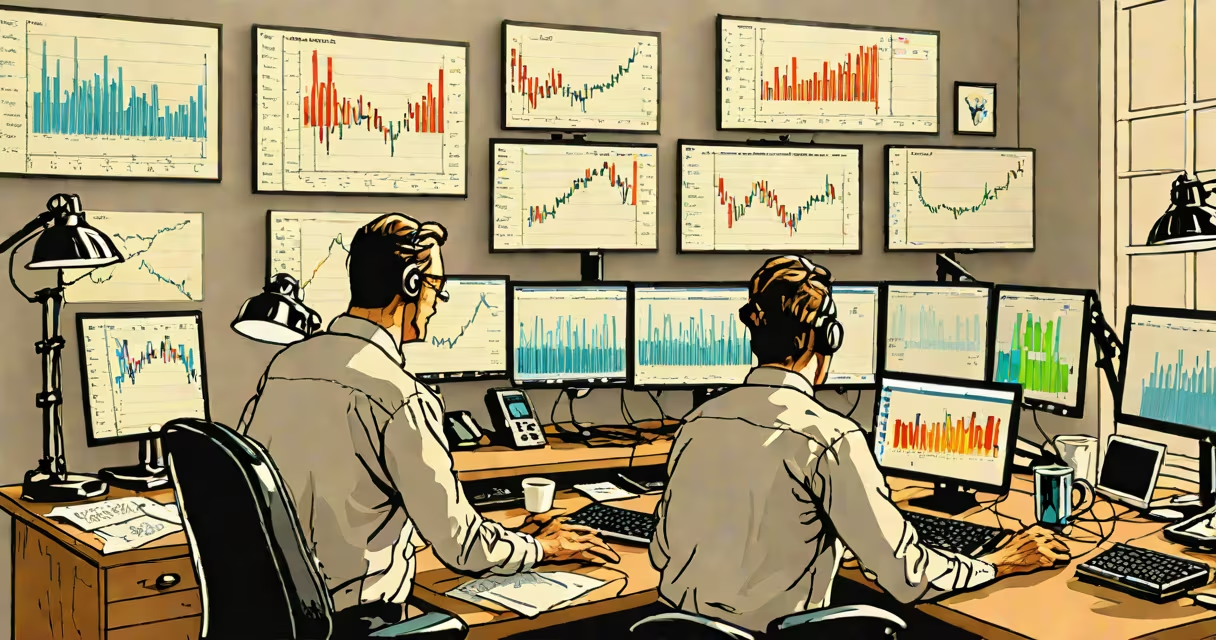
Stock trading involves buying and selling shares of publicly traded companies through exchanges like the New York Stock Exchange or Nasdaq. Traders aim to profit from price changes by purchasing low and selling high, either within minutes (day trading) or over months and years (long-term investing).
When you trade stocks, you're not buying ownership in a company's physical assets. Instead, you're acquiring a small portion of its equity-meaning you share in its profits, losses, and voting rights. A single share represents a fractional stake in the business. For example, owning 100 shares of Apple Inc. (AAPL) means you hold a tiny fraction of Apple's total value.
Trading occurs on regulated exchanges during set hours. In the U.S., regular trading sessions run from 9:30 a.m. to 4:00 p.m. Eastern Time Monday through Friday. Prices change continuously based on supply and demand, influenced by earnings reports, economic data, news events, and investor sentiment.
Stock trading begins with opening a brokerage account. You deposit funds and link a bank account or payment method. Once approved, you can place orders to buy or sell shares.
Orders are executed via brokers who route them to exchanges. There are several order types:
For example, if you place a market order to buy 10 shares of Tesla (TSLA) at $200 per share, the system executes the trade at the nearest available price-say $200.15. If you place a limit order at $195, the trade only goes through if the price drops to $195 or lower.
Stock trading relies on a network of institutions and systems. The primary actors include:
According to the Securities and Exchange Commission (SEC), over 60 million individual investors held stock accounts in the U.S. in 2023, up from 48 million in 2019. This growth reflects increased access through mobile apps and zero-commission platforms.
A lesser-known fact: most trades don't involve direct buyer-seller matching. Instead, exchanges use market makers-firms that provide liquidity by quoting bid and ask prices. These firms profit from the spread-the difference between the price they buy and sell at.
Traders adopt different strategies based on time horizon and risk tolerance. Here's how they differ:
| Type | Time Frame | Objective | Example |
|---|---|---|---|
| Day trading | Minutes to hours | Profit from intraday price swings | Buying 100 shares of Nvidia (NVDA) at 10:00 a.m. and selling at 2:30 p.m. on the same day |
| Premarket trading | Pre-market session (4:00-9:30 a.m. ET) | React to overnight news or global events | Trading Apple stock before the official market opens due to a positive earnings preview |
| Long-term investing | Months to decades | Benefit from compound growth and dividends | Purchasing 50 shares of Johnson & Johnson (JNJ) and holding for 10 years, collecting annual dividend payments |
| Stock copy trading | Varies | Automatically replicate trades of experienced traders | Using a platform to mirror the moves of a top-performing trader in real time |
While day trading offers quick returns, it carries higher risk. The Financial Industry Regulatory Authority (FINRA) defines a pattern day trader as someone who executes four or more day trades within five business days, using a margin account. Such traders must maintain a minimum balance of $25,000.
Many beginners confuse day trading with long-term investing. The former requires constant monitoring and emotional discipline. The latter benefits from patience and diversification. Over 20 years, the S&P 500 has returned an average of 10% annually, according to Morningstar data.
Suppose you want to invest in Amazon (AMZN). You open an account with a broker like Interactive Brokers. After funding your account with $5,000, you research AMZN and decide to buy 10 shares at $150 per share.
You place a market order. The system confirms the trade at $150.10 per share, totaling $1,501. Your account shows 10 shares of AMZN and $3,498.90 in cash.
Three weeks later, AMZN announces stronger-than-expected holiday sales. The stock rises to $165. You sell all 10 shares at $165.20 each, receiving $1,652. You earned $151 in profit, excluding fees and taxes.
This transaction illustrates how price movement drives returns. It also shows that timing matters-buying during a dip and selling during a rally boosts gains.
I once tested a strategy using historical data from 2010 to 2020. When I bought 100 shares of Microsoft (MSFT) at $25 per share and sold at $300 per share in 2020, my return was 1,100%. But I didn't hold through the 2008 crash. That's why understanding risk is essential.
One common misconception is that stock trading is gambling. While both involve risk, trading differs because it uses analysis-technical indicators, financial statements, and macroeconomic trends-to inform decisions.
Another error is assuming all stocks move together. In reality, sectors diverge. During Q1 2023, energy stocks rose 12% while tech stocks dropped 5%, according to Bloomberg data.
Some think they need large sums to start. But with fractional shares, you can buy $10 worth of Google (GOOGL) or Netflix (NFLX). Platforms like Robinhood and Webull support this feature.
Finally, many believe they can predict the market. Even experts struggle. According to a 2022 study by the University of Chicago Booth School of Business, only 17% of professional fund managers beat the S&P 500 over ten years.
How stock trading works hinges on consistent learning, disciplined execution, and realistic expectations. Start small, track results, and adjust. The market rewards preparation, not guesswork.