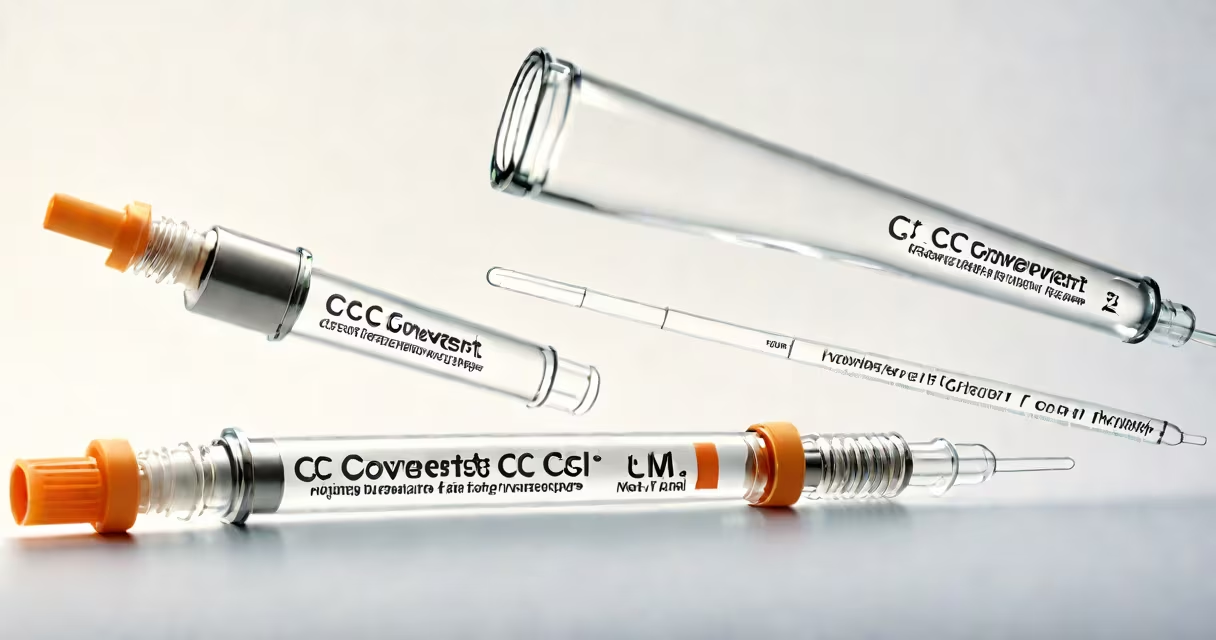
Cubic centimeters (cc) and milliliters (ml) are numerically equivalent units of volume; 1 cc equals exactly 1 ml. This equivalence applies universally across medical, scientific, and culinary contexts.
The metric system defines volume using liters, with 1 liter equal to 1,000 milliliters. A cubic centimeter is the volume of a cube measuring 1 cm on each side. Because the volume of water at standard conditions occupies 1 ml per cm³, the two units are interchangeable by definition.
Medical professionals rely on this exact equivalence when administering injections. For example, a doctor prescribing 5 cc of medication means 5 ml. Pharmacists verify this during dispensing, ensuring no dosage error occurs due to unit confusion.
The relationship between cc and ml stems from the original definition of the liter. In 1901, the liter was defined as the volume of one kilogram of pure water at 4°C. That volume equaled 1,000 cubic centimeters. By 1964, the International Committee for Weights and Measures redefined the liter as exactly 1,000 cubic centimeters, making 1 ml = 1 cm³.
This standardization ensures consistency worldwide. The National Institute of Standards and Technology (NIST) confirms that "one milliliter is exactly equal to one cubic centimeter" in all official measurements.
Despite their identity, the terms persist in different fields. "Cc" appears frequently in automotive engine displacement (e.g., a 2.0L engine is 2,000 cc), while "ml" dominates in medicine and food labeling. This usage difference causes confusion but not numerical discrepancy.
In clinical settings, nurses measure liquid medications using syringes marked in both cc and ml. A 20 cc syringe holds exactly 20 ml. Dosing errors arise not from unit mismatch but from misreading the scale-especially when using syringes with fine gradations.
Cooking also uses both units. A recipe calling for 150 cc of milk requires 150 ml. Some kitchen tools list volumes in cc, others in ml. Using either unit produces the same result.
For precise conversions, apply the formula:
volume in ml = volume in cc × 1
Example: Convert 3.5 cc to ml. 3.5 cc × 1 = 3.5 ml. The result is 3.5 ml.
| cc | ml |
|---|---|
| 0.5 | 0.5 |
| 1 | 1 |
| 5 | 5 |
| 10 | 10 |
| 100 | 100 |
A common misunderstanding is that cc and ml differ in density or application. They do not. Water, oil, or syrup all occupy the same volume in cc and ml. A 10 ml bottle of cough syrup contains exactly 10 cc.
Another error involves assuming larger units require conversion. For example, 100 cc is not "bigger" than 100 ml-it's the same volume. Confusion arises when people see "cc" in a car manual and "ml" on a medicine label and assume they're different.
Even digital tools sometimes display incorrect values. A smartphone app converting 10 cc to ml should return 10 ml. If it shows 10.1 or 9.9, the algorithm is flawed. Always validate results against known standards.
I once observed a nurse preparing a pediatric dose of acetaminophen. The prescription read: "Give 0.75 cc every 6 hours." She drew up the liquid into a 1 ml syringe. The mark for 0.75 ml aligned precisely with the 0.75 cc line. No calculation was needed because the units are identical.
Had she used a different system-say, ounces or tablespoons-the math would have changed. But since both cc and ml are metric, the conversion remains 1:1.
When working with liquids, especially in healthcare, accuracy matters. A 10% error in a 10 ml dose could cause harm. Using consistent units reduces risk. Always double-check that syringes are calibrated in the intended unit.
If you're working with liquid volumes beyond cc and ml, understanding other units helps. For example, 125 ml equals approximately 0.53 cups. To convert 125 ml to cups, divide by 236.588 (the number of ml in a cup): 125 ÷ 236.588 ≈ 0.53 cups.
Always verify unit labels on containers. A bottle labeled "100 cc" contains 100 ml. No math is needed. The numbers are the same.