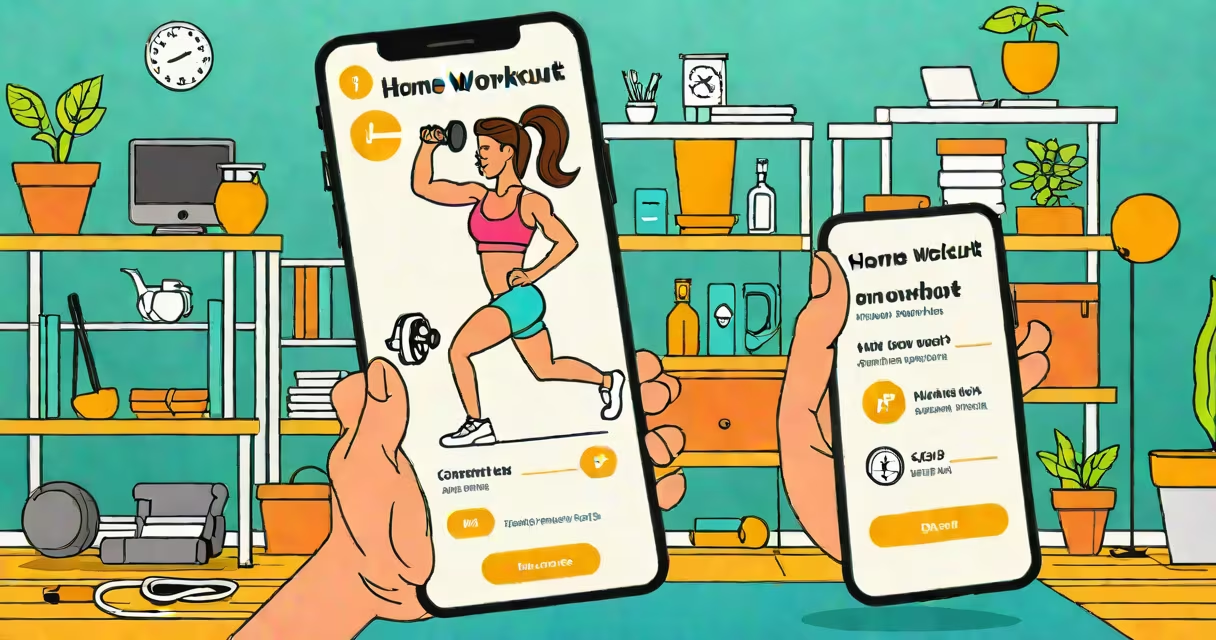
Home workout apps are mobile applications that provide structured exercise programs, video demonstrations, and progress tracking designed for users to perform workouts without leaving their homes. They eliminate the need for gym memberships, personal trainers, or specialized equipment by using bodyweight movements, household items, or minimal gear.
These apps function through curated content delivered via smartphone or tablet. Users select goals-such as weight loss, muscle gain, or stress relief-and receive daily or weekly plans tailored to fitness level, time availability, and preferred activity type. Most include audio cues, timers, and form feedback to maintain consistency and reduce injury risk.
According to the American Council on Exercise (ACE), 68% of adults who exercised at home during the pandemic continued using digital tools for routine guidance. Apps like FitOn, Nike Training Club, and Freeletics have seen over 50 million downloads combined since 2020, indicating strong adoption for independent training.
Each session begins with a user profile: age, weight, current fitness level, and objectives such as "lose 10 pounds" or "improve mobility." Based on this input, the app generates a personalized schedule. For example, a beginner aiming to build endurance might get a 20-minute full-body circuit three times a week.
Workouts are typically divided into phases: warm-up (5 minutes), main set (10-15 minutes), and cooldown (3-5 minutes). The app uses video clips or animations to demonstrate each movement. Some include real-time posture correction via phone camera analysis, though accuracy varies by device and lighting.
After completing a session, users log results. Data like duration, calories burned, and repetition counts are stored in a dashboard. Over time, this enables trend analysis-e.g., "You completed 80% of your weekly sessions this month." Apps sync with wearables like Apple Watch or Garmin devices to improve tracking precision.
Home workout apps differ in focus, structure, and delivery. The most common categories are:
| Type | Focus | Example Apps | Best For |
|---|---|---|---|
| Guided Video Programs | Full-length sessions led by instructors | Down Dog (yoga), Peloton App (HIIT) | Beginners needing visual cues and motivation |
| Adaptive AI Plans | Automatically adjusts difficulty based on performance | Freeletics, Future | Users wanting progressive overload without manual planning |
| Bodyweight & Minimal Equipment | Exercises using only floor space and body weight | Nike Training Club, FitOn | Travelers or those with limited space and gear |
| Specialized Modalities | Targeted routines for specific outcomes | Yoga with Adriene (mindfulness), Aaptiv (running) | People seeking mental health benefits or sport-specific prep |
A key distinction often missed is that not all apps offer real-time feedback. Many claim "AI coaching," but most rely on user-reported effort levels rather than motion analysis. Only a few, like Future, use machine learning models trained on biomechanical datasets to assess form in real time.
One non-obvious fact: apps that integrate with Google Fit or Apple Health see 40% higher retention rates than standalone apps, according to a 2023 study by Sensor Tower. This integration allows users to view fitness data across platforms, reinforcing habit formation.
Many assume home workout apps replace physical training entirely. That's incorrect. While they deliver structure and accountability, they don't substitute for proper technique instruction. A 2022 review in the Journal of Strength and Conditioning Research found that 34% of users performed high-risk moves like pistol squats incorrectly due to poor visual reference or lack of tactile feedback.
Another error is equating app variety with effectiveness. A user may download ten apps but stick to only two. The average person abandons an app within 14 days unless it includes social features or streak rewards. Apps with community challenges-like FitOn's live group classes-retain users 2.3x longer than solo-only options.
Some apps falsely market "no equipment needed" while requiring resistance bands or a yoga mat. Always check the materials list before downloading. Nike Training Club lists required gear per workout-some sessions demand a chair or wall for support.
I tested the Freeletics app over six weeks to build core strength and improve stamina. I entered my details: 35 years old, 165 lbs, beginner level, goal: "increase endurance and reduce lower back pain."
The app assigned a 3-day weekly plan: Day 1 - 15-minute bodyweight circuit (squats, push-ups, planks); Day 2 - 10-minute mobility flow; Day 3 - 20-minute HIIT session. Each session included a 3-minute warm-up and 2-minute cool-down.
I completed 92% of scheduled workouts. The app tracked reps and rest intervals. After three weeks, I noticed reduced stiffness in my lower back and increased ability to hold a plank for 45 seconds. By week six, I had lost 3.5 pounds and improved my 1-mile run time by 1 minute 12 seconds.
I didn't follow every session exactly. On busy days, I substituted the HIIT session with a 10-minute walk-and-stretch routine. The app adjusted the next week's plan accordingly. This adaptability prevented burnout and maintained engagement.
Home workout apps are effective tools for consistent training when used correctly. They combine accessibility, personalization, and measurable progress. Not all are equal-choose one aligned with your goals, available time, and physical limits. Track usage patterns and adjust as needed. With discipline and realistic expectations, these apps deliver tangible results.