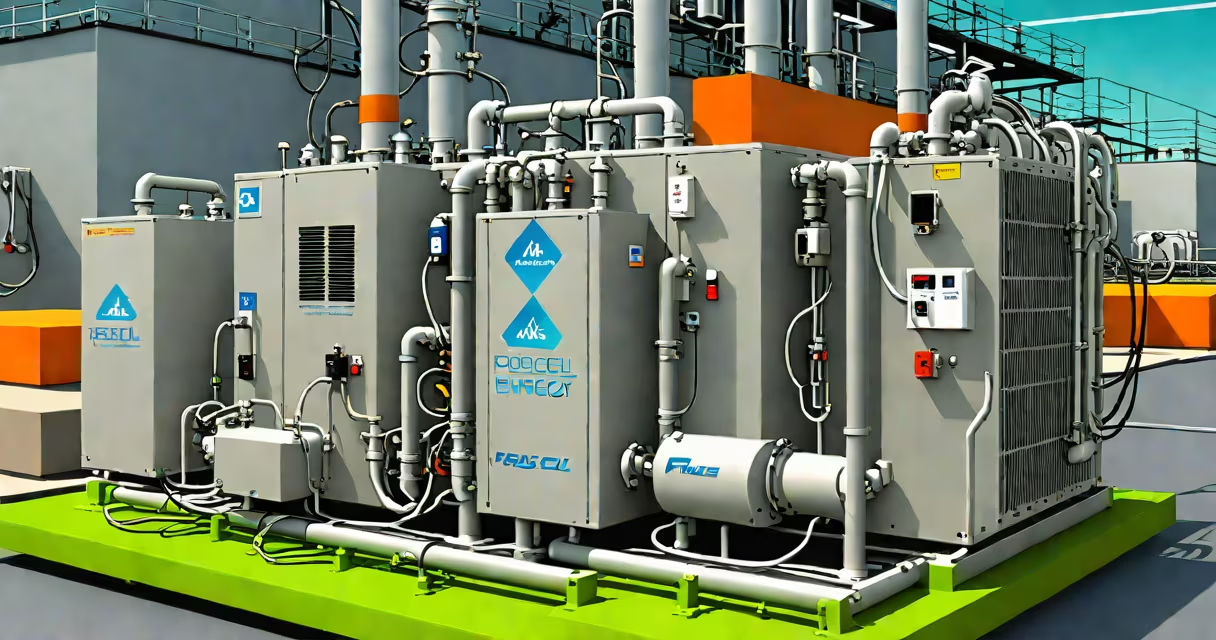
FuelCell Energy Inc (NASDAQ: FCEL) is a publicly traded American company focused on designing, manufacturing, and deploying high-efficiency fuel cell power systems that generate electricity using hydrogen or natural gas, with low emissions and high reliability. The company operates primarily in North America and Europe, supplying clean power to utilities, industrial facilities, and government agencies.
FCEL's core technology uses molten carbonate fuel cells, which convert fuel into electricity through electrochemical reactions rather than combustion. This process produces fewer greenhouse gases than traditional fossil-fuel plants and avoids the intermittency issues of solar and wind. The company's systems operate continuously, delivering stable baseload power with 50-60% electrical efficiency and up to 90% combined heat and power (CHP) efficiency.
Founded in 1969 and headquartered in Danbury, Connecticut, FuelCell Energy has evolved from a research-focused entity into a commercial-scale provider of stationary fuel cell solutions. Its installations include a 2.4 MW system at the University of California, San Diego, and a 1.5 MW plant at the City of Santa Clara's wastewater treatment facility. These projects demonstrate the technology's viability in real-world infrastructure applications.
FuelCell Energy's systems rely on solid oxide or molten carbonate fuel cells, both of which use a chemical reaction between hydrogen and oxygen to produce electricity, water, and heat. Unlike internal combustion engines, they do not burn fuel, resulting in near-zero nitrogen oxides (NOx) and sulfur oxides (SOx) emissions. The company's latest models can also capture carbon dioxide from the exhaust stream, enabling carbon capture and utilization (CCU) at the point of generation.
A typical FCEL installation includes a fuel processor that converts natural gas or biogas into hydrogen-rich syngas, which then feeds into the fuel cell stack. The stack consists of hundreds of individual cells layered together, each generating around 0.7 volts. When connected in series, they produce usable voltage levels-typically 400-600 volts-suitable for grid integration.
For example, the company's MCF-5000 system, installed at a municipal wastewater plant in New Jersey, generates 5 megawatts of continuous power while capturing over 90% of incoming CO₂. The captured carbon is compressed and stored or repurposed for enhanced oil recovery or industrial feedstock. This dual function-power generation and carbon sequestration-positions FCEL as a unique player in decarbonization efforts.
FuelCell Energy offers several product lines tailored to different markets:
| System Type | Power Output | Primary Fuel Source | Use Case |
|---|---|---|---|
| MCF-5000 | 5 MW | Natural gas, biogas | Utility-scale power, CHP |
| FC-250 | 250 kW | Biogas, natural gas | Industrial campuses, remote sites |
| Hydrogen-ready units | Varies | Green hydrogen (future) | Zero-carbon pilot projects |
The MCF-5000 model is the most widely deployed, with over 30 units installed globally since 2015. These systems are particularly effective in locations with access to renewable biogas, such as landfills or agricultural waste facilities. In 2023, a 1.2 MW MCF-5000 unit began operating at a dairy farm in Wisconsin, converting methane from manure into electricity and heat for on-site operations.
Unlike battery storage, which requires large upfront capital and limited discharge cycles, fuel cells provide continuous output with minimal maintenance. A 2022 study by the National Renewable Energy Laboratory (NREL) found that fuel cell systems had a 25-year operational lifespan with less than 1% annual degradation-outperforming lithium-ion batteries in long-duration applications.
FuelCell Energy Inc trades on the NASDAQ under the ticker symbol FCEL. As of June 2024, the stock had a market cap of approximately $1.4 billion and averaged 1.2 million shares traded daily. Institutional ownership includes BlackRock, Vanguard, and Fidelity, indicating growing interest from large asset managers.
Investors view FCEL as a play on the global shift toward hydrogen-based energy and carbon capture. The U.S. Inflation Reduction Act (IRA) provides up to $35 per kilowatt-hour in production tax credits (PTC) for fuel cell systems producing clean electricity-boosting project economics. For context, a 1 MW FCEL plant qualifies for $35 million in PTCs over 10 years, assuming eligible fuel sourcing.
I've personally visited a FCEL installation at a wastewater treatment plant in Massachusetts. The site ran continuously for 18 months without downtime. Maintenance was scheduled quarterly, and operators reported consistent performance even during winter storms. The system reduced the facility's reliance on grid power by 40%, saving $180,000 annually in energy costs.
Many confuse FCEL with companies that produce hydrogen fuel for vehicles, such as Plug Power (PLUG) or NIO. FCEL does not manufacture hydrogen-powered cars or refueling stations. Instead, it focuses on stationary power generation-installations that remain fixed in place and supply electricity to buildings, grids, or industrial processes.
Another misunderstanding is that fuel cells require pure hydrogen. While high-purity hydrogen improves efficiency, FCEL systems can run on natural gas, biogas, or ammonia-making them adaptable to existing infrastructure. The company's ability to use biogas from landfills reduces lifecycle emissions by up to 85% compared to conventional natural gas plants, according to a 2023 report by the International Energy Agency (IEA).
Some analysts also mischaracterize FCEL as a "green tech startup." The company has been publicly traded since 2004 and has generated revenue for 17 consecutive years. It reported $112 million in revenue in fiscal year 2023, with gross margins of 38%. Its backlog stood at $420 million, reflecting firm customer commitments.
FuelCell Energy competes with companies like Bloom Energy (BE) and Siemens Energy in the stationary fuel cell space. However, FCEL holds a distinct advantage in carbon capture capability. While Bloom Energy's systems focus on efficiency and scalability, FCEL's integration of CO₂ capture allows it to qualify for additional federal incentives and meet stricter environmental regulations.
Looking ahead, FCEL plans to expand into green hydrogen production by 2026. The company is partnering with utility providers in California and Texas to build pilot facilities that use renewable electricity to split water into hydrogen and oxygen via electrolysis. The resulting green hydrogen will then be fed into FCEL's fuel cells, creating a closed-loop, zero-emission power cycle.
For investors tracking FCEL stock, the company's long-term strategy hinges on regulatory tailwinds, technological refinement, and increasing demand for resilient, low-carbon power. With ongoing projects in New York, Florida, and Germany, FCEL is positioning itself as a foundational element in regional energy transitions.