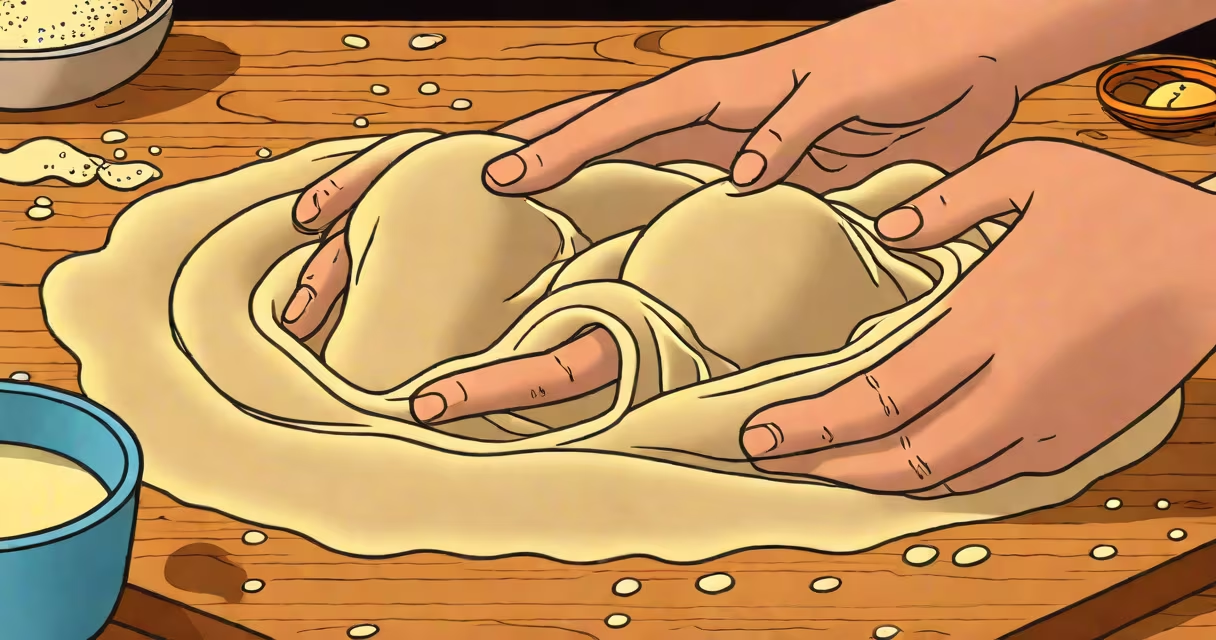
Flour and water is a basic dough mixture made from only those two ingredients, forming the base for many traditional breads, including sourdough, ciabatta, and flatbreads. This combination provides structure through gluten development and leavening via fermentation.
When mixed, flour's proteins-primarily gliadin and glutenin-bind with water to form gluten. Kneading strengthens this network, trapping gases produced during fermentation. The resulting dough rises, then bakes into bread with texture ranging from chewy to crisp.
Most recipes use a flour-to-water ratio between 50% and 100% hydration. A 100% hydration dough contains equal parts by weight of flour and water-e.g., 500 grams flour and 500 grams water. Higher hydration produces more open crumb structures but requires skilled handling.
Gluten forms when flour and water are combined and agitated. As the dough rests, enzymes in the flour break down starches into sugars. Yeast or wild microbes consume these sugars, producing carbon dioxide and alcohol. Gases expand the dough, creating air pockets.
During baking, heat sets the protein structure permanently. Water evaporates, leaving behind a porous interior. The crust forms through the Maillard reaction-browning caused by sugar and amino acid interaction under high heat.
A 100% hydration dough, such as a classic Italian pane di casa, takes 24 hours to rise. After mixing, it rests for 30 minutes, then undergoes stretch-and-fold sessions every 30 minutes for four cycles. Final proofing occurs overnight in the refrigerator before baking at 475°F (245°C).
Different flours alter the outcome. All-purpose flour yields a moderate chew. Bread flour, with higher protein (12-14%), produces stronger gluten and taller loaves. Whole wheat flour absorbs more water and results in denser bread due to bran interrupting gluten formation.
| Flour Type | Protein Content | Hydration Range | Resulting Texture |
|---|---|---|---|
| All-purpose | 10-11% | 60-75% | Even crumb, soft bite |
| Bread flour | 12-14% | 70-100% | Open holes, chewy |
| Whole wheat | 13-15% | 50-65% | Dense, nutty |
Some cultures use alternative flours. In Ethiopia, injera uses teff flour and fermented batter. In India, roti relies on whole wheat flour and a high hydration level (around 80%). These variations demonstrate how flour choice shapes both technique and final product.
Flour and water doughs appear in nearly every global cuisine. In Italy, focaccia uses 75% hydration. In Japan, shokupan (sweet milk bread) adds sugar and butter but begins with a 65% hydration base. Even pizza dough often starts with a 60% hydration mix.
Artisan bakers favor flour and water because it eliminates variables. No eggs, fats, or sweeteners mean the flavor comes purely from fermentation and grain. This focus allows bakers to refine technique and understand how small changes affect texture and taste.
Commercial bakeries sometimes add enzymes or important wheat gluten to stabilize high-hydration doughs. But traditional methods rely solely on time, temperature, and hand skills. For example, a 2019 study by the American Society of Baking found that artisan sourdoughs made with only flour and water had higher microbial diversity than those with additives.
Many assume flour and water doughs require long fermentation times. While extended bulk fermentation improves flavor, a 4-hour rest at room temperature can yield acceptable results. The key is consistent temperature-ideally 75-78°F (24-26°C)-not duration.
Another error is equating hydration percentage with difficulty. A 100% hydration dough is sticky but manageable with proper tools. Using a bench scraper and wet hands prevents sticking. Over-kneading leads to toughness, not under-kneading.
Some believe all flour and water breads must be sourdough. That's false. Commercial yeast can leaven the dough in under two hours. The term "flour and water" refers only to ingredients, not fermentation method.
Using 500g bread flour and 500g water (100% hydration), mix until shaggy. Rest 30 minutes. Perform four sets of stretch-and-folds every 30 minutes. Bulk ferment 12 hours at 77°F (25°C). Shape into a ball, rest 1 hour. Bake at 475°F (245°C) with steam for 30 minutes, then 20 minutes without steam.
The final loaf has a crisp crust, large irregular holes, and a tangy flavor. Internal temperature reaches 205°F (96°C) when done. Slicing reveals a moist, airy crumb with visible fermentation bubbles.
My first attempt at this recipe failed-the dough collapsed during shaping. I later learned that over-proofing causes weakness. Now I check dough elasticity by pressing a finger; if it slowly springs back, it's ready to shape.
Flour and water differs from batters. Batters are liquid-heavy and pourable-like pancake mix. Doughs are thick enough to hold shape. Flour and water doughs fall into the latter category.
It also differs from paste. Paste is typically made with starch and water, such as cornstarch slurry. Flour and water is not a paste-it forms a cohesive, elastic mass.
Finally, flour and water is not synonymous with "simple bread." While it uses minimal ingredients, the process demands precision. A 1% variation in water weight alters hydration by 10% in a 500g batch. Measuring by weight-not volume-is essential.
Understanding flour and water as a foundational pairing enables mastery of bread-making. It's not just a recipe-it's a system of balance between ingredient, time, and skill.