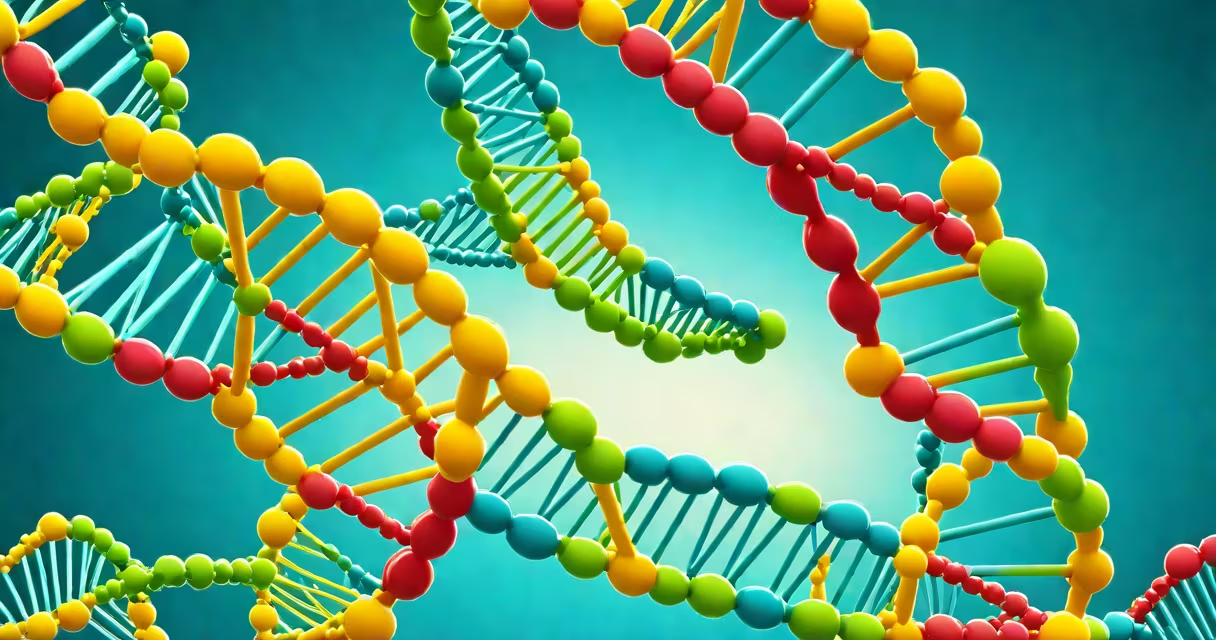
DNA stands for deoxyribonucleic acid in biology - the molecule that encodes the genetic instructions used in the development and functioning of all known living organisms.
Deoxyribonucleic acid is a long-chain polymer composed of nucleotide units. Each nucleotide contains a phosphate group, a five-carbon sugar called deoxyribose, and one of four nitrogenous bases: adenine (A), thymine (T), cytosine (C), or guanine (G). These bases pair specifically - A with T, and C with G - forming the rungs of the famous double helix structure discovered by James Watson and Francis Crick in 1953.
The sequence of these bases along the DNA strand determines the genetic code. This code specifies how amino acids are arranged to form proteins, which carry out most cellular functions. DNA's ability to replicate itself helps each new cell receives an identical copy during cell division.
DNA operates through a process called gene expression. Genes are segments of DNA that contain instructions for making specific proteins. During transcription, a segment of DNA is copied into messenger RNA (mRNA), which then travels to ribosomes in the cytoplasm. There, translation converts the mRNA sequence into a chain of amino acids, forming a protein.
This flow of information - DNA to RNA to protein - is known as the central dogma of molecular biology. It applies across all domains of life, from bacteria to humans. Mutations in DNA sequences can alter protein structure and function, leading to diseases such as sickle cell anemia or cystic fibrosis.
A single human cell contains approximately 6 billion base pairs distributed across 23 chromosome pairs. The entire set of DNA in an organism is called its genome. The Human Genome Project, completed in 2003, mapped the full sequence of human DNA, providing foundational data for medical genetics and personalized medicine.
While most DNA exists as a double helix, variations occur under different conditions. The standard form is B-DNA, which is right-handed and stable under normal physiological conditions. Other forms include A-DNA (shorter and wider, formed under low humidity), Z-DNA (left-handed, found in regions rich in GC sequences), and quadruplex structures (G-quadruplexes) that form in telomeres and oncogene promoters.
| Type | Shape | Conditions | Biological Relevance |
|---|---|---|---|
| B-DNA | Right-handed helix | Normal cellular conditions | Primary form in chromosomes |
| A-DNA | Shorter, wider helix | Low hydration | Observed in crystallized samples |
| Z-DNA | Left-handed helix | GC-rich sequences, high salt | Regulates gene expression |
| G-quadruplex | Four-stranded structure | High guanine concentration | Involved in telomere maintenance and cancer regulation |
Scientists have identified over 100 distinct DNA conformations using techniques like X-ray crystallography and cryo-electron microscopy. The stability of B-DNA is due to optimal hydrogen bonding between complementary bases and hydrophobic stacking interactions between adjacent bases.
Many assume DNA is synonymous with genes. While genes are functional units within DNA, they represent only about 1.5% of the human genome. The remaining 98.5% includes regulatory sequences, repetitive elements, and non-coding regions once dismissed as "junk DNA." Recent research shows many of these regions play roles in controlling gene activity and maintaining chromosomal integrity.
Another misconception is that DNA differs between species. In reality, humans share about 98.8% of their DNA sequence with chimpanzees, and even yeast shares around 30% of its genes with humans. Sequence similarity reflects evolutionary relationships, not functional equivalence.
DNA does not directly produce proteins. It serves as a template. The actual synthesis occurs via RNA intermediates and ribosomes. This distinction is critical in understanding how genetic disorders arise - a mutation in DNA may not affect protein function if it occurs in a non-coding region or results in a silent substitution.
Forensic science relies heavily on DNA analysis. In criminal investigations, short tandem repeats (STRs) - highly variable regions of DNA - are amplified using PCR and compared across samples. The FBI's Combined DNA Index System (CODIS) uses 13 core STR loci to generate unique profiles. A match between crime scene DNA and a suspect's sample has a statistical probability of less than one in a billion for a random individual.
In agriculture, genetically modified crops use recombinant DNA technology. For example, Bt corn contains a gene from Bacillus thuringiensis inserted into its genome. This gene produces a toxin lethal to certain insect pests, reducing the need for chemical pesticides. Field trials show a 20-30% increase in yield under pest pressure.
Personal genomics services like 23andMe analyze over 600,000 SNPs (single nucleotide polymorphisms) across the genome. These variants correlate with traits such as lactose tolerance, risk for Alzheimer's disease, and response to medications. However, clinical interpretation requires caution - many SNP associations are probabilistic, not deterministic.
During my time working in a university lab, I observed DNA extraction from banana cells using a simple household protocol: mash the fruit, add detergent and salt, filter through coffee paper, then precipitate the DNA with cold ethanol. The resulting white, stringy material was visible to the naked eye - a tangible demonstration of how genetic material exists in everyday substances.
DNA is often confused with RNA. While both are nucleic acids, DNA uses deoxyribose sugar and thymine, while RNA uses ribose sugar and uracil (U) instead of thymine. DNA is typically double-stranded and stable, whereas RNA is usually single-stranded and transient. Messenger RNA (mRNA), transfer RNA (tRNA), and ribosomal RNA (rRNA) are essential in protein synthesis but do not store long-term genetic information.
DNA should not be conflated with chromosomes. Chromosomes are tightly packed bundles of DNA and associated proteins (histones). In humans, 46 chromosomes make up the diploid set. During mitosis, DNA condenses into visible chromosomes under a microscope.
DNA stands for deoxyribonucleic acid in biology - the fundamental molecule of heredity and cellular function. Its precise sequence governs everything from eye color to susceptibility to complex diseases. Understanding DNA is essential to modern medicine, biotechnology, and evolutionary biology.