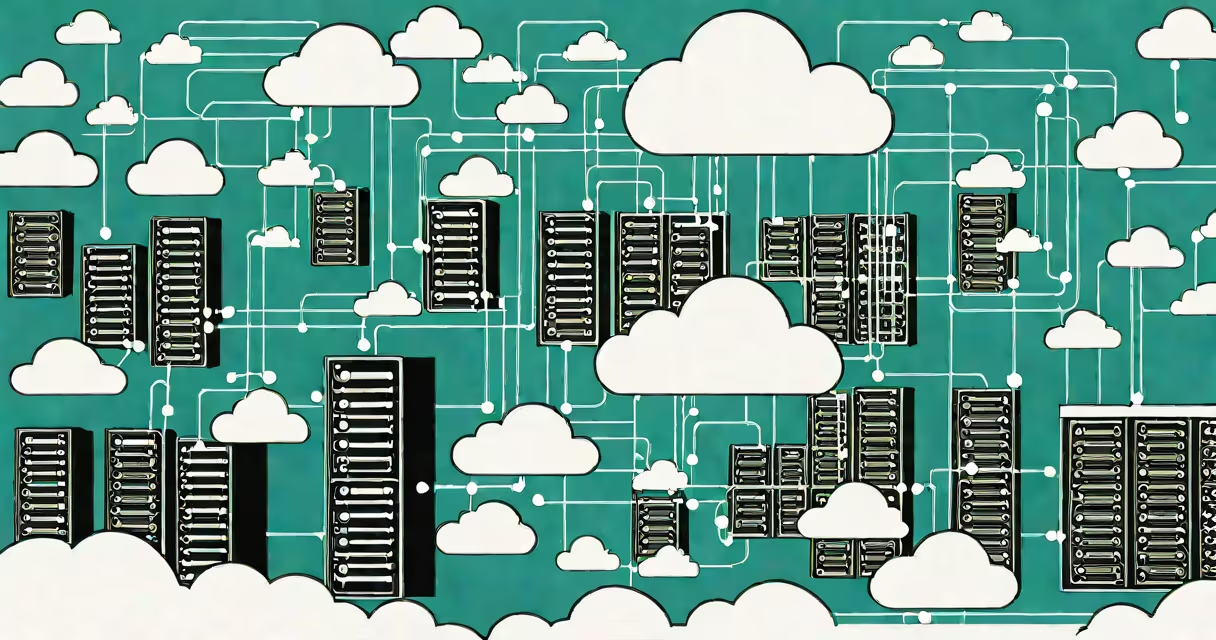
Cloud based architecture is a design model that uses remote servers hosted on the internet to store, manage, and process data instead of relying on local servers or personal computers. It enables applications to scale dynamically, recover from failures automatically, and deliver services globally with low latency.
This architecture relies on virtualized computing resources distributed across multiple geographic locations. Instead of purchasing physical hardware, organizations provision compute, storage, and networking capacity through cloud providers like AWS, Google Cloud, and Microsoft Azure. These services operate under a pay-per-use model, reducing upfront capital costs and increasing operational flexibility.
The foundation of cloud based architecture lies in abstraction. Physical machines are hidden behind APIs and management consoles. Developers interact with virtual machines, containers, databases, and networks through software-defined interfaces. This abstraction allows teams to deploy applications faster and respond to demand changes in seconds rather than days.
At its core, cloud based architecture operates through a layered stack of services. The lowest layer is infrastructure-virtual machines, storage volumes, and network switches managed by the provider. Above that sits platform services such as managed databases, message queues, and serverless functions. The top layer contains application logic, user interfaces, and business workflows deployed on top of these components.
When a user requests access to a web app, the request travels through load balancers that distribute traffic across multiple instances running in different availability zones. If one zone fails, traffic reroutes automatically. This redundancy ensures high availability and fault tolerance. Data is replicated across regions to prevent loss during outages.
For example, Netflix uses a cloud based architecture on AWS to stream content to over 260 million users. During peak hours, the system scales from thousands to tens of thousands of virtual machines within minutes. When a user opens the app, the system retrieves their viewing history from a distributed database, serves video chunks via edge caches, and updates recommendations in real time-all without requiring the user's device to handle heavy processing.
Cloud based architecture typically includes five core elements: compute, storage, networking, security, and orchestration. Compute resources run applications using virtual machines or containerized environments. Storage options range from object storage (like Amazon S3) to block storage (EBS) and file systems (EFS). Networking connects components securely across public and private subnets.
Orchestration tools like Kubernetes or AWS ECS coordinate the deployment, scaling, and lifecycle of containerized applications. Security is enforced through identity and access management (IAM), encryption at rest and in transit, and continuous monitoring via tools like CloudTrail or Azure Monitor.
| Type | Use Case | Example Provider | Latency & Cost Trade-off |
|---|---|---|---|
| Public Cloud | Web applications, AI training, global user bases | AWS EC2, Google Cloud Run | Lowest cost per unit, higher latency due to distance |
| Private Cloud | Regulated industries, strict compliance needs | VMware on-premises, Azure Stack | Higher cost, lower latency, full control |
| Hybrid Cloud | Legacy systems with cloud migration plans | Google Anthos, AWS Outposts | Mixed cost, balanced performance and compliance |
Many organizations adopt hybrid models to meet regulatory requirements while still benefiting from cloud elasticity. For instance, a bank may keep customer account data in a private cloud for audit compliance but use public cloud resources for transaction processing during peak hours.
One widespread misunderstanding is that cloud based architecture eliminates the need for IT staff. In reality, managing cloud environments requires specialized skills in DevOps, security, and infrastructure as code (IaC). A 2023 report from Gartner found that 70% of cloud failures stem from misconfigurations, not provider outages.
Another error is assuming all cloud services are inherently secure. Default settings often expose data publicly. In 2021, a misconfigured S3 bucket led to the exposure of 100 million records from a U.S. healthcare provider. Proper IAM policies and automated scanning tools are essential to prevent such breaches.
Some assume cloud based architecture is only for startups. Large enterprises like General Electric and Procter & Gamble have migrated entire operations to the cloud. GE uses AWS to analyze sensor data from jet engines in real time, improving maintenance scheduling and fuel efficiency.
I once designed a cloud based architecture for a regional e-commerce platform handling 50,000 daily transactions. We used AWS Lambda for order processing, DynamoDB for inventory tracking, and CloudFront for serving static assets. The system scaled from 10 to 500 concurrent processes during holiday sales without manual intervention.
Key practices include defining clear boundaries between microservices, using API gateways to route traffic, and implementing circuit breakers to isolate failing components. We also adopted Infrastructure as Code (IaC) using Terraform to version-control our cloud setup. This reduced configuration drift and enabled consistent deployments across staging and production.
Cloud based architecture is not a single product-it's a set of principles applied across systems. Its strength lies in resilience, scalability, and automation. By choosing the right combination of services and enforcing disciplined engineering practices, teams build systems that adapt to changing demands while maintaining performance and security.