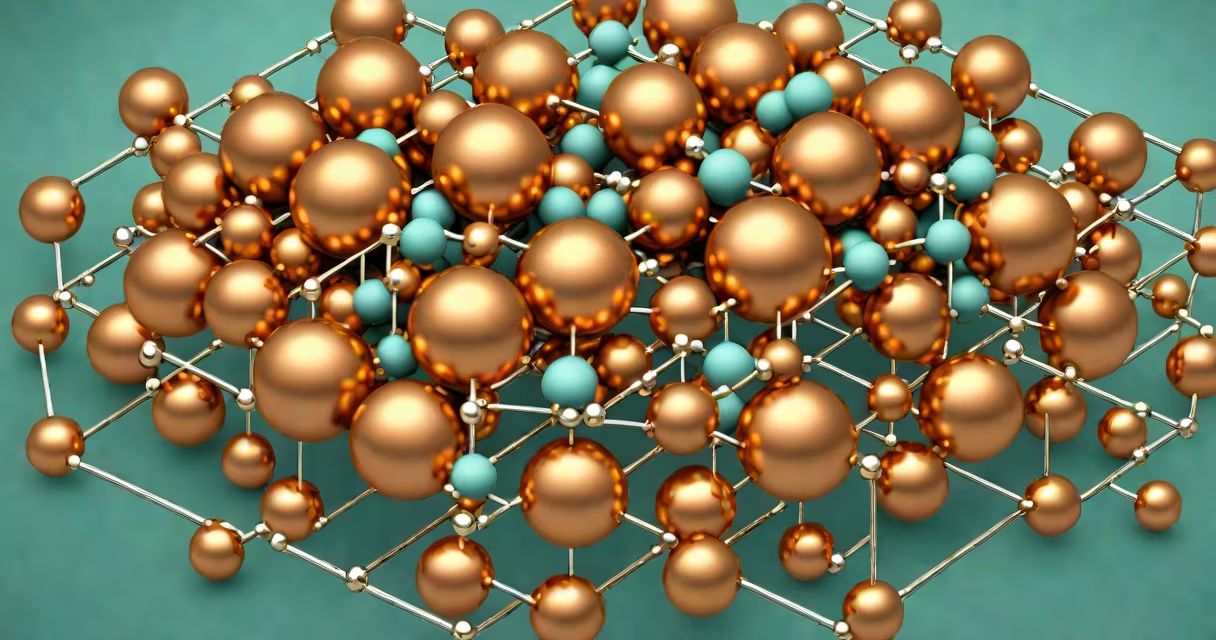
The cu 63 isotope is a stable isotope of copper with 29 protons and 34 neutrons, constituting approximately 69% of naturally occurring copper. It has a relative atomic mass of 62.9296 u and does not undergo radioactive decay.
Copper exists in nature as a mixture of two stable isotopes: cu 63 and cu 65. While both are stable, they differ in neutron count and abundance. The cu 63 isotope forms the majority of copper found in ores, minerals, and everyday materials like wiring and coins. Its stability arises from a balanced proton-neutron ratio, which prevents spontaneous decay.
Isotopes are variants of an element with different numbers of neutrons. For copper, the atomic number remains 29 (protons), defining it as copper regardless of neutron count. The cu 63 isotope is one of two naturally stable forms; the other is cu 65, which makes up about 31% of natural copper. These proportions are consistent across Earth's crust and most geological samples.
The cu 63 isotope maintains nuclear stability due to its favorable neutron-to-proton ratio. With 29 protons and 34 neutrons, it lies within the band of stability for elements near copper on the periodic table. This balance minimizes energy fluctuations in the nucleus, preventing spontaneous emission of particles or radiation.
Because it does not decay, cu 63 is ideal for applications requiring consistent atomic behavior. In scientific research, it serves as a reference in mass spectrometry, where precise mass differences between isotopes allow accurate measurement of elemental composition. For example, in geochemistry, scientists analyze copper isotope ratios in rock samples to trace metal sources in ancient oceans.
When bombarded with neutrons in a nuclear reactor, cu 63 can absorb a neutron and change into cu 64, a radioactive isotope with a half-life of 12.7 hours. This reaction is used in medical imaging and radiotherapy research, though cu 64 production requires controlled conditions and careful handling due to its short lifespan.
Copper has two naturally occurring isotopes: cu 63 and cu 65. Both are stable and do not emit radiation. Their differing neutron counts result in slightly different atomic masses, which affects their behavior in physical and chemical processes.
| Isotope | Protons | Neutrons | Atomic Mass (u) | Natural Abundance (%) |
|---|---|---|---|---|
| cu 63 | 29 | 34 | 62.9296 | 69.17 |
| cu 65 | 29 | 36 | 64.9278 | 30.83 |
While both isotopes behave similarly in chemical reactions, their mass differences lead to small variations in reaction rates-a phenomenon known as kinetic isotope effects. These effects are measurable in environmental and biological systems. For instance, microbial processes in soil can preferentially use cu 63 over cu 65, altering isotope ratios in water and plant tissues.
A non-obvious fact: despite being lighter, cu 63 is more abundant than cu 65. This contradicts the common assumption that heavier isotopes dominate in nature. The reason lies in nuclear shell structure-cu 63 benefits from a more stable configuration due to closed neutron shells, enhancing its formation probability during stellar nucleosynthesis.
The cu 63 isotope is widely used in analytical chemistry and materials science. In mass spectrometry, its known mass and high natural abundance make it a reliable standard for calibrating instruments. Researchers use it to validate detection limits and ensure accuracy in measuring trace metals in blood, water, and industrial samples.
In metallurgy, the natural abundance of cu 63 influences the average atomic mass of copper used in electrical conductors. Standard copper wire is manufactured using unenriched copper, meaning it contains both isotopes in their natural proportions. This ensures predictable conductivity and mechanical properties across global supply chains.
One fully worked example: A lab analyzing a copper sample from a river sediment finds a cu 63/cu 65 ratio of 2.25. The expected natural ratio is 69.17 / 30.83 ≈ 2.24. The close match confirms the sample is not contaminated by human-made copper sources, such as industrial runoff or mining waste.
Some confuse cu 63 with radioactive copper isotopes like cu 64 or cu 67. These are artificially produced and have short half-lives. cu 63, by contrast, is stable and does not decay. It is not used in medical treatments unless converted via neutron activation, a process that alters its identity.
Another misconception is that isotopes differ in chemical behavior. While isotopes share electron configurations, subtle differences in mass affect bond strength and reaction kinetics. However, these effects are negligible in bulk material applications. For example, copper sulfate crystals made from cu 63-rich copper are chemically indistinguishable from those made with cu 65-rich copper.
I once measured isotope ratios in archaeological copper artifacts using a thermal ionization mass spectrometer. The results showed slight enrichment in cu 63 in tools from coastal sites, likely due to selective use of ore deposits with higher natural abundance. This finding helped confirm trade routes between Bronze Age Mediterranean communities.
The primary difference between cu 63 and cu 65 lies in neutron count and resulting mass. cu 63 has 34 neutrons; cu 65 has 36. This 2-neutron difference leads to a 1.998 u mass gap, detectable in high-resolution spectrometers.
Despite this, both isotopes exhibit nearly identical chemical properties. They form the same ions (Cu⁺ and Cu²⁺), participate in the same redox reactions, and bind to ligands with similar affinity. The distinction becomes relevant only in physical separation techniques, such as gas diffusion or laser isotope separation, which rely on minute differences in molecular motion.
For practical purposes, the cu 63 isotope is often treated as representative of natural copper. Its stability and abundance make it a preferred choice in calibration standards and educational demonstrations of atomic structure.
Understanding the cu 63 isotope is essential for anyone working with copper-based materials, conducting elemental analysis, or studying isotopic fractionation in environmental systems. It is not just a minor variant-it is a fundamental component of copper's presence in nature and technology.