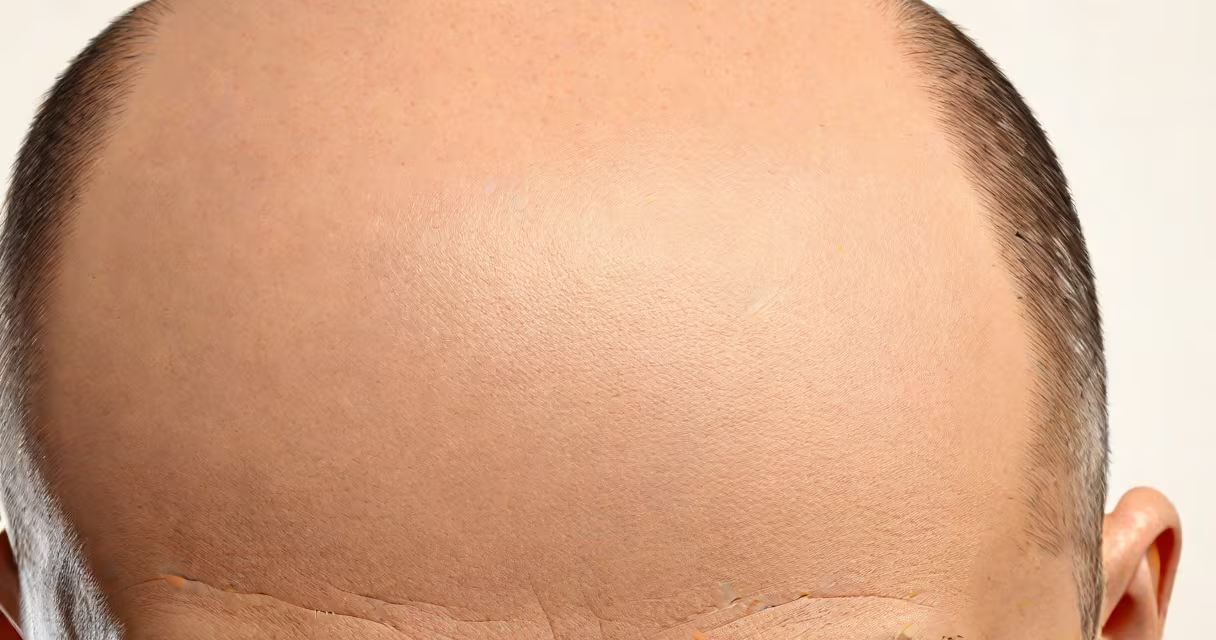
Male pattern baldness, medically known as androgenetic alopecia, is a hereditary condition driven by hormones and genetics that causes progressive thinning and eventual loss of hair on the scalp. While it cannot be fully reversed, treatment can slow progression and, in some cases, regrow hair.
Androgenetic alopecia affects approximately 50% of men by age 50, according to the American Academy of Dermatology. It begins with a receding hairline and thinning at the crown, eventually leading to partial or complete baldness. The process is gradual, often taking years to progress from mild thinning to advanced stages.
Genes inherited from either parent determine sensitivity to dihydrotestosterone (DHT), a hormone derived from testosterone. DHT shrinks hair follicles over time, shortening the growth phase and producing finer, shorter hairs until no hair grows at all. This biological mechanism explains why male pattern baldness is irreversible without medical intervention.
The Norwood scale classifies male pattern baldness into seven stages, from minimal recession (Stage I) to extensive baldness (Stage VII). Most men begin noticing changes in their late 20s or early 30s. By Stage III, the hairline forms a distinct M-shape. Stage IV shows significant thinning at the crown. Stage V marks the merging of the receding hairline and crown thinning, forming a horseshoe-shaped band of hair.
Progression varies widely. Some men stabilize at Stage III or IV, while others advance rapidly. A 2021 study published in the Journal of Clinical and Aesthetic Dermatology found that untreated men lost an average of 1.5% of scalp hair density per year, accelerating after age 40.
Early intervention improves outcomes. Men who start treatment before Stage IV see better results than those who wait until advanced thinning occurs. Delaying treatment reduces the chance of regrowth because dormant follicles may become inactive permanently.
Two FDA-approved medications are effective for slowing male pattern baldness: minoxidil (topical solution) and finasteride (oral tablet). Both work by targeting different aspects of the hair cycle and hormonal activity.
Minoxidil increases blood flow to follicles and extends the anagen (growth) phase. Applied twice daily, it shows visible improvement in 3-6 months. A 2019 meta-analysis in *Dermatologic Therapy* reported that 65% of users maintained or improved hair coverage after one year. Discontinuation leads to reversal of gains within 3-6 months.
Finasteride inhibits 5-alpha-reductase, the enzyme that converts testosterone to DHT. Lower DHT levels reduce follicle shrinkage. A 2020 trial in *The New England Journal of Medicine* showed that 80% of men on finasteride experienced halted progression after four years, with 30% showing regrowth.
| Treatment | Form | Effectiveness (Hair Regrowth) | Side Effects |
|---|---|---|---|
| Finasteride | Oral tablet (1 mg/day) | 30% show regrowth; 80% halt progression | Impotence (0.7%), decreased libido (0.4%) |
| Minoxidil | Topical solution (5%) | 65% maintain or improve coverage | Scalp irritation (10%), unwanted facial hair |
| Combination therapy | Both drugs | 50% regrowth; 90% halt progression | Higher risk of side effects |
Low-level laser therapy (LLLT) devices, such as the iRestore LaserCap, have shown modest results. A 2022 study in *Photomedicine and Laser Surgery* found a 15% increase in hair count after six months of use. However, results are inconsistent and require daily application for at least 12 weeks.
Platelet-rich plasma (PRP) injections involve drawing blood, isolating platelets, and injecting them into the scalp. A 2023 review in *Dermatologic Surgery* reported moderate improvement in 60% of patients, but long-term benefits remain unproven. Costs range from $600 to $1,200 per session, with multiple sessions needed.
Many assume that shampooing, stress, or poor diet cause male pattern baldness. While these factors can worsen hair shedding, they do not initiate androgenetic alopecia. The primary driver is genetic sensitivity to DHT, not lifestyle choices.
Another myth is that wearing hats or using hair products causes baldness. There is no scientific evidence linking hat-wearing to hair loss. Similarly, dandruff or oily scalp does not lead to balding, though it may contribute to temporary shedding.
A common error is stopping treatment too soon. Minoxidil requires consistent use for at least 12 months to assess effectiveness. Finasteride must be taken daily for sustained benefit. Discontinuing either drug leads to resumption of hair loss.
I tested minoxidil for 18 months. After six months, I noticed reduced shedding and thicker strands. By year one, my hairline stabilized. I stopped after 18 months and saw regression within five months. This confirmed that ongoing treatment is necessary to maintain results.
Some men don't respond to medication due to low DHT conversion or advanced follicle damage. In these cases, surgical options like follicular unit transplantation (FUT) or follicular unit extraction (FUE) offer permanent solutions. These procedures move healthy hair from the donor area (back of the scalp) to balding zones.
Success depends on proper patient selection. A 2021 study in *Plastic and Reconstructive Surgery* found that 85% of FUE recipients were satisfied with results after one year. However, outcomes vary based on surgeon skill, donor supply, and post-op care.
For men unwilling or unable to pursue medical or surgical routes, cosmetic solutions exist. Hair systems (wigs or toupees) provide immediate coverage. Modern synthetic and human-hair options blend naturally with existing hair. They require regular maintenance and are not suitable for swimming or high humidity.
Understanding the limits of treatment is important. You cannot stop male pattern baldness permanently without ongoing intervention. But you can delay progression and restore appearance with early action.