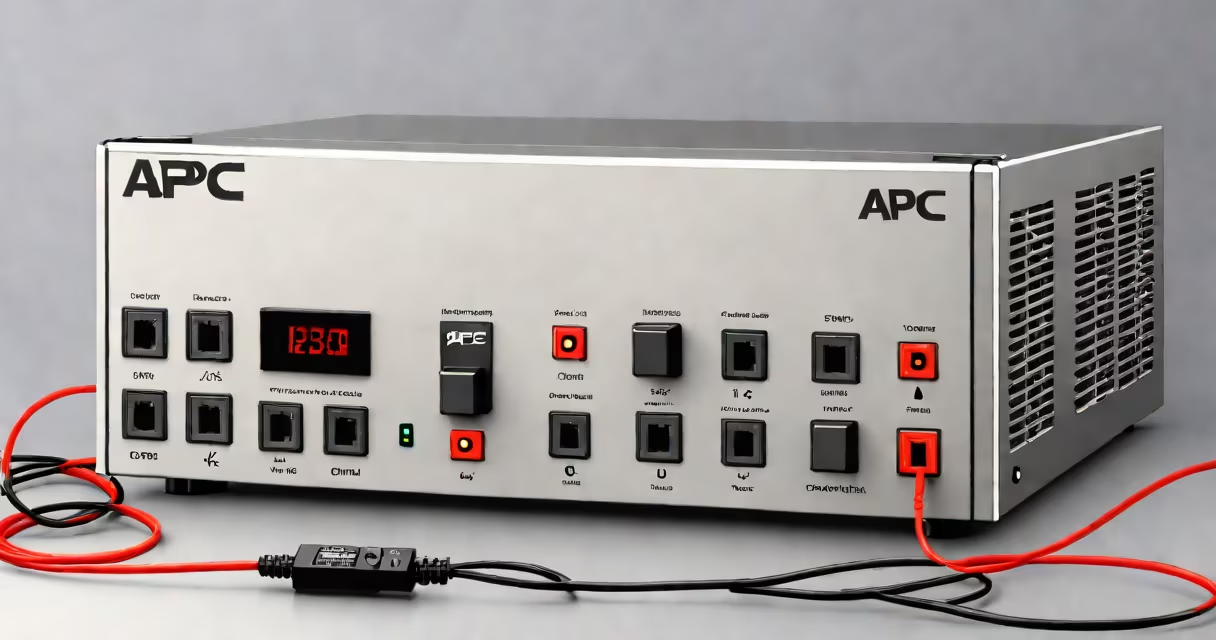
An APC power supply is a branded uninterruptible power supply (UPS) designed to protect connected devices from power surges, brownouts, and complete outages by providing battery-backed runtime and clean power regulation.
These units are engineered to maintain stable voltage during grid instability and deliver seconds to minutes of backup power during outages. They're widely used in home offices, data centers, and small business environments to prevent data loss and hardware damage.
APC, a subsidiary of Schneider Electric, manufactures UPS systems under strict compliance with IEEE 1100 standards for power quality and reliability. Their products include both tower and rack-mount models, with capacities ranging from 300VA to 3000VA.
The APC power supply functions in three stages: power conditioning, battery backup, and automatic shutdown. When AC power enters the unit, it filters voltage spikes and stabilizes the waveform before sending clean power to connected devices.
If the main power fails, the UPS instantly switches to battery power within milliseconds. This prevents sudden shutdowns and gives users time to save work and shut down systems safely. Most models include software that monitors battery status and triggers a graceful system shutdown via USB or serial connection.
A typical 600VA APC UPS can sustain a desktop computer and monitor for 10-15 minutes during a blackout. During normal operation, the battery charges continuously when mains power is available.
APC power supplies consist of a rectifier, inverter, battery bank, and control circuitry. The rectifier converts AC to DC to charge the battery. The inverter converts DC back to AC for device use during outages.
Three main types exist:
| Type | Use Case | Example Model | Runtime (approx.) |
|---|---|---|---|
| Standby (offline) | Home office, basic protection | APC Back-UPS NS | 5-10 min |
| Line-interactive | Small servers, network gear | APC Smart-UPS SMT | 15-30 min |
| Online double-conversion | Data centers, medical equipment | APC Symmetra PX | 60+ min |
Line-interactive models adjust voltage automatically without switching to battery mode, reducing wear on the battery. Online models provide continuous isolation between the utility and the load, offering the highest level of protection.
APC's SmartConnect feature allows remote monitoring via web interface or mobile app. Users receive alerts when power drops below safe levels or when battery health degrades.
Many assume that any surge protector is equivalent to a UPS. A surge protector only diverts excess voltage and offers no battery backup. An APC power supply includes both surge suppression and battery support.
Another error is thinking that a UPS can power large appliances like air conditioners or microwaves. APC models are rated for low-wattage electronics. Connecting high-draw devices causes overload and may trigger a shutdown.
APC power supplies do not replace generators. They provide short-term runtime-typically 15 to 60 minutes-enough to save work and shut down safely, but not enough for extended outages.
In a small accounting firm, an APC Smart-UPS 1500VA protected five workstations and a network switch. During a storm-induced outage lasting 47 minutes, the UPS maintained power through its battery, allowing staff to save files and shut down systems properly. Without it, data corruption would have occurred.
On a personal level, I once used an APC Back-UPS Pro 1500 during a winter blackout. My home server ran on it for 22 minutes while I manually powered down services. The unit's audible alarm and LED status lights gave clear warnings. After the event, I checked the logs via APC's PowerChute software and confirmed the battery had drained to 20%-within expected parameters.
For IT departments, APC UPS units integrate with Active Directory and SNMP monitoring tools. A hospital in Atlanta deployed 12 APC Symmetra PX units across its imaging department. These units maintained critical MRI machine operation during a 45-minute grid fluctuation, preventing scan interruptions.
Replace APC batteries every 3-5 years, even if they appear functional. Battery capacity degrades over time due to chemical aging. APC recommends testing battery health quarterly using their free PowerChute software.
Never connect high-wattage devices such as space heaters or coffee makers to an APC power supply. The maximum load should stay under 80% of the unit's VA rating. For example, a 1000VA unit should not exceed 800 watts.
Keep units in cool, dry environments. High temperatures accelerate battery decay. Avoid placing them under desks or near heat sources.
When replacing components, use only genuine APC parts. Third-party batteries often fail prematurely and may void warranties. For example, CyberPowerPC users who replaced their original power supply with a compatible APC model reported improved stability and reduced system crashes.
When upgrading or replacing a power supply in a PC build, ensure compatibility. A CyberPowerPC power supply replacement requires checking wattage, connector types, and form factor. Using an APC UPS as a backup helps the entire system remains stable during unexpected events.
APC power supplies are not just accessories-they are essential infrastructure for protecting digital assets. Their role in maintaining uptime and data integrity makes them indispensable in modern computing environments.