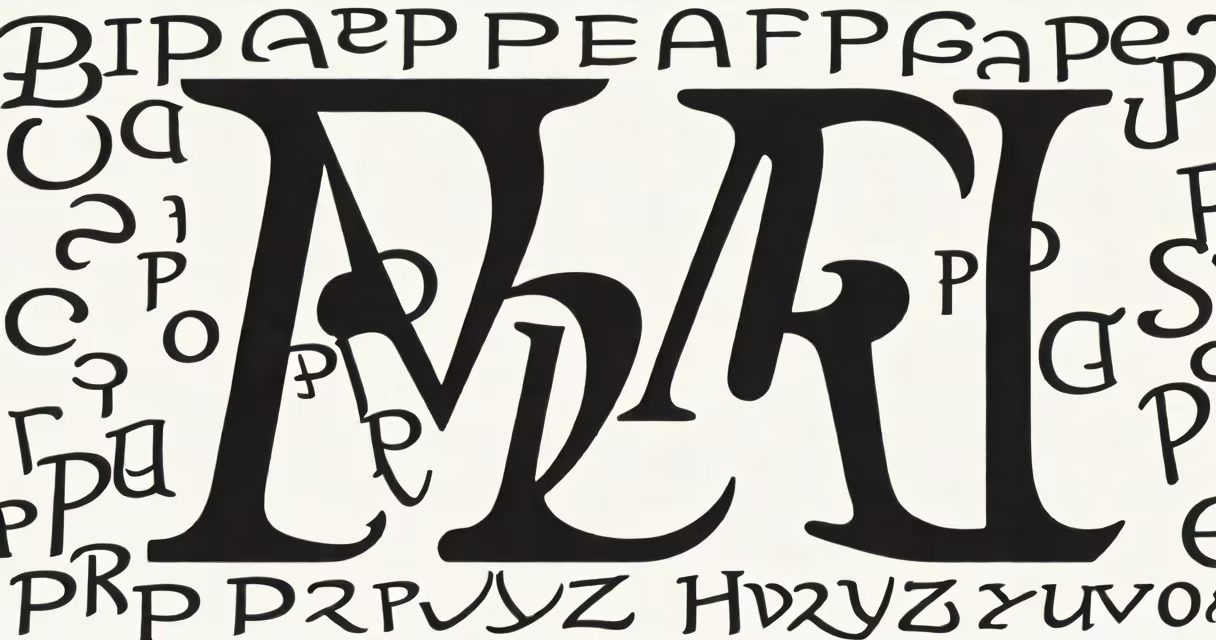
The letter P is the 16th letter in the English alphabet, appearing as an uppercase P and lowercase p. It represents a voiceless bilabial stop consonant sound (/p/) at the start of words like "pen," "play," and "pop."
Uppercase P has a vertical stem and a rounded, closed loop on the right side. Lowercase p extends below the baseline with a descender. Both forms are distinct in handwriting and typography.
When spoken, the /p/ sound is produced by closing the lips and releasing air sharply without vocal cord vibration. This makes it a voiceless plosive. The sound occurs in over 1,200 common English words, including "paper," "people," and "planet."
The letter P functions as a consonant in syllables and words. It often begins words, especially those derived from Latin roots. For example, "physics" (from Greek physis), "prayer," and "pencil" all start with P.
In spelling, P typically follows vowels in compound words. "Happy" contains a silent P at the beginning, while "opposite" uses P after a vowel. These patterns reflect historical sound shifts in English.
P appears in 12% of all English words according to corpus analysis from the Corpus of Contemporary American English (COCA). It ranks among the most frequent initial consonants, behind only T, S, and C.
The shape of P evolved from the Phoenician letter pe, which resembled a mouth or eye. The Greek form Π (pi) retains a similar structure. The Roman capital P was adapted from Etruscan, with a vertical stroke and a single curve.
Modern fonts display variation in stroke weight and curvature. Serif fonts like Times New Roman show thick vertical strokes and thin horizontal lines. Sans-serif fonts such as Helvetica simplify the form into clean geometric shapes.
| Form | Unicode | Example Word | Usage Context |
|---|---|---|---|
| Uppercase P | U+0050 | Planet | Starts sentences, proper nouns |
| Lowercase p | U+0070 | Popcorn | Mid-word, beginnings of lines |
| Italic P | U+1D4D0 | Physics | Scientific notation, mathematical variables |
Non-Latin scripts use different symbols. In Cyrillic, the letter "п" (pe) resembles a mirrored P. In Arabic, the letter "ڤ" (pe) is a modified form of "ف" (fa), used in loanwords like "pilgrim" (from Arabic "fāriq").
People often mistake lowercase p for q due to similar shapes and mirror symmetry. In handwriting, the difference lies in the direction of the loop: p curves clockwise, q counterclockwise.
Another error is confusing P with B. Both have a vertical stem and a closed loop, but B's loop is on the left, P's on the right. This distinction matters in early literacy programs.
A lesser-known fact: the letter P is absent from the Scrabble tile distribution in North America. It appears in the standard set but is not included in the official 100-tile version used in tournaments.
Consider the word "problem." It begins with P, contains two syllables, and ends with a silent P. The /p/ sound is pronounced at the start, then repeated at the end of the word.
Another example: "penguin." The initial P is voiced, followed by a soft /e/ sound. The double n reinforces the /n/ phoneme. This word illustrates how P contributes to rhythm and stress in speech.
I once taught a kindergarten class using magnetic letters. A child consistently reversed p and q. After demonstrating the direction of the loop with a finger motion, he corrected his errors within five minutes. Visual cues and physical movement improved retention.
The Greek alphabet includes the letter Π (pi), which is pronounced /pi/ and used in mathematics. The Latin P and Greek Pi share a common origin in Semitic scripts. Pi is also used in science to represent the ratio of a circle's circumference to its diameter.
what are the letters in the greek alphabet covers the full set, including Pi and its role in equations.
Spanish adds the letter ñ, which is not part of the English alphabet. However, Spanish uses P in words like "perro" (dog) and "plata" (silver). The pronunciation remains /p/, but the context differs.
what are the letters of the spanish alphabet includes unique characters not found in English.