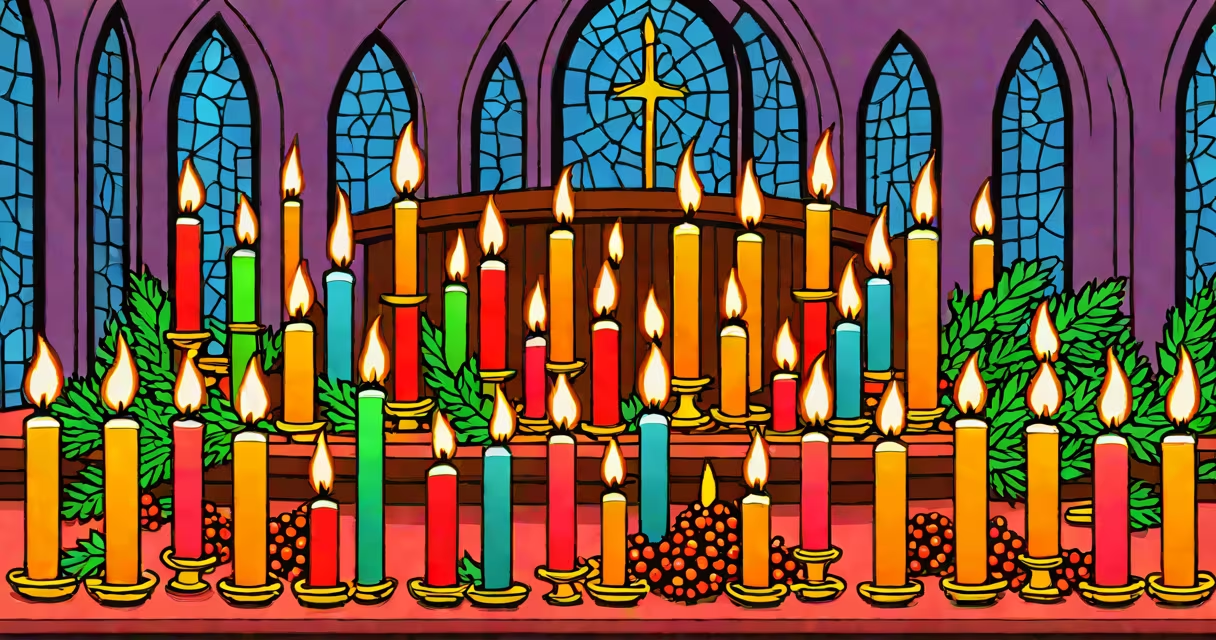
Advent Sunday is the first Sunday of the four-week Advent season, marking the beginning of the Christian liturgical year. It centers on spiritual preparation for the celebration of Jesus Christ's birth at Christmas and anticipates his promised return. Churches begin the cycle of scripture readings, hymns, and rituals focused on hope, peace, joy, and love.
The term "Advent" comes from the Latin *adventus*, meaning "arrival" or "coming." This period is not just a countdown to Christmas-it reflects both the historical birth of Christ and the eschatological expectation of his future return. The season begins on the fourth Sunday before Christmas Day, which falls between November 27 and December 3, depending on the year.
Advent Sunday sets the tone for the entire season. Liturgical colors shift to purple or blue (depending on denomination), symbolizing penitence and anticipation. Churches often light the first candle on the Advent wreath, a tradition rooted in 16th-century German Protestant practice and now widely adopted across Christian denominations.
Advent Sunday initiates a structured four-week process through scripture, music, and ritual. The liturgical calendar, established by the early Church and formalized in the 6th century, divides the year into seasons based on theological themes. Advent is the first of these, preceding Christmas, Epiphany, Lent, Easter, and Pentecost.
Each Sunday of Advent brings a new theme: hope (first), peace (second), joy (third), and love (fourth). These themes are drawn from prophetic texts, especially Isaiah's visions of a coming Messiah. For example, the first Sunday's Gospel reading often includes Matthew 24:37-44, where Jesus warns of his sudden return, reinforcing the idea of vigilance.
Churches use a lectionary-a scheduled list of Bible passages-to guide weekly readings. The Revised Common Lectionary (RCL), adopted by most mainline Protestant and Anglican churches, assigns specific texts for each Sunday. On Advent Sunday, the RCL selects passages like Isaiah 2:1-5 or Matthew 24:29-31, emphasizing divine presence and future redemption.
The core elements of Advent Sunday include the Advent wreath, candle lighting, special liturgies, and seasonal music. The wreath, typically made of evergreen branches, represents eternal life. Four candles-three purple, one pink (on the third Sunday)-are placed around it. The first candle, lit on Advent Sunday, symbolizes hope.
Some traditions use a white candle in the center, lit on Christmas Eve or Christmas Day, representing Christ's purity. Others, particularly in Eastern Orthodox Christianity, use a different format: a large cross-shaped wreath with five candles-one for each Sunday and one for Christmas Eve.
Regional variations exist. In Germany and Scandinavia, families may hang Advent calendars with daily doors revealing small images or treats. In the Philippines, communities hold *simbang gabi*-early morning Masses starting on December 16-though these occur after Advent Sunday, they reflect the same spirit of anticipation.
Table: Advent Sunday Themes and Symbolism
Theme | Candle Color | Scripture Focus | Symbolic Meaning
Hope | Purple | Isaiah 11:1-10 | Anticipation of the Messiah
Peace | Purple | Micah 5:2-4 | The Prince of Peace
Joy | Pink | Luke 1:26-38 | Mary's acceptance of God's plan
Love | Purple | John 1:1-14 | The Word made flesh
A lesser-known fact: the color blue is increasingly used in some congregations, especially in the United Methodist Church and certain Episcopal parishes. Blue signifies anticipation and hope, distinct from purple's association with mourning and royalty. This shift reflects a move toward inclusivity and fresh theological interpretation.
Advent Sunday is observed in nearly all Christian denominations, including Roman Catholic, Eastern Orthodox, Lutheran, Anglican, Presbyterian, and many Baptist and nondenominational churches. Its purpose is to counteract the commercialization of Christmas by refocusing attention on spiritual readiness.
For example, the Catholic Church mandates that Advent begins on the fourth Sunday before Christmas. The General Instruction of the Roman Missal (2000) states that the liturgy during Advent emphasizes "the expectation of the Lord's coming at the end of time." This dual focus-past, present, and future-is central to the season's theology.
Many churches host Advent services with special music, such as *O Come, O Come Emmanuel*, a 9th-century chant adapted into English in the 19th century. The hymn's seven verses correspond to the seven "O Antiphons," ancient prayers sung during the last seven days of Advent. Singing these antiphons connects worshippers to centuries of Christian worship.
One widespread misconception is that Advent is solely about preparing for Christmas Day. In reality, it encompasses both the first and second comings of Christ. The Church teaches that Christ came in humility at Bethlehem and will return in glory at the end of time. Ignoring the eschatological dimension reduces Advent to a seasonal decoration event.
Another error is assuming all Advent traditions originated in the West. The Eastern Orthodox Church observes Advent as part of the Nativity Fast, beginning on November 15. This 40-day fast-similar in structure to Lent-includes abstinence from meat and dairy, emphasizing fasting and prayer. The Western Church's four-week model evolved later, influenced by the Gregorian calendar reform of 1582.
I once attended an Advent service in a rural New England parish where the congregation sang *Silent Night* on the first Sunday. The pastor corrected the misunderstanding: "We don't sing 'Silent Night' until Christmas Eve. We save it for the moment of arrival." That moment of restraint-waiting-was the lesson. The hymn's quiet beauty gains power only when contrasted with anticipation.
At St. Paul's Episcopal Church in Portland, Oregon, Advent Sunday begins with a procession carrying a large green wreath into the nave. The priest lights the first purple candle while chanting, "Lord, come quickly. We wait in hope." The congregation responds, "Come, Lord Jesus."
After the sermon, children participate in a "Wreath Story" session, where they learn how each candle represents a stage in God's promise. The first candle, lit on the first Sunday, is called "The Candle of Hope." Children draw pictures of what hope looks like to them-some drew a family, others a tree growing from a seed.
Throughout the month, the church hosts weekly events: a community meal on the second Sunday, a craft night on the third, and a candlelight service on the fourth. By Christmas Eve, the central white candle is lit, signaling the fulfillment of the season's promise.
Advent Sunday meaning is not just a date on a calendar. It is a lived rhythm of waiting, reflection, and joyful expectation. Whether through liturgy, music, or personal devotion, it invites believers to enter a deeper awareness of God's presence in history and in their lives.