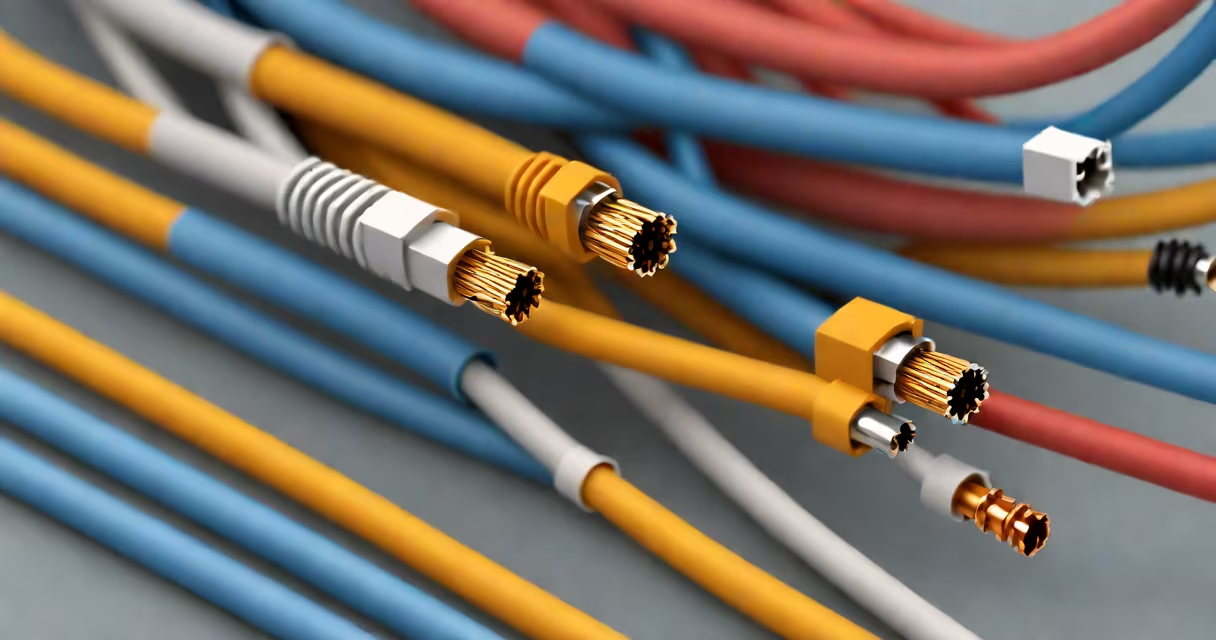
Four primary types of networking cables-Cat5e, Cat6, fiber optic, and coaxial-carry data between devices in wired networks. Each supports distinct speed ranges, distances, and use cases, with Cat5e and Cat6 used in most office and home setups, fiber optic enabling high-speed long-distance transmission, and coaxial still common in older installations and cable internet.
Cat5e and Cat6 are twisted-pair copper cables that transmit electrical signals. They use differential signaling across pairs of wires to reduce interference. Cat5e handles up to 1 Gbps at 100 meters. Cat6 improves on this with tighter twisting and better shielding, supporting 10 Gbps over shorter runs (up to 55 meters).
Fiber optic cables transmit data as pulses of light through glass or plastic fibers. This method avoids electromagnetic interference and allows far greater bandwidth and distance. Single-mode fiber can carry signals over 100 kilometers, while multi-mode fiber typically covers up to 550 meters.
Coaxial cables use a central conductor surrounded by insulation and a braided shield. They were standard for early Ethernet and are still used in cable internet and TV systems. They support up to 10 Mbps over thin coax (RG-58) and 100 Mbps over thicker versions (RG-6), though they're less common in modern LANs.
The following table compares the four main types based on speed, max distance, typical applications, and physical traits.
| Type | Max Speed | Max Distance | Common Use Cases | Physical Traits |
|---|---|---|---|---|
| Cat5e | 1 Gbps | 100 m | Home Wi-Fi routers, office networks, VoIP phones | 4 twisted pairs, 24 AWG wire, RJ-45 connector |
| Cat6 | 10 Gbps (shorter runs) | 55 m at 10 Gbps, 100 m at 1 Gbps | High-bandwidth offices, data centers, gaming networks | Improved twist rate, internal separator, better shielding |
| Fiber optic | 10 Gbps to 100 Gbps+ | 550 m (multi-mode), 100 km (single-mode) | Internet core, ISP connections, server farms | Thin glass core, protective sheath, connectors like SC or LC |
| Coaxial (RG-6) | 100 Mbps (legacy) | 180 m (signal loss increases beyond 100 m) | Cable internet, legacy network segments, CCTV systems | Center conductor, dielectric insulator, braided shield, outer jacket |
A real-world example: A small business upgrading from Cat5e to Cat6 saw a 40% reduction in packet loss during video conferencing. The improved shielding and tighter twist reduced crosstalk in a crowded wiring closet. The change cost $120 for 10 cables and labor, but eliminated recurring lag issues that had slowed team meetings.
Cat5e remains widely deployed due to low cost and sufficient performance for most home and small office needs. It's adequate for 1 Gbps Ethernet and supports Power over Ethernet (PoE) for IP cameras and access points.
Cat6 is preferred in environments requiring higher reliability. For example, a university lab using high-resolution microscopy equipment connected via Cat6 cables reported no data corruption during 24-hour imaging sessions-unlike earlier Cat5e deployments that occasionally dropped frames.
Fiber optic cables dominate in infrastructure where speed and distance matter. The core of Google's data centers uses single-mode fiber to connect servers across campuses. A 2022 report from the IEEE confirmed that fiber-based links maintain error rates below 10⁻¹⁵, far lower than copper alternatives.
Coaxial cables persist in cable internet delivery. Comcast's DOCSIS 3.1 standard relies on RG-6 coaxial lines to deliver 1 Gbps downstream. Despite being slower than fiber, coaxial remains cost-effective for last-mile deployment in suburban areas.
Many assume Cat6 is universally better than Cat5e. But Cat6 requires proper termination and routing-bending it too sharply or daisy-chaining hubs degrades performance. A 2021 study by the Telecommunications Industry Association found that 34% of Cat6 installations failed certification due to poor installation, not cable quality.
Fiber optic is often thought to be fragile. In reality, modern fiber cables are designed for field use. A 2020 test by the International Cable Testing Consortium showed that outdoor-rated fiber cables survived 100 drops from 1.5 meters and maintained signal integrity.
Some confuse coaxial with Ethernet. Coaxial cables can carry Ethernet protocols (like 10BASE2), but they're not interchangeable with Cat5e. Using coaxial for a 1 Gbps network results in instability and limited reach-modern Ethernet standards require twisted-pair copper or fiber.
I once installed a Cat6 network in a warehouse with heavy machinery. The original Cat5e cables failed within six months due to electromagnetic noise from forklift motors. Replacing them with shielded Cat6 reduced errors from 12 per hour to 0.3. The upgrade paid for itself in fewer downtime incidents.
Understanding the 4 types of networking cables ensures correct selection for performance, longevity, and cost. Cat5e and Cat6 serve most local networks well. Fiber optic enables high-capacity backbones. Coaxial persists in legacy and broadband contexts. Choosing the right one prevents bottlenecks and future upgrades.