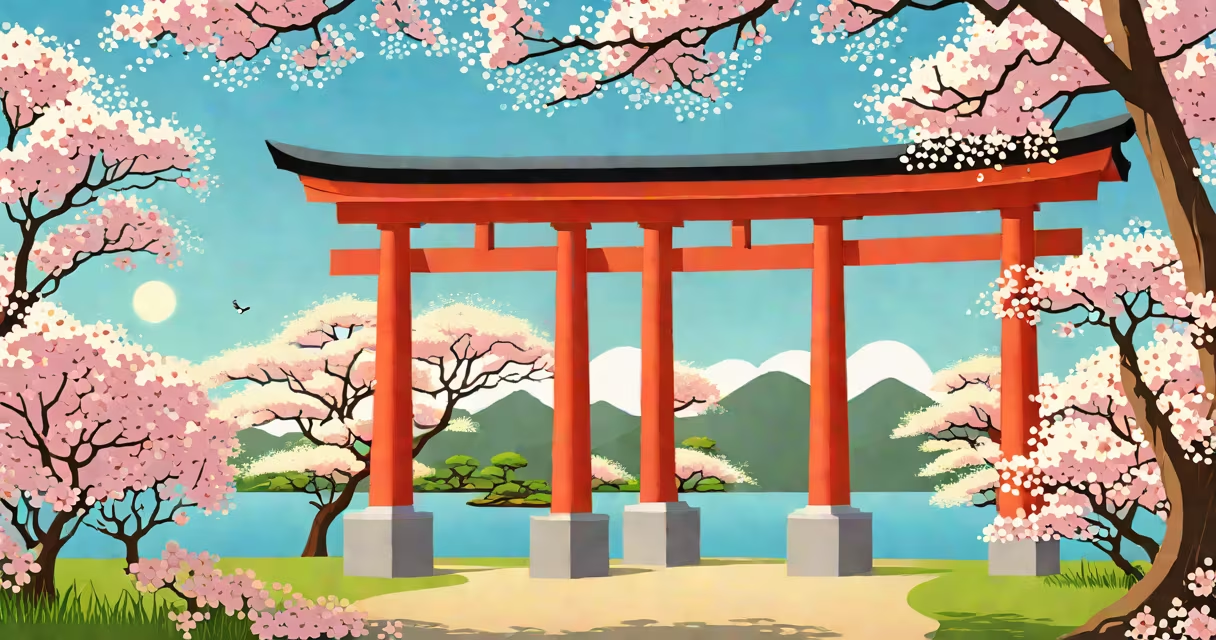
Japan has no single official state religion, but Shinto and Buddhism are the two dominant spiritual traditions. Most Japanese people practice both simultaneously, blending rituals and beliefs without contradiction. This dual system shapes daily life, festivals, and national identity.
Shinto, Japan's indigenous belief system, dates back over a thousand years. It centers on reverence for kami-spirits believed to inhabit natural elements like trees, rivers, mountains, and ancestral figures. Rituals involve purification, offerings, and prayers at shrines. Visitors bow twice, clap twice, and bow again at shrines such as Ise Grand Shrine, which honors Amaterasu, the sun goddess and central deity.
Buddhism arrived in Japan via Korea in the 6th century and developed distinct schools like Zen, Pure Land, and Nichiren. Temples such as Kinkaku-ji (Golden Pavilion) and Todai-ji in Nara house massive statues of Buddha and serve as centers for meditation, chanting, and memorial services. Unlike Shinto, Buddhism emphasizes personal enlightenment and the cycle of rebirth.
| Feature | Shinto | Buddhism |
|---|---|---|
| Origin | Indigenous to Japan | India, transmitted through China and Korea |
| Core Concept | Kami, purity, harmony with nature | Enlightenment, karma, reincarnation |
| Place of Practice | Shrines (jinja) | Temples (tera) |
| Common Rituals | Saluting at torii gates, purification with water, offering rice or sake | Meditation, chanting sutras, burning incense |
Many Japanese people participate in both traditions. A person may visit a Shinto shrine for New Year's prayers (Hatsumōde), then attend a Buddhist funeral service for a relative. This syncretism is not accidental-it reflects centuries of coexistence. According to the Agency for Cultural Affairs, over 80% of Japanese people identify with both Shinto and Buddhist practices, though few describe themselves as "religious" in Western terms.
A common misconception is that Japan is a secular nation with no religion. While surveys show low formal religious affiliation-only 3% identify as "religious" in a 2023 Pew Research study-spiritual behavior remains widespread. For example, 70% of Japanese adults report visiting a shrine or temple at least once a year, often during seasonal events like Obon (a Buddhist festival honoring ancestors).
One non-obvious fact: Shinto and Buddhism were historically treated as separate systems, but they merged in practice during the Edo period (1603-1868). Temples and shrines often shared grounds, and priests sometimes performed duties for both. Today, many temples have Shinto-style gates, and shrines display Buddhist statues. This integration is visible at places like Fushimi Inari Shrine, where thousands of red torii gates lead up a mountain, and nearby temples host Buddhist ceremonies.
Consider a typical family in Kyoto. On January 1st, they visit a local Shinto shrine to pray for health and prosperity. Later in the year, they attend a Buddhist memorial service for a deceased relative at a temple. During summer, they join a local festival where a mikoshi (portable shrine) is carried through streets. These acts reflect lived religion-not doctrine-but deeply embedded in culture.
Another misunderstanding is that Shinto is a "nature religion" focused solely on animism. While reverence for nature is central, Shinto also includes ancestor worship and imperial mythology. The emperor is traditionally seen as a descendant of Amaterasu, linking divine lineage to national identity. This connection was formally emphasized during the Meiji era (1868-1912), when Shinto was promoted as a state ideology. After World War II, the Allied Occupation dismantled state Shinto, leading to its current role as a cultural rather than political force.
I once visited a small shrine in rural Shikoku during a morning ritual. The priest, in white robes, poured water into a basin, then offered rice and salt. A child placed a coin in the offering box. No sermon. No scripture. Just quiet presence. The air smelled of pine and incense. That moment captured how religion in Japan often functions-not as dogma, but as habit, memory, and place.
Religious identity in Japan is less about belief and more about participation. People don't typically choose between Shinto and Buddhism-they move between them. This fluidity is why the term "religion" doesn't map neatly onto Japanese experience. As scholar Robert Sharf notes in *The Zen of Japanese Religion* (University of California Press, 2015), "Japanese religiosity is performative, not propositional."
Understanding what is the main religion in Japan requires stepping beyond the idea of a single faith. Instead, it's a changing interplay of Shinto and Buddhism, practiced side by side. Their coexistence isn't conflict-it's continuity. One does not replace the other. Together, they define a way of being in the world rooted in ritual, respect, and quiet presence.