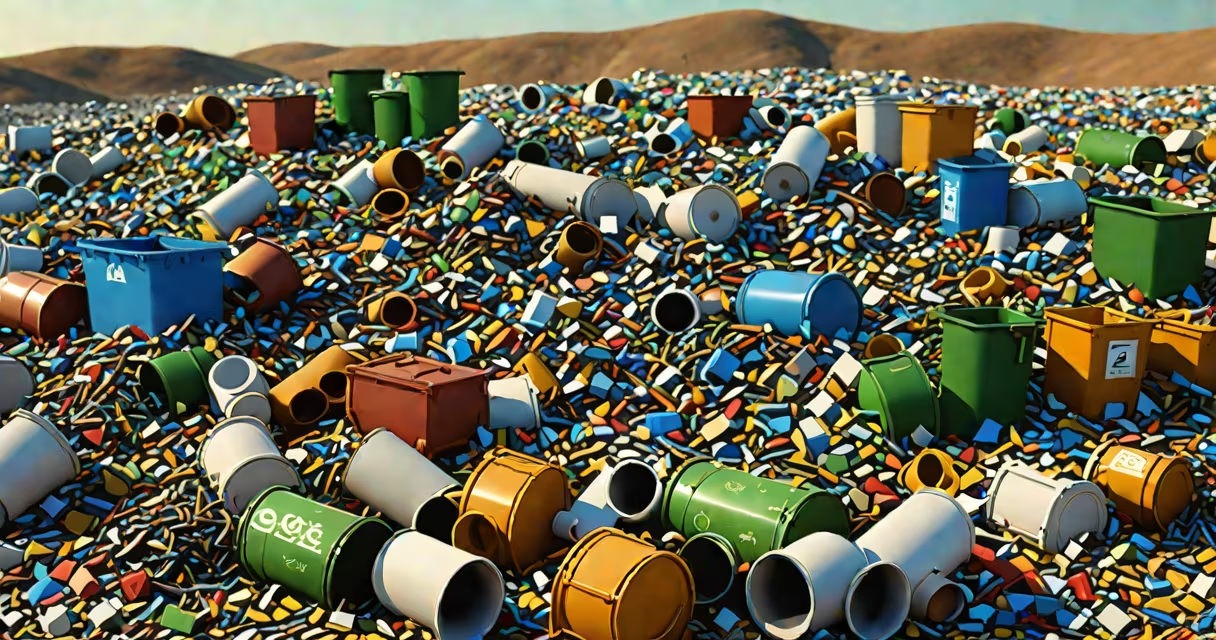
Solid waste consists of discarded materials generated from residential, commercial, industrial, and institutional activities. These materials are typically non-liquid and non-gaseous, ranging from food scraps and packaging to construction debris and electronic components. Proper handling prevents environmental contamination and supports resource recovery.
Solid waste originates from daily human activity and industrial processes. Common sources include homes, offices, factories, hospitals, and construction sites. The composition varies by region, season, and economic development level. In high-income countries, household waste averages 400-600 kg per capita annually, while low-income nations report lower volumes due to informal recycling systems and less consumption.
The United Nations Environment Programme (UNEP) estimates global urban areas produce 2.01 billion tonnes of municipal solid waste annually, with 33% not managed in an environmentally safe manner. This includes open dumping and uncontrolled burning, which release harmful pollutants into air and soil.
Not all solid waste is the same. It falls into distinct categories based on origin and hazard level. Understanding these types ensures appropriate disposal and treatment.
| Type | Source | Examples | Risk Level |
|---|---|---|---|
| Residential | Households | Food waste, paper, plastic containers | Low to moderate |
| Industrial | Factories, mines | Slag, ash, metal shavings | Moderate to high |
| Hazardous | Chemical plants, labs | Batteries, solvents, pesticides | High |
| Medical | Hospitals, clinics | Used syringes, contaminated bandages | High |
| Construction & Demolition | Build sites | Concrete, wood, drywall | Low to moderate |
Residential waste makes up the largest share of municipal solid waste in most countries. In the U.S., the Environmental Protection Agency (EPA) reports that 52% of total waste comes from homes, with paper and cardboard leading in volume. Industrial waste often contains heavy metals and persistent organic compounds, requiring specialized treatment to prevent groundwater contamination.
A common misconception is that all solid waste ends up in landfills. In reality, only about 13% of global municipal waste is recycled or composted. The rest is either incinerated, dumped, or burned openly. Countries like Japan and South Korea achieve recycling rates above 50%, thanks to strict sorting laws and public education campaigns.
Waste management strategies depend on waste type, local infrastructure, and regulatory standards. The most widely used methods include landfilling, incineration, composting, and recycling.
Landfilling remains the dominant disposal method worldwide. Modern landfills are engineered with liners and leachate collection systems to reduce soil and water pollution. However, they still emit methane-a greenhouse gas 25 times more potent than CO₂ over 100 years. The EPA estimates that landfills contribute about 15% of U.S. methane emissions.
Incineration, or waste-to-energy, burns waste at high temperatures to generate electricity. While it reduces volume by up to 90%, it releases dioxins and particulates unless equipped with advanced filtration. Germany operates over 600 such facilities, processing 40% of its municipal waste through energy recovery.
Composting converts organic waste into nutrient-rich soil amendments. A single household generating 1 kg of food waste per day can divert over 300 kg annually from landfills. Cities like San Francisco mandate composting, achieving a 80% diversion rate from landfills since 2009.
Recycling transforms materials like aluminum, glass, and plastics into new products. Recycling one ton of paper saves 17 trees and 7,000 gallons of water. Yet, only 32% of plastic waste globally is recycled, largely due to contamination and lack of sorting infrastructure.
People often equate solid waste with trash or garbage, but these terms differ in technical usage. "Trash" implies disposable items, while "waste" includes materials with potential reuse value. For example, scrap metal is waste but not trash-it's valuable for recycling.
Another misunderstanding is that recycling eliminates the need for landfilling. In practice, only certain materials are recyclable at scale. Plastics labeled #3, #6, and #7 are rarely processed due to complex chemical structures. These often end up in landfills or are incinerated.
A lesser-known fact: e-waste is a rapidly growing segment of solid waste. The Global E-waste Monitor 2020 reported 53.6 million metric tons of e-waste generated globally in 2019-equivalent to 1.5 million blue whales. Only 17.4% was formally collected and recycled. The rest ended up in informal dumps, especially in West Africa and Southeast Asia, where toxic substances like lead and mercury leach into soil and water.
I once observed a community cleanup event in Portland, Oregon, where volunteers sorted 2.3 tons of waste collected from city parks. Of that, 68% was recyclable or compostable. But only 12% had been properly separated at the source. This highlighted how poor source separation undermines even well-intentioned waste programs.
Unmanaged solid waste leads to health risks, environmental degradation, and lost economic value. Contaminated water supplies from landfill leachate have been linked to gastrointestinal illnesses in nearby communities. In India, open dumping near slums contributes to respiratory diseases among children.
Proper waste segregation enables higher recovery rates. For example, separating organics from recyclables increases recycling efficiency by up to 40%. Cities like Seoul, South Korea, enforce mandatory sorting with fines for non-compliance, resulting in a 60% reduction in landfill use between 2011 and 2021.
When waste is handled responsibly, it becomes a resource. Organic waste fuels biogas plants. Plastic waste can be converted into fuel via pyrolysis. Metals recovered from e-waste yield 10 times more gold per ton than mined ore. These processes support circular economy models that reduce dependency on raw material extraction.
Understanding what is solid waste begins with recognizing its diversity and impact. From kitchen scraps to broken circuit boards, each piece demands tailored solutions. Effective management reduces pollution, conserves resources, and protects public health.