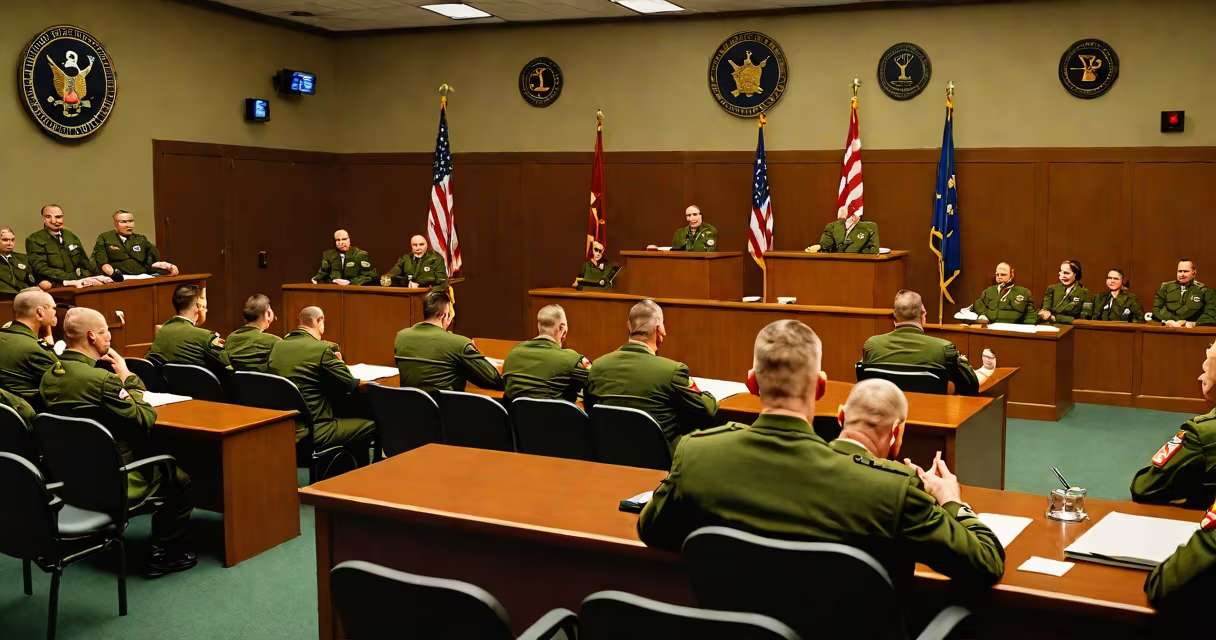
Rule 11, formally known as Article 11 of the Uniform Code of Military Justice (UCMJ), prohibits conduct unbecoming an officer and a gentleman. It applies specifically to commissioned officers and addresses behavior that undermines military discipline, integrity, and the reputation of the armed forces.
This rule targets actions that fall below the ethical standard expected of military leaders. It is not a catch-all for minor misconduct but focuses on serious breaches involving dishonesty, cowardice, indecent behavior, or actions that bring discredit upon the military. Violations can result in court-martial and penalties including dismissal from service, confinement, or reduction in rank.
The UCMJ, enacted in 1951 and codified under Title 10 of the United States Code, establishes legal standards for all branches of the U.S. Armed Forces. Rule 11 is one of several articles addressing professional conduct, alongside Article 134 (general offenses) and Article 120 (sexual assault).
Rule 11 applies only to commissioned officers-those who hold a commission from the President, such as captains, majors, colonels, and generals. Enlisted personnel are not subject to this specific charge, though they may face similar consequences under other articles.
Prosecutors must prove beyond a reasonable doubt that the accused officer engaged in conduct that was both dishonorable and contrary to military values. The act does not need to be illegal under civilian law-it must violate the unwritten code of military honor. Examples include lying under oath, failing to report misconduct, engaging in inappropriate relationships with subordinates, or publicly undermining command authority.
A 2018 case involving a Navy commander illustrates this principle. He was charged under Rule 11 after sending explicit messages to a subordinate during a deployment. Though the messages were not criminal under state law, the court-martial board ruled they constituted conduct unbecoming an officer due to the abuse of authority and breach of trust.
Rule 11 covers many behaviors, but courts have consistently narrowed its application to acts that reflect a fundamental failure of leadership and moral responsibility. The following categories represent common grounds for prosecution:
| Type of Conduct | Examples | Legal Basis |
|---|---|---|
| Dishonesty | Falsifying reports, lying to superiors, misusing funds | UCMJ Article 11(a) |
| Abuse of Authority | Unlawful fraternization, coercion, retaliation | UCMJ Article 11(b) |
| Discrediting the Service | Public statements damaging military reputation, leaking classified info | UCMJ Article 11(c) |
| Cowardice or Neglect | Abandoning duty during combat, refusing orders without cause | UCMJ Article 11(d) |
Each category requires evidence of intent and context. For instance, a single lapse in judgment-like a drunken outburst at a base event-may not rise to the level of unbecoming conduct unless it reflects a pattern of poor decision-making or repeated disregard for standards.
Rule 11 is frequently misunderstood as a tool for punishing personal failings or private indiscretions. This is incorrect. The U.S. Court of Appeals for the Armed Forces (CAAF) has ruled that mere social missteps-even affairs or public embarrassment-do not automatically constitute violations unless they directly impact military readiness or integrity.
A 2021 ruling in United States v. Smith clarified that "conduct unbecoming" must involve a breach of duty or a threat to unit cohesion. A Marine lieutenant who had a brief romantic relationship with a civilian while stationed overseas was acquitted because the court found no evidence of abuse of position or damage to morale.
Another misconception is that Rule 11 applies to all service members. It does not. Only commissioned officers are subject to this charge. Enlisted personnel may be prosecuted under Article 134 for similar behavior, but the burden of proof and standards differ.
In 2022, a U.S. Air Force colonel faced charges under Rule 11 after being caught in a video circulating online showing him making racially charged remarks during a training session. The footage, recorded by a junior officer, led to an investigation. The trial board found the remarks were not isolated incidents but part of a broader pattern of discriminatory behavior that eroded unit trust.
The colonel was convicted and dismissed from service. His defense argued that the remarks were made in a heated moment and not intended to harm. The court rejected this, stating that "leadership demands accountability, especially when words undermine the principles of equality and respect."
As of 2023, the Department of Defense reported 42 Rule 11 cases initiated across all branches, with 28 resulting in convictions. The majority involved misuse of authority or failure to uphold ethical standards during deployments or leadership roles.
Rule 11 helps military leadership remains accountable to the highest standards of conduct. It protects the chain of command from corruption, dishonesty, and abuse. Without it, the military's ability to maintain discipline and public trust would be compromised.
For service members, understanding Rule 11 is essential. It is not a vague moral guideline-it is a legally enforceable standard with real consequences. Officers must recognize that their actions, even off-duty, are scrutinized for alignment with military values.
Rule 11 is not about perfection. It is about integrity. When leadership fails in character, the entire institution suffers. The UCMJ exists to uphold that balance.