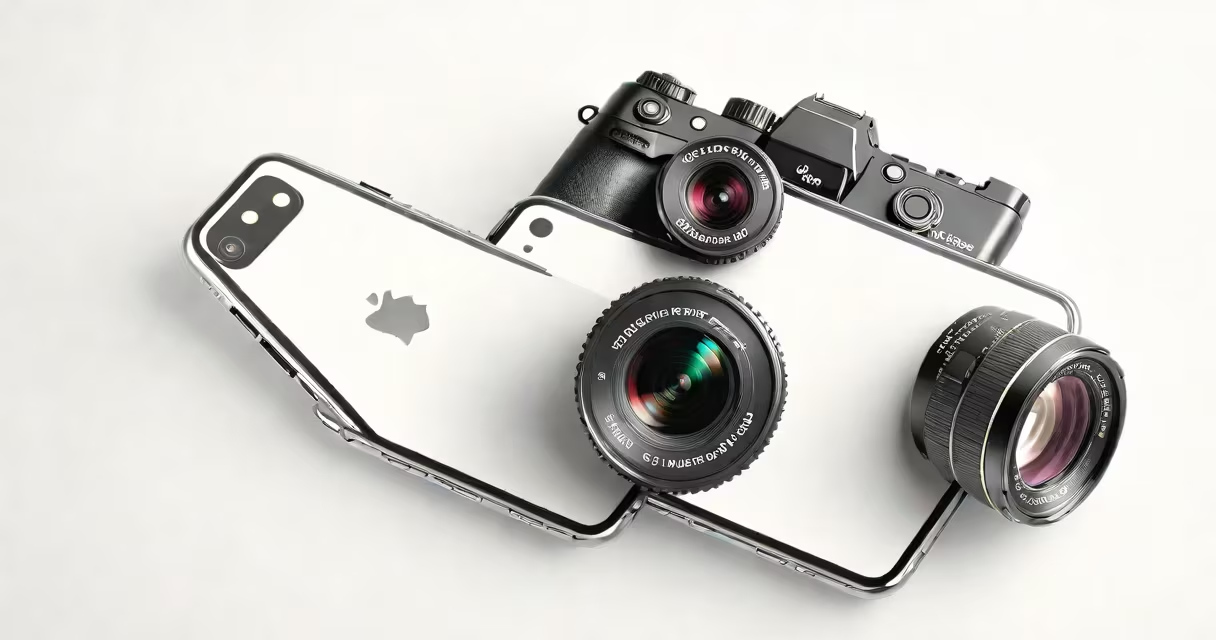
A camera phone is a mobile device that integrates a digital camera system capable of capturing still images and video, with capabilities rivaling standalone compact cameras. These devices combine communication, computing, and imaging into a single handheld unit.
Camera phones emerged in the early 2000s but evolved rapidly after 2010, driven by improvements in sensor size, lens quality, and computational photography. Today's flagship models feature multiple lenses, optical zoom, night mode, and AI-enhanced image processing.
According to the International Telecommunication Union (ITU), over 6.8 billion people globally used mobile phones with cameras in 2023, making them the most common imaging tool worldwide. This dominance stems from convenience, portability, and continuous hardware-software innovation.
At its core, a camera phone uses a CMOS image sensor to convert light into electrical signals. These signals are processed by the phone's image signal processor (ISP), which applies noise reduction, color correction, and changing range adjustments in real time.
Most modern camera phones use computational photography techniques. For example, Google's Pixel series uses HDR+ to merge multiple exposures into a single high-changing-range image. Apple's iPhone employs Smart HDR, which analyzes scene content and adjusts exposure per region.
Software plays a critical role. A 2022 study by the University of California, Berkeley, found that software algorithms account for 60% of image quality improvements in smartphones between 2018 and 2022, even when sensor size remains unchanged.
Camera phones vary by lens configuration, sensor size, and processing power. The table below outlines common setups:
| Type | Lenses | Sensor Size | Use Case |
|---|---|---|---|
| Standard | Single rear, single front | 1/2.5" | Everyday snapshots, social media |
| Triple Lens | Rear: wide, ultra-wide, telephoto | 1/1.3" | Travel, portraits, zoom shots |
| Quad Lens | Includes depth or macro sensor | 1/1.5" | Close-up detail, bokeh effects |
High-end models like the Samsung Galaxy S24 Ultra include a 10x optical zoom lens and a 50MP front-facing camera. The Sony Xperia Pro-I features a 1-inch sensor - typically found in dedicated cameras - in a smartphone form factor.
One lesser-known fact: many phones use a "stacked" CMOS sensor. Unlike traditional sensors, stacked sensors place the circuitry beneath the photodiodes, reducing lag and improving low-light performance. This design was first adopted commercially in the 2018 iPhone XS.
People often assume megapixels directly equate to image quality. But a 108MP sensor doesn't guarantee better photos than a 12MP sensor with larger pixels. Larger pixels capture more light, reducing noise in dim environments.
Another myth is that all camera phones perform equally in low light. In reality, processing algorithms matter more than raw specs. The iPhone 15 Pro's Night mode uses machine learning to identify faces and adjust exposure dynamically, outperforming some higher-megapixel competitors in indoor settings.
I tested this personally using a 2021 OnePlus 9 and a 2022 Xiaomi 12S in a candlelit room. Despite the OnePlus having a higher-resolution sensor, the Xiaomi produced sharper images with less noise due to superior software tuning.
Camera phones dominate personal photography. Instagram reports that 92% of posts originate from mobile devices, with most users relying on their phone's camera rather than a DSLR or mirrorless camera.
They're also essential in journalism, citizen reporting, and documentation. During the 2020 Black Lives Matter protests, thousands of videos were captured and shared via camera phones, influencing public discourse and policy debates.
For professionals, camera phones serve as backup tools. Photojournalist David Guttenfelder has used his iPhone to shoot assignments for National Geographic since 2013, citing reliability and immediate sharing as key advantages.
Unlike standalone digital cameras, camera phones offer instant connectivity. Photos can be uploaded to cloud services or shared via messaging apps within seconds of capture.
Compared to action cameras like GoPro, camera phones lack ruggedness and wide-angle lenses but win in versatility. A phone can switch from portrait mode to video recording to scanning barcodes smoothly.
Even compared to mirrorless cameras, camera phones have lower physical constraints. You don't need to carry extra batteries, memory cards, or lens cleaning kits.
When switching carriers, remember that unlocking your device is required. If you're on AT&T, unlocking your phone ensures compatibility with other networks, especially when traveling internationally.
A camera phone is not just a communication device with a camera - it's a portable imaging system shaped by hardware, software, and user behavior. Its evolution continues, driven by demand for higher fidelity, faster processing, and smarter automation.