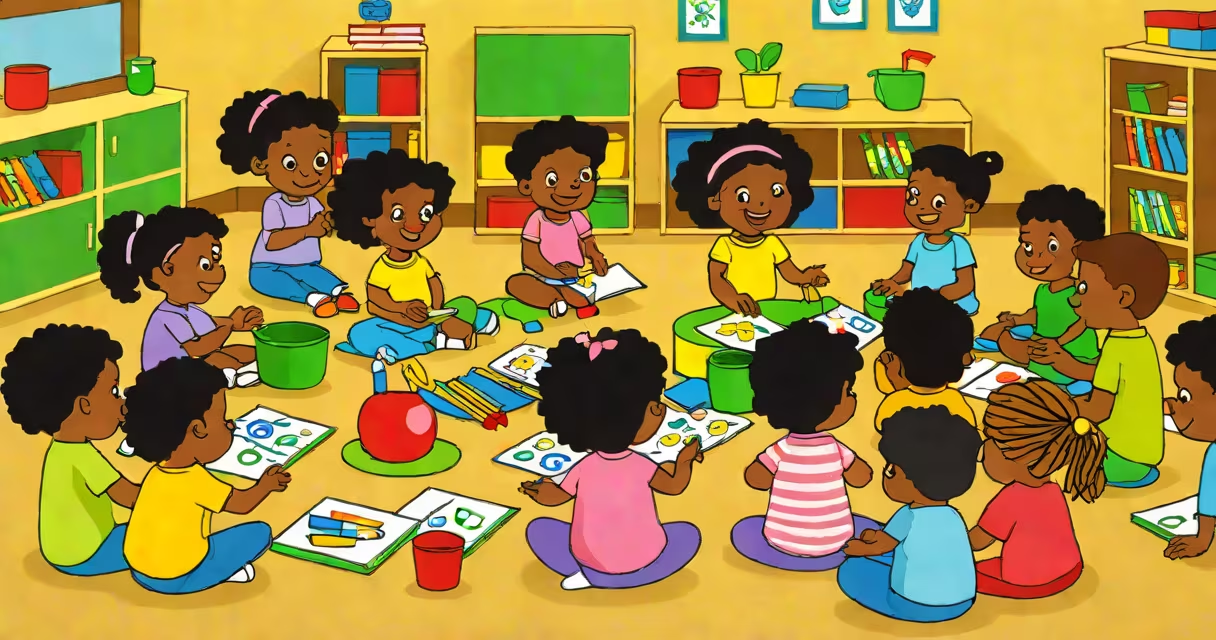
Pre kindergarten is a structured educational program for children typically aged 4 to 5 years, designed to prepare them for the academic and social demands of kindergarten. It focuses on early literacy, numeracy, motor skills, emotional regulation, and cooperative play through guided activities and routines.
Pre kindergarten is not a universal requirement in U.S. public schools, but many states offer state-funded programs for eligible families. These programs often follow national standards set by organizations such as the National Association for the Education of Young Children (NAEYC) and the Council for Professional Recognition.
Children in pre kindergarten spend time on letter recognition, counting to 20, sorting shapes, using scissors safely, and practicing sharing. They participate in daily circle time, storytelling, and outdoor play. Teachers assess progress through observation and informal checklists rather than standardized tests.
Pre kindergarten operates on a daily schedule that balances free play, teacher-led instruction, and structured routines. A typical morning includes arrival time, snack, circle time, a theme-based activity (e.g., "Animals in the Rainforest"), outdoor recess, and a quiet period for drawing or reading.
Teachers use developmentally appropriate practices. For example, instead of drilling math facts, they might ask children to count how many blocks are needed to build a tower. Instead of requiring handwriting practice, they may encourage scribbling with large crayons to develop fine motor control.
Classrooms often include designated areas: a dramatic play zone (like a pretend grocery store), a science corner with magnifying glasses and nature specimens, and a reading nook with child-sized furniture. These spaces support exploration and independent learning.
Pre kindergarten programs vary by location and funding source. The most common types are:
| Type | Funding Source | Age Group | Typical Schedule | Key Focus |
|---|---|---|---|---|
| State-Funded Pre-K | Public school districts or state grants | 4-5 years | Full-day, 5 days/week | Academic readiness, equity access |
| Private Pre-K | Parent tuition | 3-5 years | Half-day or full-day options | Curriculum variety, specialized themes |
| Head Start Pre-K | Federal grant (U.S. Department of Health and Human Services) | 3-5 years | Full-day, 5 days/week | Complete services: health, nutrition, family engagement |
| Preschool (non-pre-K) | Private or nonprofit | 2.5-4 years | Part-time or full-day | Basic socialization, sensory play |
State-funded pre-K programs are increasingly available in states like Oklahoma, Georgia, and New Jersey. In Oklahoma, for example, all 4-year-olds are offered free pre-K through the state's Early Childhood Education Program, which serves over 100,000 children annually.
A common misconception is that pre kindergarten is equivalent to preschool. While both serve young children, pre-k is more academically focused and often aligned with kindergarten standards. Preschool tends to emphasize social-emotional growth and basic exploration.
Research shows that children who attend high-quality pre kindergarten enter kindergarten with stronger language, math, and executive function skills. A 2020 study published in *Child Development* found that students in state-funded pre-K programs scored 12% higher on kindergarten readiness assessments than peers who did not attend.
Pre kindergarten supports children from low-income families disproportionately. According to the National Institute for Early Education Research (NIEER), children in pre-K programs are less likely to require special education services or be held back a grade. The average cost per student in a public pre-K program is $7,200 annually, according to NIEER's 2023 report.
One non-obvious distinction: pre kindergarten is not a test of intelligence. It measures developmental progress, not IQ. A child who struggles with letter sounds may improve after 9 months in a well-designed program. Conversely, a child who excels in early reading may still benefit from the social structure and routine of pre-K.
In a public pre-K classroom in Portland, Oregon, a typical week includes:
Each activity aligns with the Oregon Early Learning Standards, which define what children should know by the end of the year. By spring, most students can identify uppercase letters, count to 20, and describe a story's beginning, middle, and end.
I taught pre kindergarten for two years in a rural district. One student arrived unable to speak in full sentences. After six months of consistent routines, peer interaction, and targeted language prompts, he began asking questions like "Why do leaves fall?" and "Can we go to the park?" His mother later told me he now speaks in complete thoughts at home.
Many people assume pre kindergarten is just "school for toddlers." That's incorrect. Children in pre-K are older than preschoolers and engage in more complex tasks. They're expected to follow multi-step instructions ("Put your shoes in the cubby, then sit on the rug") and manage transitions between activities.
Another myth: pre-K is only for kids who aren't ready for kindergarten. This is false. Many high-achieving children attend pre-K to strengthen their focus, learn classroom norms, and build confidence. The goal is not to accelerate learning but to ensure all children feel safe, supported, and prepared.
Some parents confuse pre-K with Montessori or Waldorf programs. While those models emphasize independence and creativity, they don't necessarily align with state curriculum benchmarks. Pre-K programs are usually required to meet specific learning objectives, especially in public settings.
Understanding what pre kindergarten means involves recognizing it as a bridge between early childhood and formal education. It's not about teaching reading or math in isolation, but fostering curiosity, cooperation, and confidence. High-quality pre kindergarten programs lay the foundation for lifelong learning.
If you're considering enrolling your child, look for classrooms with trained teachers, small group sizes (no more than 12 children per adult), and a balance of free play and guided learning. Check whether the program follows state early learning standards and offers family engagement opportunities.