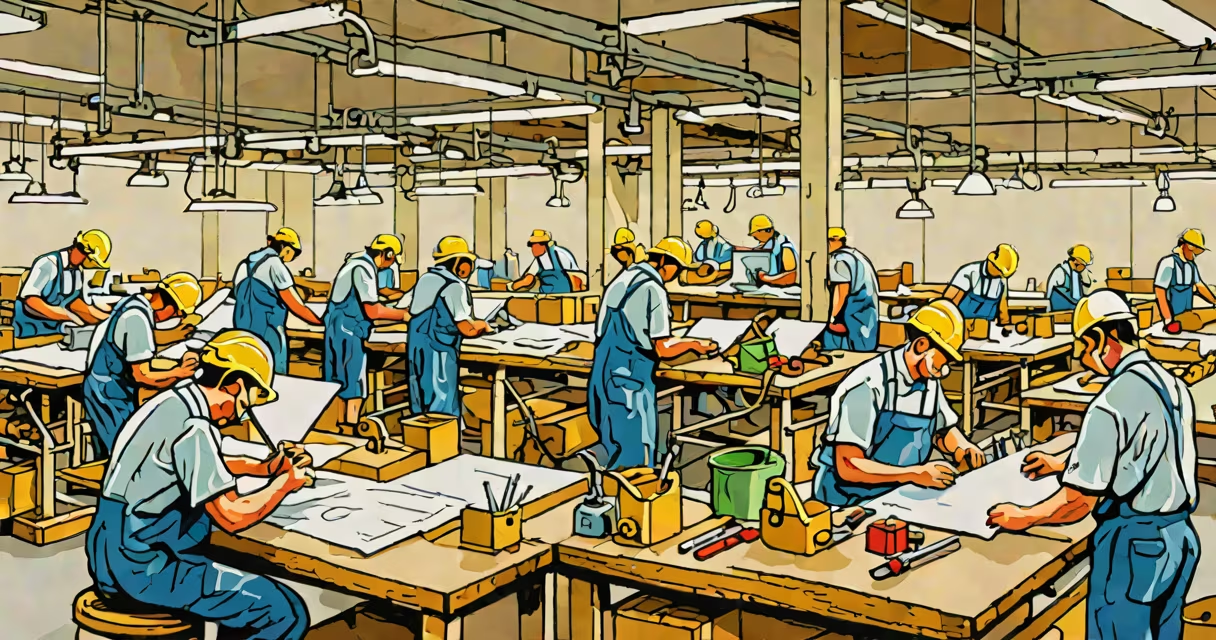
Lean manufacturing is a systematic approach to minimizing waste within a manufacturing system without sacrificing productivity. It focuses on creating maximum value with minimal resources by identifying and eliminating non-value-adding activities. This philosophy originated in postwar Japan and was refined at Toyota, forming the foundation of the Toyota Production System.
The term "lean" refers to stripping away excess-time, materials, motion, inventory, defects-to deliver only what the customer values. It's not about cutting corners. It's about working smarter. A lean environment reduces lead times, improves quality, and increases responsiveness to demand changes. For example, a car manufacturer using lean methods reduced assembly time per vehicle from 12 hours to 6.5 hours while improving defect rates by 40%.
At its core, lean manufacturing operates on the principle of continuous flow. Work moves smoothly from one stage to the next with no bottlenecks or idle time. This requires standardizing tasks, reducing setup times, and maintaining consistent work-in-process levels. Visual controls such as kanban cards signal when parts are needed, preventing overproduction and stockouts.
Every process is analyzed for muda-Japanese for waste. There are seven recognized types: overproduction, waiting, transportation, over-processing, inventory, motion, and defects. A single production line might identify 37 instances of motion waste during a daily audit. By redesigning workstation layouts, employees reduce unnecessary steps by 28%, leading to faster cycle times and fewer injuries.
Teams use structured problem-solving methods like the Plan-Do-Check-Act (PDCA) cycle to test improvements. A team at a Midwest appliance plant used PDCA to reduce paint overspray by adjusting spray gun settings. After three iterations, they cut material waste by 19% and saved $120,000 annually.
Lean manufacturing integrates several interlocking practices. The most common include:
| Practice | Description | Real-World Example |
|---|---|---|
| Kanban | Visual signals to trigger replenishment based on actual consumption. | A bicycle parts supplier uses colored bins to indicate when to reorder brake calipers. |
| 5S | Sort, Set in order, Shine, Standardize, Sustain-organizing the workspace for efficiency. | A machine shop reduced tool search time from 12 minutes to 90 seconds after implementing 5S. |
| Value Stream Mapping | Documenting every step in production to identify waste and improve flow. | An electronics firm mapped its circuit board assembly process and eliminated 14 non-value-added steps. |
| Kaizen | Ongoing, small-scale improvements driven by frontline staff. | Factory workers at a packaging facility suggested a new conveyor belt angle, reducing product jams by 33%. |
These aren't isolated techniques. They form a culture. At Toyota, every employee is trained to stop the line if they spot a flaw. This empowers teams to act immediately rather than wait for audits. The result is a system where problems are caught early and resolved permanently.
Manufacturers across industries apply lean principles. Automotive plants use it to manage complex supply chains. Medical device makers rely on it to meet strict regulatory standards while reducing costs. Even food processors adopt lean to handle perishable goods with tight shelf lives.
For example, a U.S.-based snack food company faced rising spoilage due to inconsistent batch sizes. After mapping their value stream, they discovered that 22% of processing time was spent adjusting equipment between recipes. By standardizing changeover procedures and training operators, they cut downtime by 52% and increased output by 18% per shift.
Lean isn't limited to factories. Service organizations use lean concepts too. A hospital emergency department implemented lean workflows to reduce patient wait times. By analyzing arrival patterns and staffing levels, they decreased average wait time from 97 minutes to 43 minutes within six months.
Many mistake lean manufacturing for cost-cutting or downsizing. That's incorrect. Lean is not about reducing headcount-it's about increasing output per worker. A study by the Lean Enterprise Institute found that companies applying lean principles saw a 25% increase in labor productivity over five years, not a decrease in workforce size.
Another misconception is that lean requires expensive software or hardware. While digital tools help, the foundation is human observation and process design. A small furniture maker in Oregon improved workflow by simply rearranging tools on a bench. No sensors, no dashboards-just better layout. Output rose 22% in three months.
Finally, people assume lean is a one-time project. It's not. It's a mindset. At a California auto parts supplier, leadership introduced lean training for all new hires. Over three years, the company maintained a 15% annual improvement rate in on-time delivery-not because of new equipment, but because employees kept refining processes.
I observed a lean rollout at a midsize metal fabrication shop. The team began with a 5S initiative. They labeled every tool, assigned storage zones, and posted cleaning schedules. Within two weeks, the floor was clutter-free. But the real shift came when supervisors stopped walking through the shop to inspect work. Instead, they held daily 15-minute huddles where workers reported issues and proposed solutions. One welder suggested adding a magnetic tray to hold small bolts. It reduced lost parts by 60%. The change wasn't big-but it was sustainable.
After six months, the shop reduced scrap rates by 31% and cut overtime by 27%. Management didn't mandate changes. They asked, "What's slowing you down?" Then they removed barriers. That's the heart of what does lean manufacturing mean: listening to those closest to the work and acting on their insights.