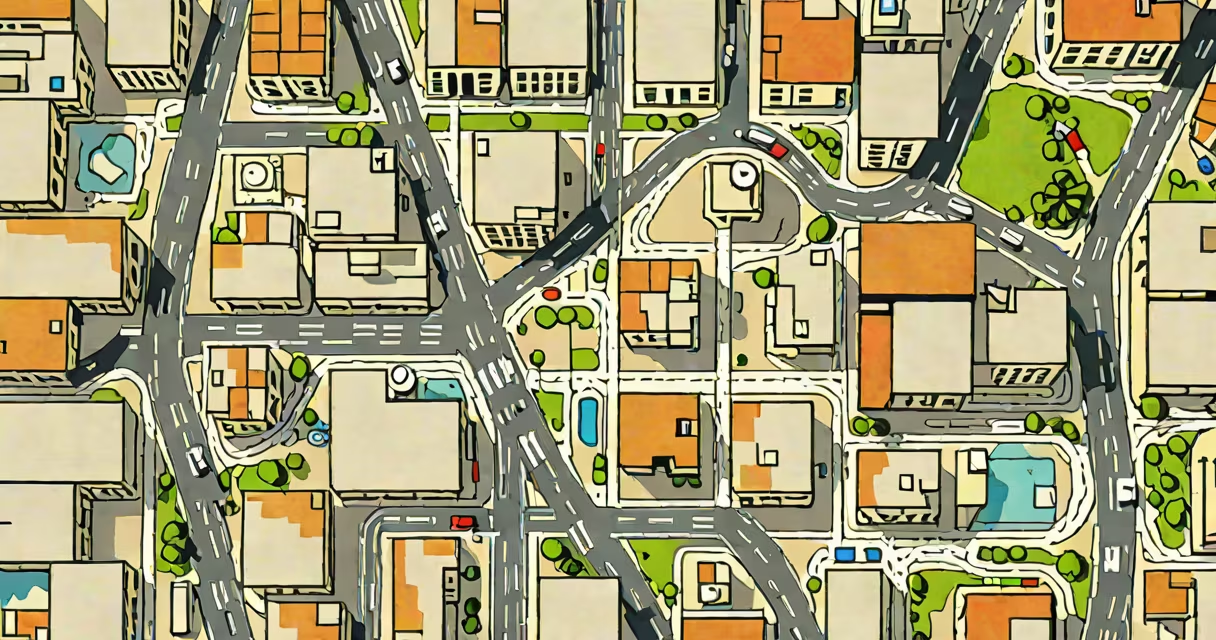
A grid is a network of evenly spaced horizontal and vertical lines forming a pattern of squares or rectangles. It provides structure for organizing space in maps, designs, and digital interfaces. Grids enable consistent alignment, simplify navigation, and support scalable layouts.
Grids appear in many forms. A city's street layout often follows a grid pattern-streets run perpendicular to each other, creating uniform blocks. In mathematics, a coordinate grid uses numbered axes to locate points using ordered pairs like (3, 4). On websites, a responsive grid system arranges content into columns that adapt to screen size.
The term "grid" describes both physical and conceptual frameworks. It's not just a visual tool-it's a functional system for managing spatial relationships. Whether planning a building site or designing a mobile app, grids reduce complexity by enforcing order.
Grids function through repetition and alignment. Each line or boundary acts as a reference point. In a spreadsheet, rows and columns form a grid where data sits at specific intersections. In architecture, a grid guides the placement of walls, windows, and structural supports.
When you enter coordinates on a map, you're referencing a grid. GPS systems use latitude and longitude lines- a global grid-to pinpoint locations. For example, the intersection of 40°N latitude and 74°W longitude marks Manhattan's central area. This system allows precise location tracking across continents.
In digital design, grids are often invisible but essential. A website built with a 12-column grid helps images, text, and buttons align consistently across devices. Without it, elements may shift unpredictably during resizing.
Grids come in several standard forms, each suited to different tasks:
| Type | Structure | Common Use | Example |
|---|---|---|---|
| Cartesian | Perpendicular axes with numbers | Math, science, plotting functions | Plotting y = x² on graph paper |
| Modular | Repeating cells in rows and columns | Web design, print layouts | Adobe XD's 12-column grid for app screens |
| Column-based | Vertical divisions with flexible spacing | News websites, blogs | Medium's article layout with variable-width columns |
| Geographic | Street networks based on cardinal directions | Urban planning, navigation | New York City's Manhattan grid system |
Each grid type serves a purpose. Cartesian grids are ideal for data visualization because they allow accurate measurement. Modular grids work well in responsive design-they scale while preserving proportions. Geographic grids make cities easier to go through and address.
One non-obvious fact: not all grids are rectangular. Some systems use hexagonal grids, especially in game design and geographic modeling. Hex grids minimize distortion when mapping large areas and offer six directional paths instead of four, improving movement accuracy in simulations.
People often mistake a grid for a mere background pattern. But a grid is a functional structure-not decorative. A wallpaper with faint lines doesn't qualify as a grid unless those lines define measurable units or alignment points.
Another error is assuming all grids are rigid. In reality, many modern grids are adaptive. A web layout might start with a 12-column grid but collapse into a single column on mobile devices. The underlying structure remains, but the visible form changes.
Some assume grids only apply to visuals. But grids underlie databases, algorithms, and even neural networks. In machine learning, data is often arranged in grid-like tensors-multi-dimensional arrays where each element has a position. This structure enables efficient computation and pattern recognition.
Consider building a fitness tracker app. You want users to see workout logs, progress charts, and daily goals. Using a modular grid ensures consistency across screens.
You set up a 6-column grid for the home screen. Each card-workout duration, calories burned, steps taken-occupies one column. On a tablet, the layout expands to show four cards side-by-side. On a phone, it stacks vertically. The grid maintains spacing and alignment regardless of device size.
Without this system, elements might overlap or leave awkward gaps. The grid prevents misalignment and improves usability. According to Google's Material Design guidelines, consistent spacing reduces cognitive load and increases task completion rates by up to 23% in controlled tests.
During testing, users reported faster navigation and fewer errors when interacting with the app. The grid wasn't visible-but its presence made the interface feel stable and predictable.
Understanding "what does grid mean" involves recognizing it as a foundational tool across disciplines. From urban planning to AI, grids provide order in complex environments. They're not just visual aids-they're structural enablers.
When you see a city laid out in perfect blocks, a spreadsheet with aligned data, or a website that resizes smoothly, a grid is likely working behind the scenes. Its power lies in simplicity: a few lines create clarity.