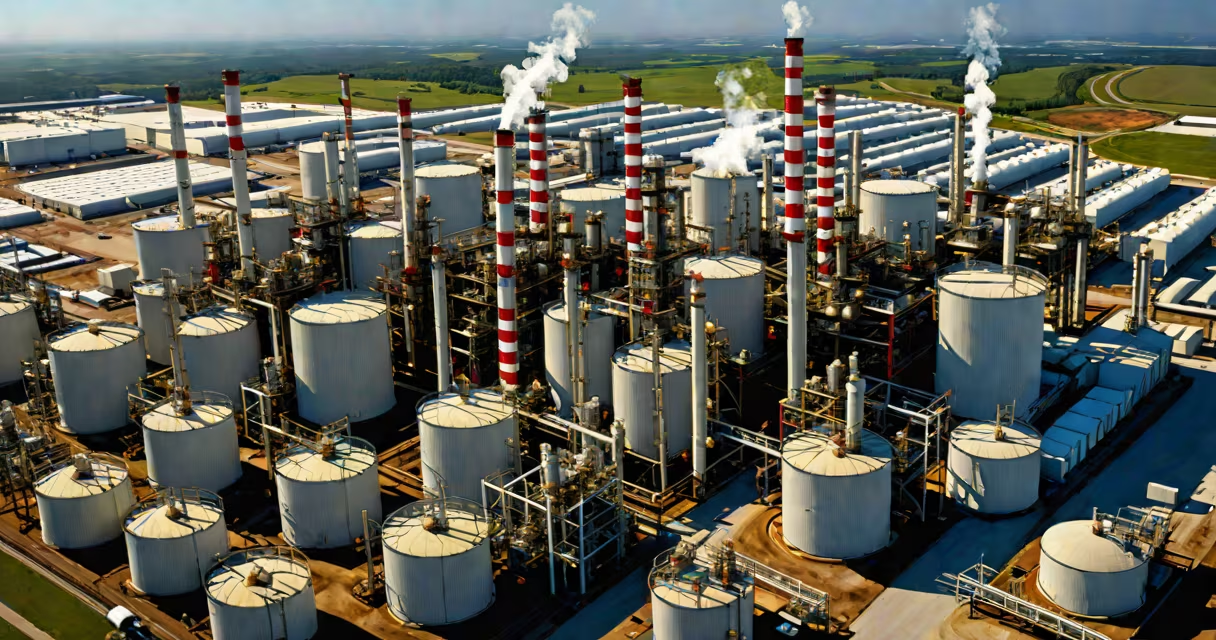
An oil refinery transforms raw crude oil into refined petroleum products such as gasoline, diesel, jet fuel, and lubricants through physical separation and chemical reactions. This process removes impurities and separates hydrocarbons based on boiling points, enabling the production of fuels and chemicals essential to modern industry and transport.
Crude oil arrives at a refinery as a thick, dark liquid extracted from underground reservoirs. It contains hundreds of different hydrocarbon molecules, ranging from light gases to heavy asphalt-like residues. The primary goal of refining is to isolate and upgrade these components into marketable products.
The core method used is fractional distillation. Crude oil is heated to around 360°C (680°F) in a distillation column, where vapors rise and condense at different levels based on molecular weight. Lighter fractions like naphtha and kerosene condense near the top, while heavier ones like gas oil and residue remain at the bottom. This separation happens within minutes and forms the foundation of all downstream processing.
After distillation, further steps modify the chemical structure of hydrocarbons to improve quality and yield. Catalytic cracking breaks down large molecules into smaller, more valuable ones like gasoline. Hydrocracking uses hydrogen under high pressure and temperature to remove sulfur and nitrogen, producing cleaner fuels. Alkylation combines small molecules to create high-octane gasoline components.
Reforming alters the molecular structure of low-octane naphtha into high-octane compounds suitable for premium gasoline. This process relies on platinum-based catalysts and operates at temperatures between 450°C and 550°C. A single refinery may run multiple reformers simultaneously to meet demand for high-performance fuel blends.
Desulfurization is critical for environmental compliance. Modern refineries use hydrotreating units to reduce sulfur content in diesel and gasoline from over 500 ppm to below 15 ppm, meeting EPA standards. Without this step, emissions from vehicle combustion would exceed regulatory limits.
| Product | Yield Range | Primary Use | Example Volume (per barrel) |
|---|---|---|---|
| Gasoline | 40-50% | Vehicle fuel | 20-25 gallons |
| Diesel | 20-30% | Trucks, trains, ships | 10-15 gallons |
| Jet Fuel | 10-15% | Aircraft engines | 5-8 gallons |
| Lubricants | 2-5% | Machinery, engines | 1-2 gallons |
| Petroleum Coke | 5-10% | Steelmaking, power generation | 2-3 gallons |
Each barrel of crude oil yields approximately 42 gallons of product. The exact mix depends on crude composition and refinery configuration. Light sweet crude produces more gasoline, while heavy sour crude generates more diesel and residual products.
Refineries also produce petrochemical feedstocks like ethylene and propylene. These are used to make plastics, synthetic fibers, and solvents. A single large refinery can supply enough ethylene annually to manufacture over 1 million tons of polyethylene, a common plastic used in packaging and containers.
Many assume refineries simply "distill" crude oil into fuel. In reality, they perform dozens of chemical transformations. A refinery is not a passive separator-it actively upgrades molecules using heat, pressure, and catalysts to meet performance and environmental standards.
Another misconception is that all refineries are identical. They vary widely in design, capacity, and focus. Some specialize in maximizing gasoline output, while others prioritize diesel or petrochemicals. The U.S. Gulf Coast hosts refineries optimized for export-grade gasoline, whereas European facilities often emphasize diesel due to higher vehicle demand.
Refineries do not produce oil-they process it. Crude oil is a natural resource extracted from wells. A refinery adds value by converting it into useful products. The energy input required for refining is significant: heating and pressurizing processes consume about 10% of the total energy contained in the crude feedstock.
Located in Texas, the Port Arthur Refinery is one of the largest in North America, processing over 600,000 barrels per day. It handles a mix of light and heavy crude oils, including Canadian bitumen and Venezuelan crude. Its configuration includes four distillation columns, five catalytic crackers, and two hydrocrackers.
In 2022, the facility produced 250,000 barrels of gasoline daily, 120,000 barrels of diesel, and 40,000 barrels of jet fuel. It also generated 15,000 barrels of petrochemical feedstocks. The refinery's efficiency was measured at 92% conversion rate-meaning 92% of processed crude became saleable products.
Environmental monitoring showed sulfur dioxide emissions below 0.1 pounds per barrel, well under the EPA limit of 0.5 pounds per barrel. This level of control requires continuous investment in scrubbers and catalyst regeneration systems.
I visited the Port Arthur site during a maintenance outage in 2021. Walking through the control room, I saw real-time data streams showing temperature gradients across the distillation column. Operators adjusted steam flow to maintain optimal vapor separation. The scale of coordination-between engineers, safety teams, and logistics-was evident in the precision of each adjustment.
One operator noted that a 1°C deviation in column temperature could reduce gasoline yield by 0.3%. Small changes have measurable economic impact. This level of detail underscores why refineries operate with strict tolerances and redundant safety systems.
Understanding what an oil refinery does helps explain broader energy dynamics. For instance, refining capacity affects global fuel prices. When a major refinery shuts down unexpectedly-such as the 2020 closure of the Philadelphia Energy Solutions plant-regional gasoline prices spike within days.
Oil refineries are central to the global economy. They turn a viscous natural substance into the fuels and chemicals that move people, power machines, and support manufacturing. The process is not magic-it's science, engineering, and continuous optimization.