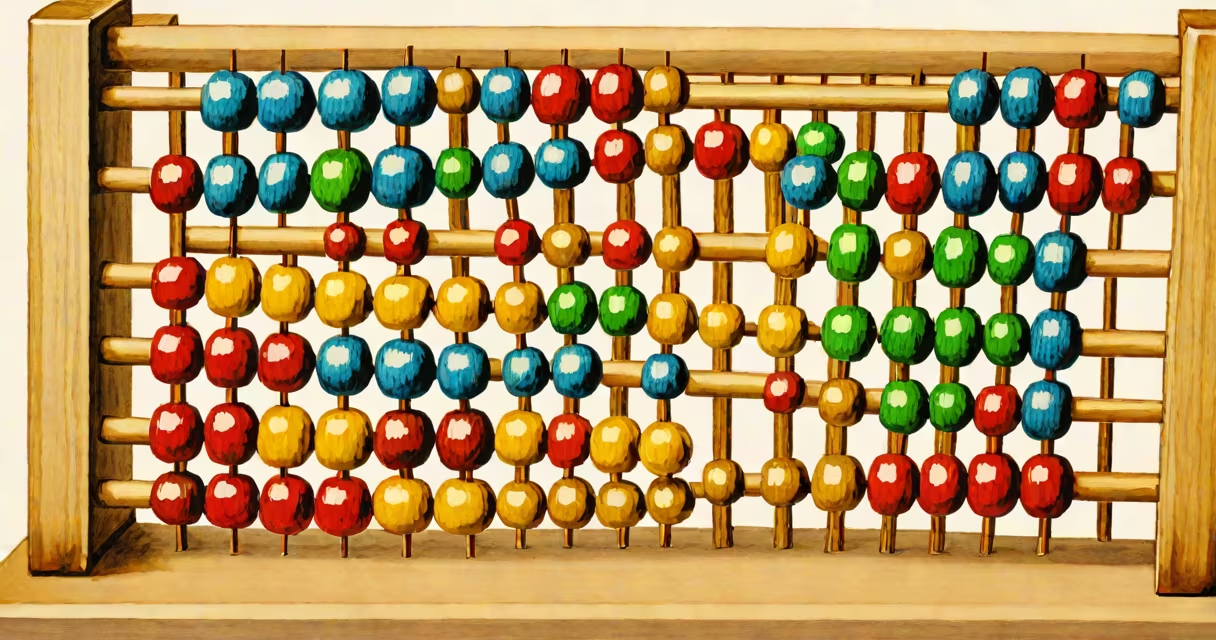
The abacus is a counting device consisting of beads sliding on rods, used for performing arithmetic calculations manually. It predates written numerals and remains in use in parts of Asia and for teaching basic math concepts.
Originating in Mesopotamia around 2400 BCE, the abacus evolved into various forms across cultures. The Roman version used grooved boards with pebbles, while the Chinese suanpan and Japanese soroban feature bead frames. These tools enabled users to perform addition, subtraction, multiplication, and division through physical manipulation of beads.
Each rod represents a place value-units, tens, hundreds-and beads above and below a dividing bar represent different values. On a standard suanpan, two beads above the bar equal five each, and five beads below represent one each. Moving beads toward the center bar registers numerical input.
Users move beads along horizontal rods to represent numbers. For example, setting one bead in the upper section and two in the lower on the units rod equals seven (5 + 1 + 1). Addition involves shifting beads upward; subtraction reverses the motion.
To calculate 34 + 17:
This process mirrors mental calculation but reduces error through tactile feedback. Users trained in abacus methods often develop faster mental arithmetic skills than those using paper or calculators.
Different cultures developed distinct abacus designs based on their numeral systems and mathematical needs.
| Type | Region | Bead Configuration | Use Case |
|---|---|---|---|
| Suanpan | China | Two beads above (5 each), five below (1 each) | General arithmetic, trade, education |
| Soroban | Japan | One bead above (5), four below (1 each) | Elementary math training, precision work |
| Roman Calculi | Rome | Peek stones in grooves, no beads | Accounting, military logistics |
The soroban is particularly efficient due to its simplified design. The one-bead-above configuration allows for quicker carry-over during complex operations. In Japan, abacus proficiency is still taught in schools, and national competitions test speed and accuracy.
A 2013 study published in *Cognitive Science* found that children trained in abacus use showed improved working memory and attention control compared to peers using traditional math instruction. This suggests the tool's benefits extend beyond arithmetic-it enhances cognitive processing.
Many assume the abacus is outdated or obsolete. In reality, it's still used in daily commerce in parts of China, India, and Southeast Asia. In rural markets, vendors rely on it for quick, accurate calculations without electricity or devices.
Another myth is that abacus users are slow because they're physically moving beads. In practice, expert users can perform multi-digit operations in under ten seconds. A 2019 world record set by a Japanese student involved solving 100 problems in 1 minute and 57 seconds-averaging less than 1.2 seconds per problem.
Some confuse the abacus with early mechanical calculators like Pascal's machine or the adding machine. Unlike those, the abacus requires no power, has no moving gears, and depends entirely on human dexterity and pattern recognition.
Abacus training builds foundational number sense. Research from the University of California, Irvine, shows that students who practiced abacus-based mental math scored higher on standardized tests in algebra and geometry later in school.
I once observed a class in Shanghai where sixth graders solved 3-digit multiplication mentally after months of abacus training. One student, aged 11, calculated 478 × 632 in under 15 seconds-without writing anything down. He visualized the abacus in his mind, a technique known as "mental abacus."
Today, the abacus serves both practical and educational roles. In classrooms, it teaches place value and number decomposition. In cultural contexts, it preserves historical knowledge. In neuroscience, it offers insight into how the brain processes numerical information.
The abacus is not a relic. It is a living system of calculation, a bridge between ancient wisdom and modern cognition. Its enduring presence proves that some tools don't need batteries to be useful.