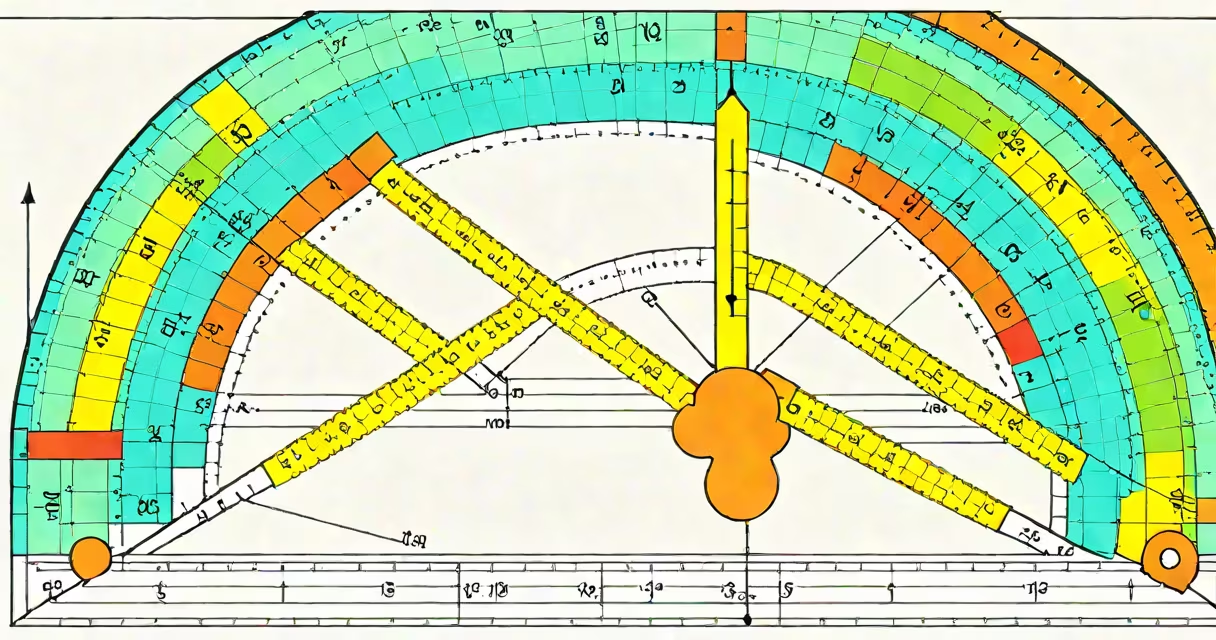
A protractor is a semicircular or circular tool used to measure angles in degrees, typically ranging from 0° to 180° or 360°. It features degree markings along its edge and a center point aligned with the vertex of the angle being measured.
Protractors are essential in geometry, engineering, architecture, and technical drawing. They allow precise angular measurement for tasks such as constructing triangles, verifying symmetry, or aligning parts in mechanical design. The most common type is the semicircular plastic protractor, widely used in classrooms and workshops.
For accurate results, place the protractor's center mark directly over the angle's vertex and align one side of the angle with the baseline (0° line). Read the degree value where the second side crosses the scale. Most protractors have dual scales-one increasing clockwise, the other counterclockwise-to accommodate angles from either direction.
The protractor operates on the principle that a circle contains 360 degrees. A semicircular protractor covers half the circle, so it spans 180 degrees. The markings are evenly spaced, with each degree represented by a small line. Major lines are numbered every 10 degrees, and minor lines indicate single-degree increments.
To measure an angle, position the protractor so its baseline lies flat against one ray of the angle and the vertex sits at the center hole. Then read the scale where the second ray intersects the arc. If the angle opens to the right, use the outer scale; if it opens to the left, use the inner scale. This dual-scale system prevents misreading due to direction bias.
For example, if you're drawing a triangle with a 60° angle between two sides, place the protractor's center on the corner point, align one side with the 0° mark, and verify the second side lands at 60°. This ensures accuracy in construction and avoids distortion in scaled models.
Protractors come in several forms based on material, size, and functionality:
| Type | Material | Use Case | Accuracy |
|---|---|---|---|
| Semicircular plastic | Clear plastic | Classroom, basic drafting | ±1° |
| Circular metal | Aluminum or brass | Engineering, precision work | ±0.5° |
| Digital protractor | Plastic with LCD display | Fieldwork, construction | ±0.1° |
| Adjustable arm protractor | Plastic with rotating arms | Woodworking, model building | ±2° |
Plastic semicircular protractors are standard in schools because they're affordable, lightweight, and easy to handle. Metal circular protractors offer greater durability and precision, often used in industrial settings where repeated measurements are needed. Digital versions use electronic sensors to detect angular displacement and display readings digitally, reducing human error.
One non-obvious fact: many students misalign the protractor's baseline with the wrong side of the angle. This leads to reading the supplementary angle instead. For instance, if the actual angle is 30°, placing the baseline incorrectly may show 150°. Always double-check alignment before recording the result.
People often confuse a protractor with a ruler or a compass. A ruler measures linear distance, while a compass draws arcs and circles. These tools serve different purposes in geometric construction. Using a ruler to estimate angles leads to significant errors-angles cannot be derived from straight-line length alone.
Another frequent mistake is assuming all protractors are identical. Some have only one scale, making them harder to use correctly. Others lack a clear center point or have worn-out markings. Always inspect the tool before use. A damaged protractor can introduce systematic error into measurements.
When working with angles in real-world contexts, such as installing roof rafters or laying out garden beds, a protractor helps ensure structural integrity. In my experience building a wooden frame for a greenhouse, I used a metal protractor to confirm the 45° miter joints. Without it, the corners wouldn't have met properly, leading to gaps and instability.
Protractors are standard in education, especially in middle school and high school geometry curricula. According to the National Council of Teachers of Mathematics (NCTM), students must demonstrate proficiency in using tools like protractors to measure and construct angles by grade 8. This skill supports understanding of triangle congruence, parallel lines, and rotational symmetry.
In professional fields, architects use protractors during initial sketching phases to maintain proportional consistency. Engineers apply them when designing mechanical linkages or evaluating joint tolerances. Even artists use them to create balanced compositions-some Renaissance drawings include carefully measured angles to achieve visual harmony.
For advanced applications, digital protractors are integrated into laser alignment systems and CNC machines. These devices automatically detect angular deviation and adjust tool paths in real time. However, manual protractors remain valuable for quick checks and educational demonstrations.
When measuring angles in complex diagrams, such as those involving intersecting lines or polygons, it's critical to identify the correct vertex and rays. Misidentifying the vertex can result in measuring the wrong angle entirely. Always label points before beginning.
While a protractor measures angles, other tools handle related tasks. A clinometer measures slope or elevation angles in surveying. A goniometer measures joint motion in physical therapy. These tools are specialized variants of angular measurement devices but differ in application and scale.
If you're learning about angle relationships, such as complementary or supplementary angles, knowing how to measure them with a protractor is foundational. For example, two angles that sum to 90° are complementary. Measuring both with a protractor confirms their relationship. This concept appears frequently in trigonometry and physics problems.
Understanding how to use a protractor correctly ensures accuracy in both academic and practical environments. aligning a piece of furniture, the right tool makes all the difference.