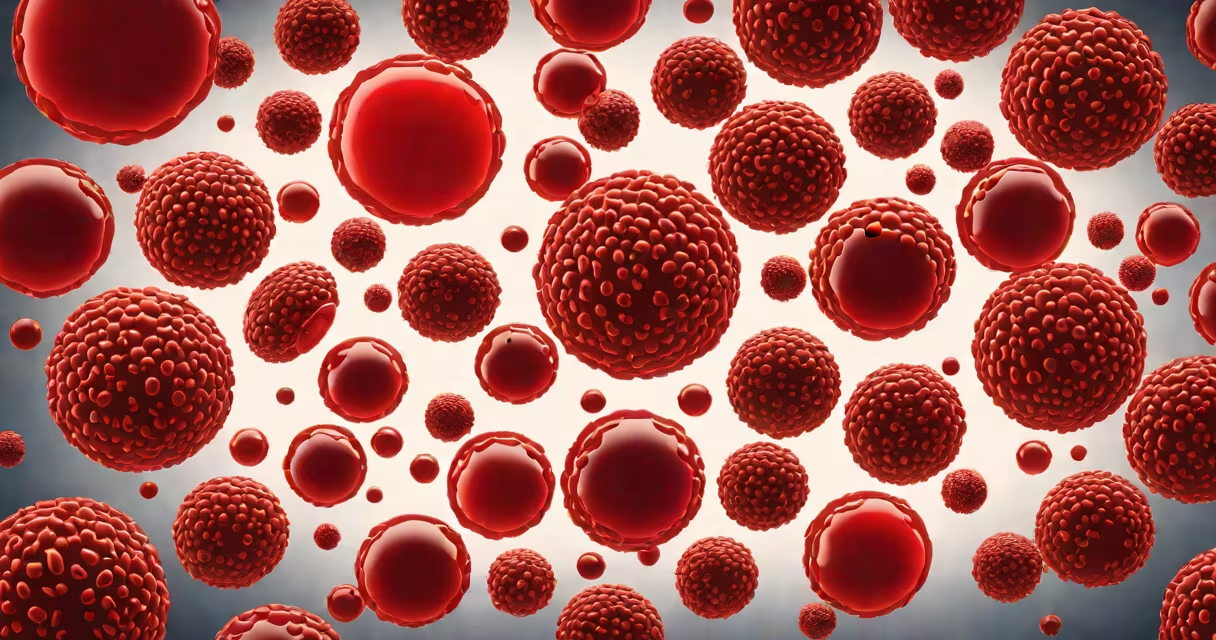
The four types of blood cells are red blood cells (erythrocytes), white blood cells (leukocytes), platelets (thrombocytes), and hematopoietic stem cells. These cells perform essential functions in oxygen transport, immune defense, clotting, and blood cell production.
Red blood cells carry oxygen from the lungs to tissues and return carbon dioxide to the lungs for exhalation. Each red blood cell contains around 250 million hemoglobin molecules, which bind to oxygen in the lungs and release it in low-oxygen environments like muscles.
White blood cells defend against infections. They include granulocytes (neutrophils, eosinophils, basophils), lymphocytes (T cells, B cells, NK cells), and monocytes. Neutrophils make up 60% of white blood cells and are the first responders to bacterial infections.
Platelets are small, disc-shaped fragments that stop bleeding by forming clots. When a blood vessel is damaged, platelets adhere to the site, change shape, and release chemicals that attract more platelets to form a plug.
Hematopoietic stem cells reside in the bone marrow and give rise to all blood cell types through a process called hematopoiesis. These undifferentiated cells renew themselves and produce progenitor cells that mature into specific blood cell lineages.
Each blood cell type has a unique structure and function. Red blood cells lack nuclei and organelles, maximizing space for hemoglobin. Their biconcave shape increases surface area for gas exchange.
White blood cells have nuclei and diverse morphologies. Neutrophils have multi-lobed nuclei and granules that stain pink. Lymphocytes are small with dense chromatin and a high nucleus-to-cytoplasm ratio. Monocytes are large with kidney-shaped nuclei and are precursors to macrophages.
Platelets are not complete cells-they are cytoplasmic fragments derived from megakaryocytes. They measure 2-4 micrometers in diameter and contain granules filled with clotting factors like fibrinogen and von Willebrand factor.
Hematopoietic stem cells are rare-about 1 in 10,000 bone marrow cells-and express the CD34 surface marker. They can self-renew and differentiate into myeloid or lymphoid lineages.
| Type | Function | Normal Range (per µL) | Origin |
|---|---|---|---|
| Red blood cells | Oxygen transport | 4.5-5.5 million | Bone marrow |
| White blood cells | Infection defense | 4,000-11,000 | Bone marrow |
| Platelets | Blood clotting | 150,000-450,000 | Megakaryocytes in marrow |
| Hematopoietic stem cells | Lineage initiation | ~100-200 per mL marrow | Bone marrow |
Red blood cells are critical in treating anemia. A single unit of packed red blood cells can raise a patient's hematocrit by 3%-4%. Transfusions are common in trauma, surgery, and chronic disease.
White blood cells are measured in complete blood counts (CBCs). A neutrophil count below 1,500/µL indicates neutropenia, increasing infection risk. Patients undergoing chemotherapy often receive G-CSF to stimulate white blood cell recovery.
Platelets are transfused to prevent or treat bleeding in patients with thrombocytopenia. A single platelet unit raises the count by approximately 5,000-10,000/µL in adults.
Hematopoietic stem cells are used in bone marrow transplants for leukemia, lymphoma, and certain genetic disorders. A single transplant can reconstitute a patient's entire blood system within 3-4 weeks.
Platelets are not cells-they are fragments. They lack DNA and cannot divide. Confusing them with cells leads to errors in interpreting lab results.
Not all white blood cells are involved in adaptive immunity. Neutrophils and eosinophils are part of innate immunity and respond rapidly to pathogens without prior exposure.
Red blood cells do not fight infections. They are specialized solely for gas transport. Their absence in the bloodstream causes tissue hypoxia, not immune deficiency.
A common error is assuming that blood cell counts reflect health. A normal CBC does not rule out conditions like early cancer or autoimmune disease. Clinical context is essential.
I observed a peripheral blood smear during a hematology rotation. Under a 40x objective, red blood cells appeared as uniform, pale discs. White blood cells stood out with visible nuclei-neutrophils had segmented lobes, lymphocytes were small with dark nuclei. Platelets were barely visible as tiny dots near the edges.
A 62-year-old man presented with fatigue and pallor. His CBC showed a hemoglobin of 7.2 g/dL and a hematocrit of 22%. After two units of packed red blood cells, his hemoglobin rose to 10.5 g/dL. This improvement confirmed the role of red blood cells in oxygen delivery.
Understanding the 4 types of blood cells requires knowing how they develop. Hematopoiesis begins in the yolk sac, shifts to the fetal liver, then settles in the bone marrow after birth. The process is regulated by cytokines like erythropoietin and granulocyte colony-stimulating factor.