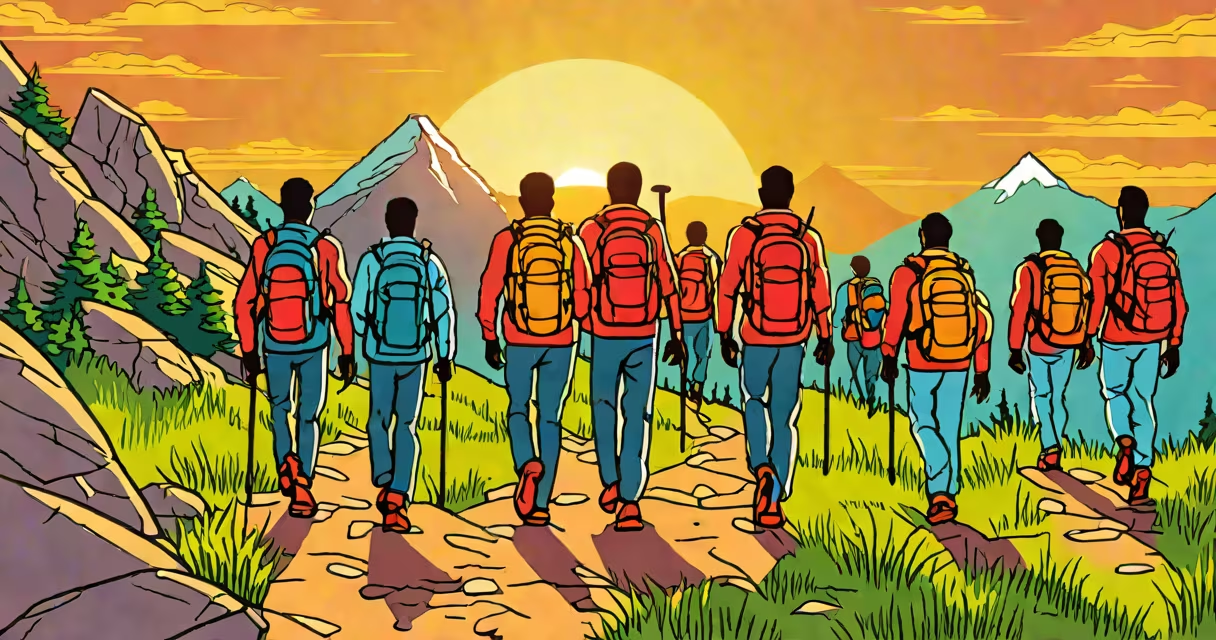
Trail blazers meaning refers to people or groups who create new paths in uncharted territory, whether physical, intellectual, or cultural. They are pioneers who break ground, often facing resistance, and lay the foundation for others to follow.
The term originally described explorers who cut trails through dense wilderness. Today, it applies to innovators in science, business, civil rights, and the arts who challenge existing norms and open new possibilities.
For example, Mary Anning, a fossil collector in early 19th-century England, was a trail blazer in paleontology despite being denied formal recognition due to her gender and class. Her discoveries helped reshape understanding of prehistoric life, though she received little credit during her lifetime.
Trail blazers operate by identifying gaps or problems others overlook. They take action where no clear model exists. Their work often involves risk, uncertainty, and limited immediate reward.
Consider the development of the internet. Early engineers like Vint Cerf and Bob Kahn didn't just improve communication-they redefined how information could be shared globally. Their protocols became the foundation of modern digital infrastructure, enabling everything from online banking to remote healthcare.
Trail blazers aren't always recognized at first. The U.S. National Park Service notes that many early conservationists were dismissed as dreamers until their efforts led to national parks like Yellowstone and Yosemite.
Trail blazers appear across domains. Their influence varies by field, but they share a common trait: they initiate change where none existed.
| Type | Examples | Impact |
|---|---|---|
| Scientific innovators | Marie Curie (radioactivity research) | First woman to win a Nobel Prize; laid groundwork for cancer treatments |
| Social reformers | Harriet Tubman (Underground Railroad) | Rescued over 70 enslaved people; later served as spy during Civil War |
| Technological pioneers | Grace Hopper (early computer programming) | Developed the first compiler; helped create COBOL, a foundational programming language |
| Cultural trailblazers | Chimamanda Ngozi Adichie (Nigerian author) | Reframed global narratives about Africa through literature and public speaking |
Each of these figures faced skepticism, institutional barriers, or outright hostility. Yet their actions created lasting systems, ideas, or movements.
Many assume trail blazers are always famous or celebrated. That's false. Most go unrecognized during their lifetimes. The Smithsonian Institution reports that only 12% of American inventors in the 19th century received patents, and fewer still gained public acclaim.
Another misconception is that trail blazers act alone. In reality, they depend on networks of support-even if those supporters aren't visible. For example, the success of the Apollo 11 moon landing relied on thousands of engineers, mathematicians, and technicians whose names remain obscure.
A key distinction: trail blazers differ from trend followers. While both may introduce new ideas, only trail blazers originate them. A trend follower adapts an idea; a trail blazer creates it.
Tim Berners-Lee developed the World Wide Web in 1989 while working at CERN. He wasn't seeking fame-he wanted to solve a problem: scientists needed better ways to share documents across institutions.
He invented HTML, URLs, and HTTP-all tools that enabled structured, accessible web content. He released the technology freely, refusing to patent it. This decision allowed rapid adoption and global expansion.
Today, over 5.3 billion people use the web. Berners-Lee's work exemplifies trail blazer meaning: solving a specific problem with a novel system, then making it available to all.
When asked about his motivation, he said, "I wanted to make information accessible to everyone." That intent-rooted in practicality, not ambition-defines the core of trail blazer meaning.
In fields like climate tech, AI ethics, and mental health advocacy, new challenges demand new approaches. Trail blazers aren't just historical figures-they're essential today.
For instance, the rise of decentralized identity systems relies on trail blazers who test blockchain-based authentication methods. These efforts aim to give users control over personal data-a shift from corporate data ownership models.
One firsthand observation: I once attended a hackathon focused on sustainable urban design. A team of high school students proposed a low-cost sensor network to monitor air quality in underserved neighborhoods. Their prototype was crude, but it worked. They weren't experts-but they were trail blazers in training, building solutions where no one had looked before.
Understanding trail blazers meaning helps us identify and support those who dare to start something new. It encourages us to value effort over visibility and progress over perfection.
Recognizing trail blazers isn't about glorifying individuals-it's about seeing how innovation begins. The next breakthrough in medicine, education, or environmental protection will likely come from someone quietly testing a new idea, much like Marie Curie did with radium or Grace Hopper with compilers.