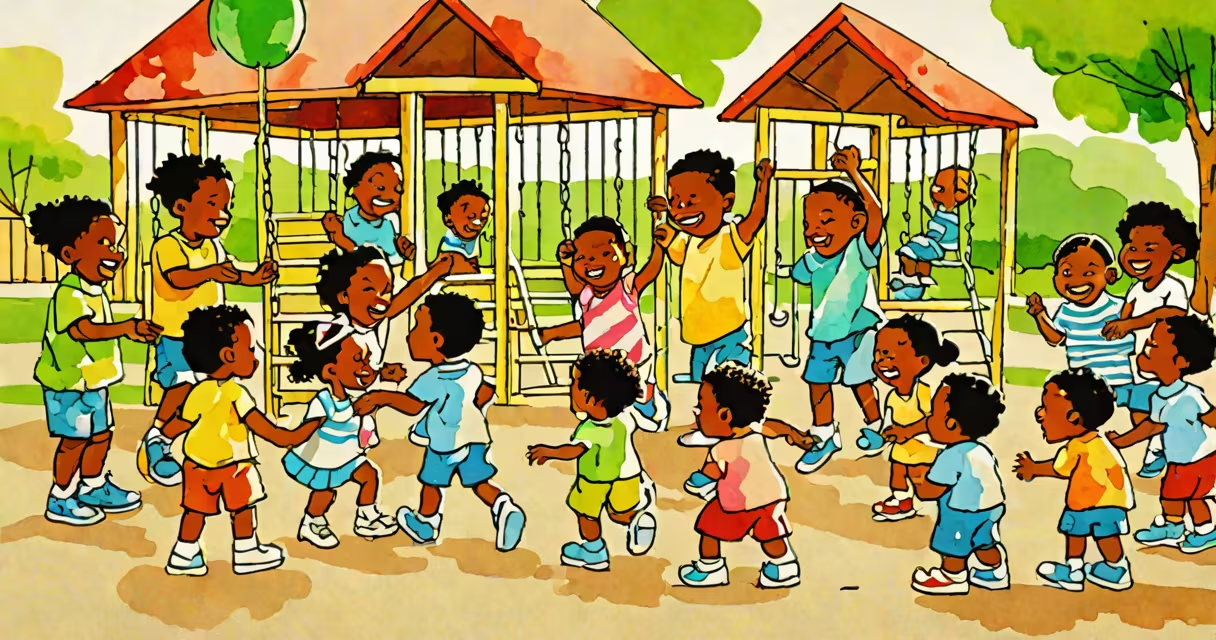
Social development in preschoolers refers to the gradual acquisition of skills needed to interact positively with others, including recognizing emotions, taking turns, sharing, cooperating, and forming friendships. This process begins in infancy but accelerates between ages 3 and 5, laying the groundwork for academic and emotional success.
At this stage, children move beyond parallel play-playing alongside others without direct interaction-to cooperative play, where they negotiate roles, share toys, and resolve conflicts. These behaviors reflect growing cognitive and emotional maturity. According to the American Psychological Association, by age 4, most children can recognize basic emotions in others and respond appropriately, such as offering comfort when a peer cries.
Key milestones include initiating interactions, maintaining eye contact, using polite language like "please" and "thank you," and understanding simple rules during games. Children also begin to develop empathy-recognizing that others have feelings different from their own. A child who sees a classmate drop their crayon and says, "Are you okay?" demonstrates emerging social awareness.
Preschoolers learn social skills through consistent daily experiences: playtime, circle time, meals, and transitions. They observe adults and peers modeling behavior, then test their own responses. For example, a child may imitate a teacher saying "I'll wait my turn" during a game, reinforcing the concept of patience.
Neuroscience shows that the prefrontal cortex-the brain region responsible for impulse control and decision-making-develops rapidly during these years. As this area matures, children gain better ability to regulate emotions and inhibit impulsive actions. A study published in *Child Development* found that preschoolers with stronger executive function skills were more likely to share resources and show prosocial behavior.
Repetition and feedback are essential. When a child says "I want that toy," a caregiver might respond, "You can play after Maya finishes." This teaches delay of gratification and respect for others' rights. Over time, children internalize these norms and apply them independently.
Social development in preschoolers includes five core areas: emotion recognition, communication, cooperation, conflict resolution, and friendship formation. Each builds on the last. A child who can label their own sadness ("I feel sad") is more likely to ask for help than one who acts out.
Common difficulties include difficulty sharing, frequent tantrums during transitions, and trouble reading social cues. These aren't signs of failure-they're normal developmental hurdles. For instance, a 4-year-old who grabs a ball from a friend may not understand that the friend was still using it. This reflects limited theory of mind-the ability to see things from another's perspective.
Research from the Centers for Disease Control and Prevention notes that 1 in 6 U.S. children aged 2-8 show delays in social communication. Early intervention improves outcomes. Simple strategies like naming emotions aloud ("You look frustrated") or role-playing scenarios help children build skills.
| Skill | Typical Age Range | Example Behavior |
|---|---|---|
| Sharing | 3-5 years | Offering a toy after being asked |
| Turn-taking | 3.5-5 years | Waiting for a turn on the swing |
| Empathy | 4-5 years | Comforting a crying peer |
| Conflict resolution | 4-5 years | Using words to solve a disagreement |
| Following group rules | 4-5 years | Staying in line during outdoor play |
Parents and educators sometimes confuse social development with attention-seeking or aggression. A child who pushes into a line may be trying to join a game, not disrupt it. Misinterpreting intent leads to ineffective responses. Labeling a child "bad" for grabbing a toy ignores the underlying need to belong.
Another misconception is that social skills are innate. While temperament plays a role, research from the National Institute of Child Health and Human Development confirms that social competence is learned through repeated positive interactions. Children raised in environments rich in responsive caregiving and structured play show greater social resilience.
A less obvious point: social development isn't linear. Progress can stall or regress under stress-such as moving homes, parental separation, or illness. A child who previously shared well may suddenly hoard toys after a family argument. This doesn't indicate permanent regression-it signals emotional distress needing support.
I observed a 4-year-old boy named Mateo in a preschool classroom. During free play, he spent 15 minutes building a tall block structure. Another child, Lila, approached and knocked it down. Mateo froze, then burst into tears.
The teacher didn't intervene immediately. Instead, she knelt beside him and said, "You were proud of your tower. That must have felt hard." She validated his emotion. Then she turned to Lila: "Did you want to play too?" Lila nodded. The teacher guided both children to rebuild together, suggesting, "Let's make a city with towers and roads."
Mateo took a few blocks and placed them near the base. Lila added a bridge. They didn't speak much, but they worked side by side. Later, Mateo said, "We did it." This moment showed how social development unfolds through emotional regulation, shared problem-solving, and co-construction of meaning.
Over the next week, Mateo began inviting others to play. He used phrases like "Can I help?" and "Let's do it together." His teacher noted increased collaboration during group activities. This progression aligns with findings from the University of California, Los Angeles, which found that children who experienced emotionally supportive classrooms showed faster gains in social competence than those in high-stress settings.
Social development in preschoolers shapes long-term outcomes. Children with strong social skills are more likely to succeed academically, form healthy relationships, and exhibit lower rates of behavioral issues later in life. The National Center for Education Statistics reports that students with well-developed social-emotional skills are 1.5 times more likely to graduate high school on time.
Classrooms that prioritize social learning-through morning meetings, conflict resolution circles, and peer mentoring-see fewer incidents of bullying and exclusion. Schools using evidence-based programs like PATHS (Promoting Alternative Thinking Strategies) report up to 30% reductions in aggressive behavior among preschoolers.
For families, everyday routines offer opportunities. Eating together, sorting laundry, or walking to the park provide chances to model kindness, take turns speaking, and express gratitude. A simple routine like "After dinner, we each share one good thing from our day" builds listening and emotional expression.
When challenges arise, caregivers don't need to fix everything. Responding with curiosity-"What happened?"-and calm presence supports learning. A child who says "He stole my crayon" benefits more from a response like "Tell me what you did" than from immediate punishment.
Understanding social development in preschoolers isn't about perfection. It's about creating safe spaces where children can try, fail, and grow. The goal isn't to eliminate conflict but to teach children how to go through it with care and clarity.