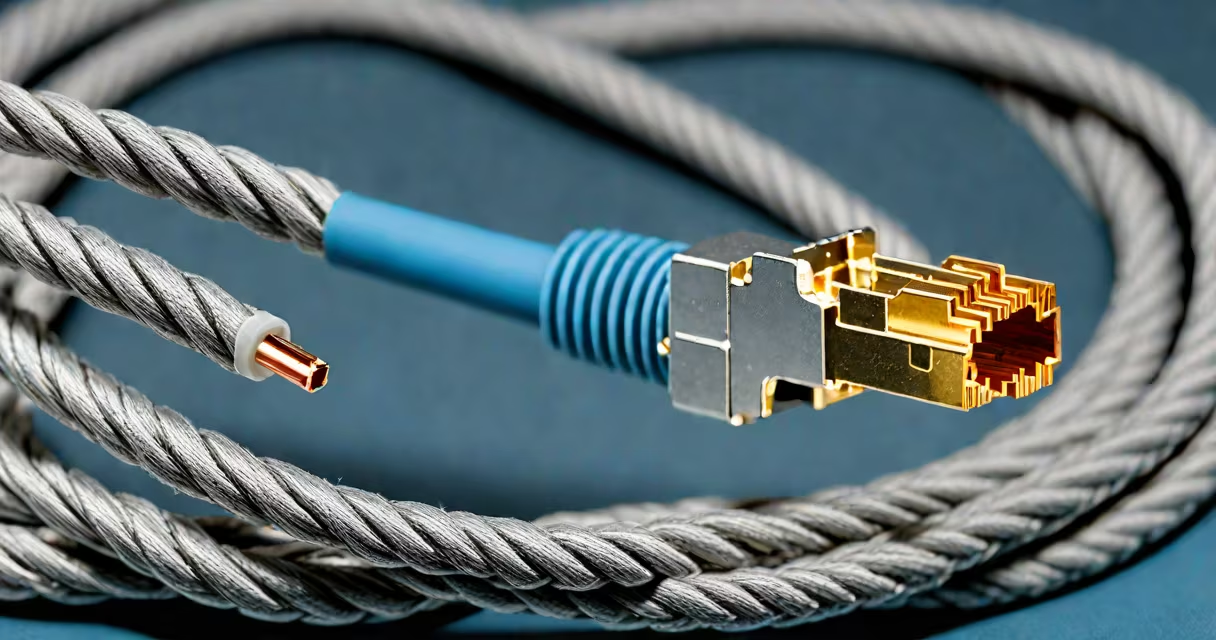
A shielded network cable is a twisted-pair Ethernet cable enclosed in a conductive layer-typically braided copper or foil-that blocks electromagnetic interference (EMI) and radio-frequency interference (RFI). This shielding improves signal integrity over long distances and in electrically noisy environments such as industrial facilities or near heavy machinery.
Unlike unshielded twisted pair (UTP) cables, which rely solely on twisting wires to reduce crosstalk, shielded network cables use physical barriers to prevent external noise from corrupting data transmission. They are rated under standards like TIA-568-C.2 and ISO/IEC 11801, which define performance levels based on frequency and attenuation.
Shielded cables are required in environments where EMI exceeds acceptable thresholds. For example, in a manufacturing plant with motors, variable frequency drives, and welding equipment, unshielded cables often fail due to signal degradation. Shielded cables maintain consistent throughput and reduce error rates.
Electromagnetic interference arises from nearby power lines, fluorescent lighting, or wireless transmitters. These sources emit signals that induce voltage fluctuations in nearby conductors. In a network cable, this can cause bit errors during data transfer.
The shield acts as a Faraday cage. When external electromagnetic fields encounter the shield, they induce currents in the conductive layer. These currents are then safely routed to ground via a drain wire or grounding clip, preventing them from reaching the inner twisted pairs.
For effective shielding, the entire cable must be grounded at both ends. If grounding is incomplete, the shield becomes a conductor for noise rather than a barrier. This is why shielded cables require proper termination using shielded connectors and grounded patch panels.
Shielded network cables come in several configurations, each suited to different installation scenarios:
| Type | Shielding Layer | Best For | Example Standard |
|---|---|---|---|
| FTP (Foiled Twisted Pair) | Foil wrap around each twisted pair | Low to moderate EMI, cost-sensitive setups | Cat5e FTP |
| STP (Shielded Twisted Pair) | Braided copper shield around all pairs | High EMI areas, secure installations | Cat6 STP |
| ScTP (Screened Twisted Pair) | Foil shield + braided shield | Harsh environments, data centers | Cat6a ScTP |
Some cables use double shielding-foil over individual pairs and a braided outer shield. This design minimizes crosstalk and external noise simultaneously. The most common types are Cat6 and Cat6a, supporting speeds up to 10 Gbps over 55 meters.
Contrary to popular belief, shielding does not increase bandwidth. Instead, it preserves signal quality, allowing higher data rates to be sustained over longer runs. A Cat6a shielded cable can reliably transmit 10 Gbps at 100 meters, while an unshielded version may drop to 1 Gbps beyond 55 meters in noisy settings.
Shielded network cables are standard in commercial and industrial infrastructure. Data centers, hospitals, and government facilities often mandate shielded cabling due to strict compliance requirements.
For example, the U.S. Department of Defense requires shielded cabling in classified communication systems. According to MIL-STD-188-124, all network connections in secure zones must use shielded cables with continuous grounding to prevent eavesdropping via electromagnetic leakage.
In healthcare, MRI rooms generate intense electromagnetic fields. Unshielded cables placed near MRI machines can introduce noise into imaging systems. Using shielded Cat6 cables helps diagnostic data remains accurate and free from artifacts.
Even in office buildings, shielded cables outperform unshielded ones when installed alongside power conduits. A study by the Telecommunications Industry Association (TIA) found that in mixed-cable trays, shielded cables had 87% fewer signal errors than UTP cables over 30 meters.
Many assume that shielded cables are always better. That's false. In low-interference environments-like home offices or small retail spaces-unshielded Cat6 cables perform equally well and cost less. Over-shielding adds weight, stiffness, and price without benefit.
Another misconception is that shielding eliminates all interference. It doesn't. Proper installation is critical. If the shield is broken during termination or not grounded, it can act as an antenna, amplifying noise instead of blocking it.
I once tested a shielded Cat6a cable in a server room with multiple switches and UPS units. Despite the shielding, the cable failed at 10 Gbps until we replaced the RJ45 connector with a shielded version and ensured the shield was connected to the jack's metal housing. Without this, the shield was electrically disconnected and ineffective.
Also, shielded cables do not replace proper cable routing. Running them parallel to power lines increases coupling. The recommended practice is to cross power and data cables at 90-degree angles, not run them side-by-side.
A factory in Detroit upgraded its control system to use Ethernet/IP for machine-to-machine communication. Initial tests showed packet loss and intermittent disconnections. Engineers traced the issue to a 100-meter run of unshielded Cat6 cable running alongside a 480V motor control panel.
After replacing the cable with shielded Cat6a (ScTP), the error rate dropped from 12 per 1,000 packets to 0.3. The shield reduced EMI from the motor's switching transients. Grounding was verified using a continuity tester-resistance between shield and ground point was below 1 ohm.
This change prevented production downtime. The factory now uses shielded cables for all critical control loops and maintains a log of shield continuity checks during routine maintenance.
When choosing a cable, look for "S" in the category rating (e.g., Cat6a S/FTP). The "S" indicates shielding. Without it, the cable lacks full protection. Always verify the cable's certification against ANSI/TIA-568-D.2 or ISO/IEC 11801:2017.
Shielded network cable is not a universal solution. It excels where EMI is present. In clean environments, unshielded cables offer better value. But in high-noise or security-sensitive applications, it's essential.