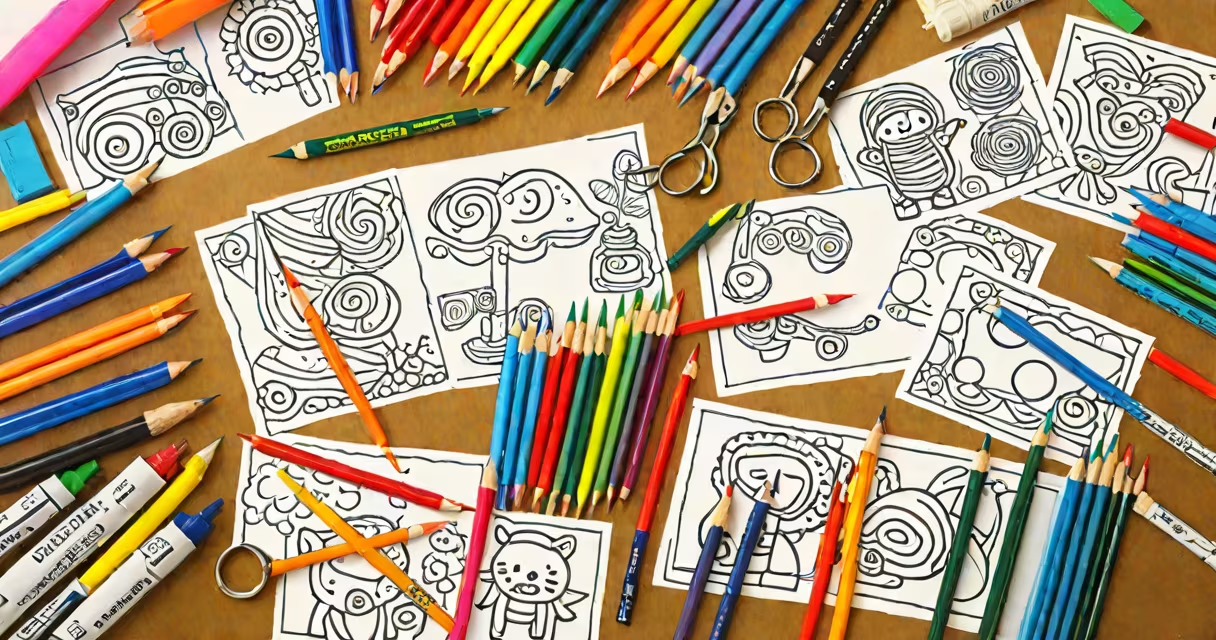
Printables for kids are downloadable PDFs or digital files designed for immediate printing and use in educational, creative, or recreational activities. They include coloring sheets, worksheets, puzzles, flashcards, and game templates tailored to children's developmental stages and interests.
These materials are created to support learning at home or in classrooms. They require no special tools beyond a printer and paper. Most are free and available instantly online. Teachers, parents, and caregivers use them to reinforce concepts in math, reading, science, and social skills.
For example, a kindergarten teacher uses a set of "counting bears" printables to teach numbers 1-10. Each page features bear-shaped cutouts with numerals and matching groups of objects. Students color, cut, and sort the bears into numbered bins. This hands-on activity builds number recognition and fine motor control.
Each printable file is designed as a single-page layout optimized for standard 8.5 x 11-inch paper. Files are typically in PDF format, ensuring consistent appearance across devices and printers. Users download the file, open it with a free viewer like Adobe Acrobat Reader, and send it to a printer.
Once printed, the material can be used immediately. Many include clear instructions, visual cues, and space for writing or drawing. Some feature perforated edges for easy removal from a notebook or binder.
Some advanced printables integrate QR codes linking to audio readings, video tutorials, or interactive versions on tablets. A printable worksheet on ocean animals might include a QR code that plays a dolphin sound effect when scanned, enhancing engagement for auditory learners.
Printables for kids fall into several functional categories based on purpose and age group. The most common types include:
| Type | Age Range | Common Use | Example |
|---|---|---|---|
| Coloring sheets | 3-8 years | Motor skill development, creativity | Animals, holidays, shapes |
| Worksheets | 5-10 years | Math, phonics, spelling practice | Letter tracing, addition problems |
| Puzzles | 6-12 years | Critical thinking, pattern recognition | Word searches, mazes, crosswords |
| Flashcards | 4-9 years | Vocabulary, sight words, math facts | Animal names, multiplication tables |
| Games & activities | 5-11 years | Role play, storytelling, STEM exploration | Recipe cards, scavenger hunts, science experiments |
Themed printables align with seasonal events, holidays, or curriculum units. A Halloween-themed printable pack may include a jack-o'-lantern coloring sheet, a trick-or-treat word scramble, and a recipe card for "monster muffins." These resources help educators and parents create immersive learning experiences.
Not all printables are equally effective. Research from the National Association for the Education of Young Children (NAEYC) shows that printables with open-ended prompts-like "Draw your favorite animal and tell me its name"-lead to higher verbal engagement than those with rigid, single-answer tasks.
Printables for kids are widely used in homes, preschools, elementary schools, and tutoring centers. Their popularity stems from low cost, ease of access, and adaptability. A parent in rural Idaho downloaded a set of "weather journal" printables to track daily conditions with their 6-year-old. The child drew clouds, raindrops, and suns each morning and wrote one sentence about the weather, building both literacy and observational skills.
Classrooms benefit from printables during transitions, quiet time, or as extensions of lessons. A third-grade teacher used a "space explorer" printable kit to supplement a unit on planets. Students completed a planet fact sheet, colored a solar system diagram, and played a matching game with planet names and images. The lesson was reinforced through multiple modalities-visual, kinesthetic, and written.
One underappreciated advantage is consistency across households. When a school sends home a printable packet on fractions, all students receive the same material. This reduces disparities in access to supplemental learning tools, especially in underserved communities.
Many assume printables for kids are passive or overly simplistic. This is incorrect. Well-designed printables encourage interaction, critical thinking, and personal expression. A printable "build-a-story" template with blank speech bubbles and character outlines allows children to invent plots, develop narrative structure, and practice writing.
Another myth is that printables replace real-world learning. They don't. Instead, they complement hands-on experiences. A printable experiment guide for making a baking soda volcano doesn't replace the actual experiment-it provides safety instructions, materials list, and prediction prompts before the child mixes ingredients.
Some educators avoid printables due to concerns about screen time. But printables reduce screen exposure when used as physical activities. A child who spends 15 minutes coloring a dinosaur sheet from a printable file is less likely to spend that time watching videos.
In 2022, a mother in Oregon used printables for kids to structure her 7-year-old's homeschool week. She selected a weekly theme: "Under the Sea." Each day included a printable activity:
She printed all materials on recycled paper. The child completed each task independently, then reviewed them together. Over six weeks, the child's vocabulary increased by 40% in science-related terms, according to a follow-up assessment using the Early Language Milestones Scale (ELMS).
This example shows how printables for kids function not as standalone tools but as parts of a larger learning structure. They provide structure, reduce planning time, and allow parents to focus on interaction rather than resource creation.
When selecting printables for kids, prioritize those with clear learning objectives, age-appropriate difficulty, and minimal distracting graphics. Avoid materials with excessive clip art or unclear instructions. Always preview the file before printing to ensure legibility and proper scaling.
Printables for kids remain a practical, accessible way to enrich childhood learning. With thoughtful selection and integration, they support cognitive growth, creativity, and independence in children aged 3 to 12.