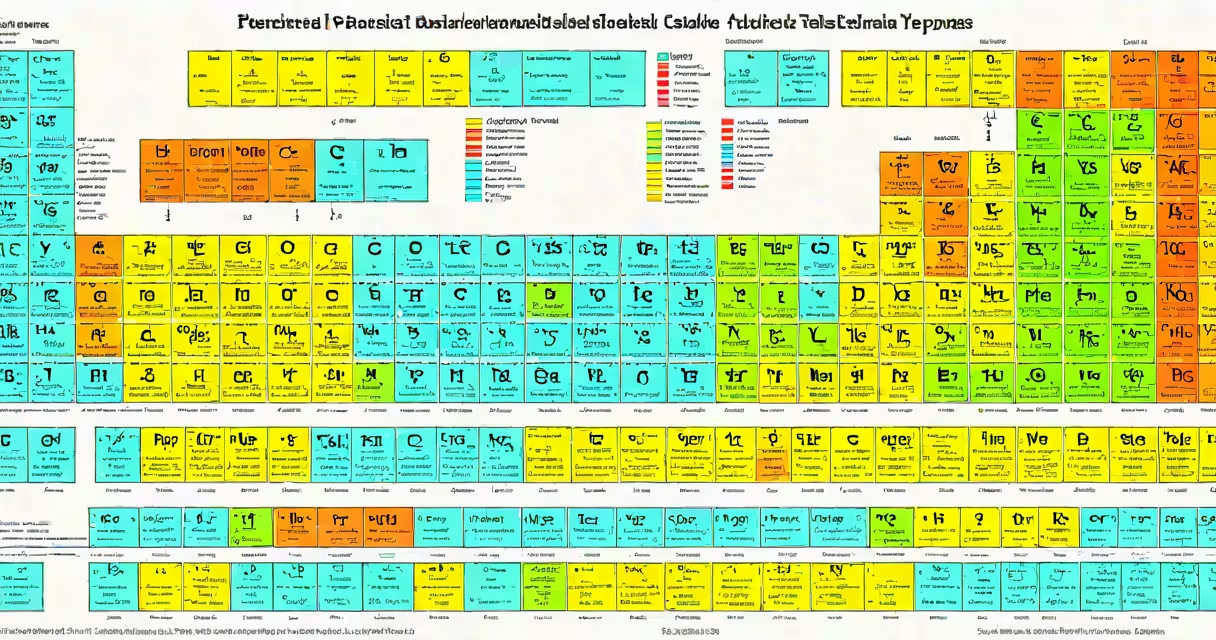
The periodic table organizes all known chemical elements by increasing atomic number, grouping them into rows (periods) and columns (groups) based on recurring chemical and physical properties. Elements are further classified into metals, nonmetals, and metalloids, and arranged in s, p, d, and f blocks according to electron configuration.
Rows are called periods. There are seven periods, each corresponding to a principal energy level. Period 1 contains only hydrogen and helium, while period 6 includes the lanthanides. Each period ends when a noble gas completes the outer shell.
Columns are groups. Elements in the same group share similar valence electron counts and exhibit analogous chemical behavior. Group 1 elements (alkali metals) all have one valence electron and react vigorously with water. Group 18 elements (noble gases) have full outer shells and rarely form compounds.
Elements are also grouped into blocks based on the subshell being filled with electrons. The s-block includes Groups 1 and 2; the p-block spans Groups 13-18; the d-block covers the transition metals (Groups 3-12); and the f-block holds the lanthanides and actinides.
Metals dominate the left side and center of the table. They conduct heat and electricity, are malleable, and tend to lose electrons in reactions. Iron, copper, and gold are common metals used in construction and electronics.
Nonmetals appear on the upper right. They lack metallic characteristics and often gain electrons during bonding. Oxygen, nitrogen, and chlorine are essential for life and industrial processes. Fluorine is the most electronegative element and forms strong bonds with almost all others.
Metalloids lie along a diagonal line between metals and nonmetals. They display mixed properties. Silicon, a metalloid, is critical in semiconductor manufacturing. Its electrical conductivity increases with temperature-unlike metals, where it decreases.
Many assume all elements in a group behave identically. But reactivity trends vary within groups. For example, lithium reacts gently with water, while cesium explodes violently. This trend arises because atomic size increases down the group, lowering ionization energy and making electron loss easier.
Another misconception is that all transition metals are hard and dense. Zinc, in Group 12, is relatively soft and low-melting. It's used in galvanizing steel due to corrosion resistance, not structural strength.
A non-obvious fact: the placement of hydrogen is debated. It sits in Group 1 due to one valence electron, but it behaves more like a nonmetal. Hydrogen forms covalent bonds, unlike alkali metals, which form ionic compounds. Some tables place it above lithium, others in a separate position.
| Type | Location | Examples | Use Cases |
|---|---|---|---|
| Alkali Metals | Group 1 | Lithium, sodium, potassium | Lithium-ion batteries, salt production, biological signaling |
| Transition Metals | d-block, Groups 3-12 | Iron, copper, gold | Construction, wiring, jewelry, catalysts |
| Halogen Nonmetals | Group 17 | Fluorine, chlorine, bromine | Water purification, plastics, pharmaceuticals |
| Noble Gases | Group 18 | Neon, argon, xenon | Lighting, inert atmospheres, medical imaging |
Consider sodium (Na, atomic number 11) and chlorine (Cl, atomic number 17). Sodium lies in Group 1, Period 3. It has one electron in its outer shell. Chlorine is in Group 17, Period 3, with seven valence electrons.
Sodium readily donates its single valence electron to achieve a stable octet. Chlorine accepts one electron to complete its outer shell. Together, they form NaCl-common table salt-through ionic bonding.
This reaction is predictable using the periodic table. Elements near opposite ends of the table often combine to stabilize their electron configurations. The table's layout reveals such patterns without needing to memorize every compound.
Some confuse "period" with "group." A period is a horizontal row; a group is a vertical column. All elements in the same period have the same number of electron shells. All elements in the same group have the same number of valence electrons.
Another error is assuming all elements in the f-block are radioactive. While many actinides are synthetic and decay quickly, cerium (Ce), a lanthanide, occurs naturally and is used in lighter flints and catalytic converters.
I once observed a student try to predict the color of francium, a Group 1 element. The periodic table doesn't show color, but knowing that alkali metals turn yellow in flame tests helped. Rubidium produces a red flame, cesium blue-violet-patterns visible through lab experiments, not the table itself.
Chemists use the periodic table to forecast unknown element behaviors. Mendeleev left gaps for undiscovered elements like gallium and germanium, accurately predicting their densities and melting points before discovery.
In materials science, engineers select elements based on position. Titanium (Group 4) is strong and lightweight-ideal for aerospace components. Its location near the transition metals reflects high melting point and resistance to oxidation.
For students learning chemistry, understanding the parts of the periodic table reduces guesswork. Recognizing that boron (Group 13) is a metalloid explains its semiconductor properties. Knowing that tin is in Group 14 helps explain its allotropes-gray and white tin-used in solder and historical artifacts.
When analyzing a new substance, start with its position on the periodic table. The element's group, period, and block reveal likely reactivity, bonding tendencies, and physical traits. This structure underpins modern chemistry, from drug design to battery development.