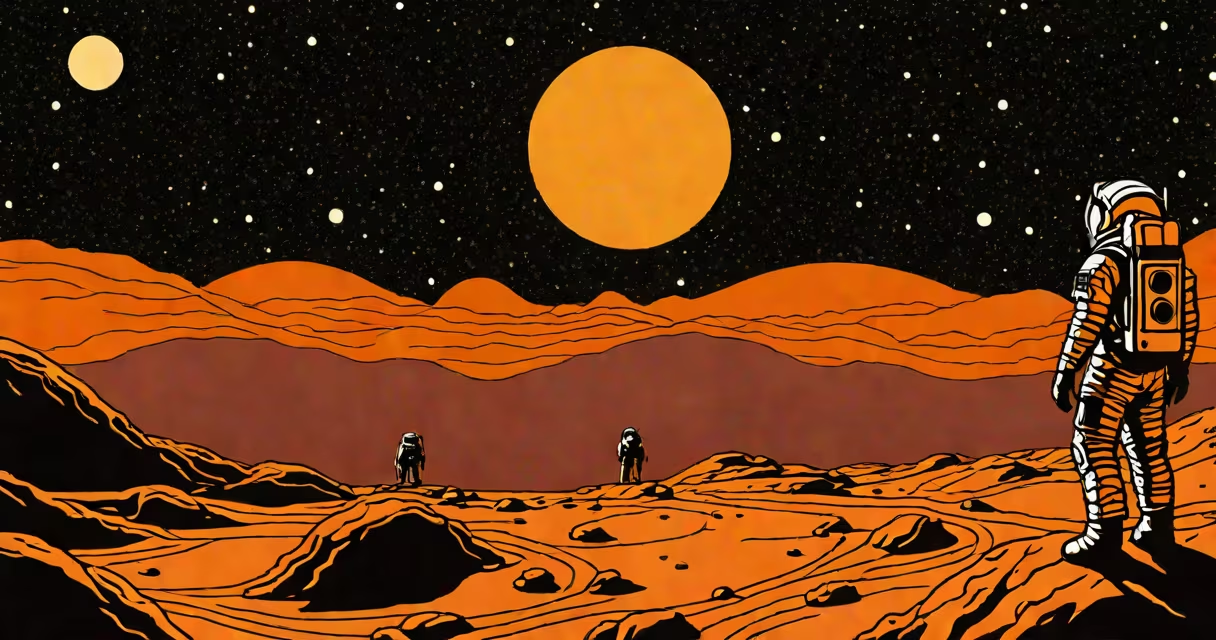
Outer Wilds game is a first-person narrative adventure set in a solar system trapped in a 22-minute time loop, where players explore alien planets, solve environmental puzzles, and uncover a cosmic mystery tied to the collapse of a star. Every cycle resets the universe, forcing players to piece together fragmented clues across multiple runs.
The game was developed by Mobius Digital and released in 2019. It won the Game Developers Choice Award for Best Game and was named Game of the Year by the British Academy Film Awards. Its design emphasizes player-led discovery over explicit instruction, rewarding curiosity and pattern recognition.
Players assume the role of an unnamed space explorer aboard the Outer Wilds spacecraft, launching into a solar system where time resets every 22 minutes. During each cycle, planetary conditions change-planets shift position, weather alters, and events unfold in sequence. The core mechanic is not death, but repetition: failure to complete objectives leads to a reset, not a penalty.
Time loops in Outer Wilds game are not just a narrative device-they're structural. The entire solar system evolves in real time during each 22-minute cycle. For example, the planet Glacial Peak slowly melts as the sun rises, revealing buried ruins. If players don't reach the cave entrance before the ice melts, they lose access until the next loop.
Each planet offers unique environmental challenges. On Timber Hearth, players must go through shifting forests shaped by gravity waves. On the planet Brittle Hollow, a fragile structure collapses under pressure, requiring precise timing. These systems are not random-they follow consistent physical rules, allowing players to learn and adapt.
Progress is measured not by levels or inventory, but by memory. Players collect audio logs, notes, and visual artifacts that build a timeline of past civilizations. The game never explains everything upfront. Instead, it trusts players to connect dots across loops. A single clue-like a child's drawing of a black hole-can trigger a chain of discoveries spanning multiple cycles.
Outer Wilds game combines procedural planet generation with handcrafted narrative beats. While the layout of planets changes slightly between loops due to gravitational shifts, the core environments are static. This balance allows for both variety and consistency in player experience.
The game uses a minimalist interface. There is no map, no quest markers, and no health bar. Players rely on observation, recording observations in a journal, and testing hypotheses. The only tools are a jetpack, a scanner, and a camera-all basic, but essential for documenting anomalies.
Sound design plays a critical role. Ambient noise, radio chatter, and distorted voices from ancient civilizations create emotional weight. The score, composed by Andrew Prahlow, uses sparse piano and ambient textures to mirror the isolation of space. One track, "The Last Transmission," plays during the final moments of each loop and is widely cited as one of the most emotionally resonant video game pieces of the decade.
| Planet | Key Feature | Discovery Timing |
|---|---|---|
| Glacial Peak | Melting ice reveals ancient ruins | Within first 6 minutes of loop |
| Timber Hearth | Gravity waves reshape forest paths | After 10 minutes; requires timing |
| Brittle Hollow | Structure collapses under stress | Only accessible during low-gravity phase |
| Dark Bramble | Living forest grows around wreckage | Best explored after 15 minutes |
Outer Wilds game is used primarily as a benchmark in narrative design and player agency. It's studied in game development curricula at institutions like the University of Southern California and NYU Game Center for its integration of environmental storytelling and emergent gameplay.
Its influence extends beyond entertainment. Educators use it to teach systems thinking. A 2021 study published in *Computers & Education* found that students who played Outer Wilds game demonstrated higher retention of scientific concepts like orbital mechanics and stellar evolution compared to traditional lecture formats.
Many players return to Outer Wilds game not for completion, but for reflection. After finishing the story, some spend hours replaying loops just to observe the quiet beauty of a planet's rotation or the way light refracts through a nebula. The game rewards patience and attention, not speed or skill.
One widespread error is assuming Outer Wilds game is a "hardcore" or "difficult" title. It is not. The challenge lies in understanding-not in reflexes or precision. Players often fail early because they expect to be guided. But the game's design assumes curiosity, not mastery.
Another misconception is that the time loop is punishment. It is not. The loop is a feature of the universe, not a barrier. The game treats each cycle as a chance to learn. You aren't failing-you're gathering data.
A less obvious but critical distinction: Outer Wilds game does not have a "true ending." The final revelation-the nature of the Dark Bramble and the fate of the Nomai people-is not a victory. It's a conclusion. The game ends not with resolution, but with acceptance. As the developers stated in a 2020 interview with *Polygon*, "We wanted players to feel the weight of knowing something profound-and then live with it."
Consider the planet the Eye of the Universe-a dying star surrounded by a swirling nebula. Early in the game, players see strange patterns in the gas. They may notice that certain shapes appear repeatedly in different loops.
By collecting audio logs from the Nomai civilization, players learn that the nebula contains echoes of their final transmissions. The real breakthrough comes when a player realizes that the nebula's form changes based on the observer's location. By flying to specific points in orbit, they can align the visual patterns to match a known constellation.
This alignment triggers a hidden signal. Decoding it reveals coordinates pointing to a buried ship beneath the surface of a moon. That ship holds the final log: "We were not the first. We were not the last. We were the ones who remembered."
This moment-discovered by thousands of players independently-demonstrates how Outer Wilds game turns exploration into epiphany. No hint, no tutorial. Just a quiet realization that the universe remembers.
I spent 37 loops trying to find the signal. On the 38th, I flew to the correct angle and saw the pattern. The screen went dark. Then silence. I didn't move for five minutes. The game had not told me to do anything. I had simply noticed.
Outer Wilds game is not about winning. It's about seeing. It's about learning that some mysteries exist not to be solved-but to be witnessed.