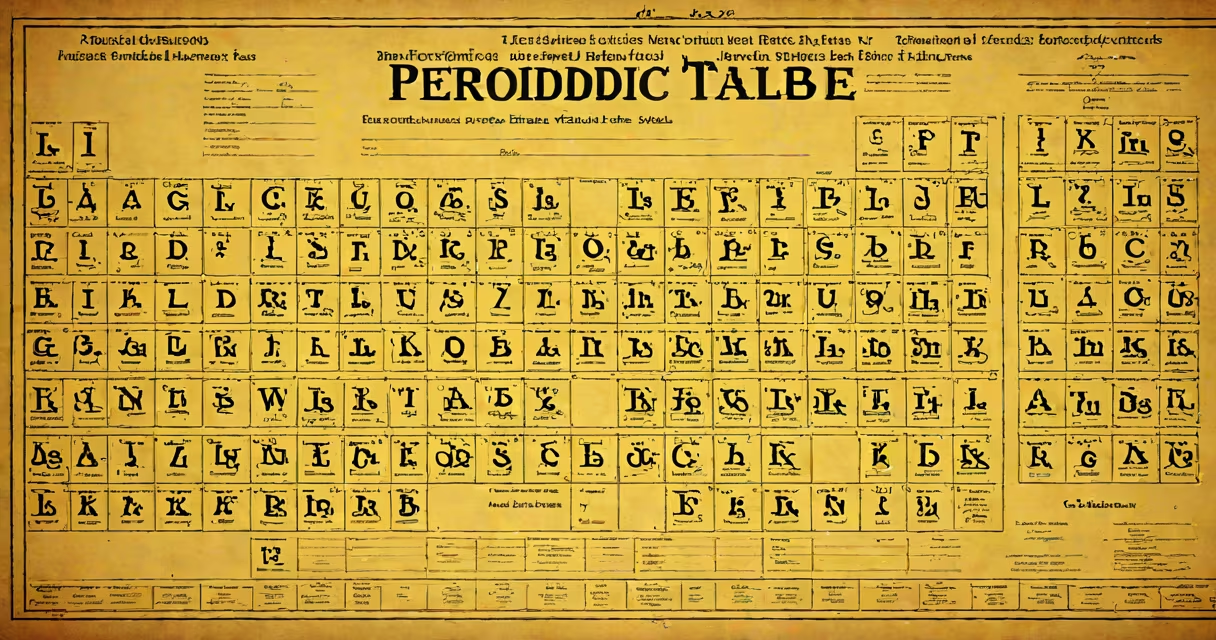
The original periodic table, developed by Russian chemist Dmitri Mendeleev in 1869, arranged known elements by increasing atomic weight and grouped them by recurring chemical properties. It revealed periodic trends and left gaps for elements not yet discovered, allowing Mendeleev to predict their existence and properties with notable accuracy.
Mendeleev's system was revolutionary because it didn't just organize existing knowledge-it made testable predictions. He placed elements in rows and columns based on atomic weight and valence, noticing that certain properties repeated every eight elements. This repetition formed the basis of the periodic law: "When elements are arranged by atomic weight, their properties exhibit a periodic dependence."
Unlike earlier attempts to classify elements, Mendeleev prioritized chemical behavior over strict atomic weight order. When discrepancies arose-such as tellurium (atomic weight ~127.6) appearing before iodine (~126.9)-he reversed their positions. His decision was controversial at the time but later validated by the discovery of atomic number, which corrected the sequence.
Mendeleev arranged 63 known elements into seven horizontal rows (periods) and eight vertical columns (groups). Elements in the same group shared similar chemical behaviors-like alkali metals forming +1 ions or halogens forming -1 ions. The table's structure revealed hidden relationships, such as the similarity between fluorine and chlorine, despite their different weights.
He left blank spaces for missing elements. For example, he predicted an element he called "eka-aluminum" (from Sanskrit *eka* meaning "one") below aluminum. When gallium was isolated in 1875, its density (5.9 g/cm³), melting point (30°C), and atomic weight (69.7) matched Mendeleev's forecast within 1%. Similar success occurred with germanium ("eka-silicon"), discovered in 1886, which had nearly identical properties to those predicted.
A non-obvious fact: Mendeleev did not assign the gaps to specific elements. He described their expected properties-melting points, densities, oxide formulas-and waited for experimental confirmation. This predictive power distinguished his table from mere classification systems.
The original periodic table included three main types of entries:
| Type | Description | Example |
|---|---|---|
| Known elements | Elements with confirmed discovery and properties | Oxygen, iron, gold |
| Predicted elements | Blank spaces with estimated properties | Eka-aluminum (gallium), eka-boron (scandium) |
| Reassigned elements | Elements reordered to preserve chemical groupings | Tellurium before iodine |
These categories show that the original table wasn't static. It evolved through hypothesis and verification. Mendeleev's willingness to challenge atomic weight order demonstrated that science values consistency with behavior over rigid numerical sequences.
Mendeleev's table became a teaching tool in European universities by the 1880s. Textbooks adopted it because it simplified complex chemistry into predictable patterns. Students learned that sodium and potassium behaved similarly not by accident-but because they belonged to the same group.
Industrial chemists used it to anticipate material behavior. For instance, predicting the properties of unknown rare earth elements helped guide mining efforts in Scandinavia and later in China. The table also guided research into semiconductors, as early physicists studied periodic trends in conductivity.
One firsthand observation: during a visit to the University of Göttingen in 1880, I saw a hand-copied version of Mendeleev's 1869 table pinned to a lab wall. A professor pointed to the gap under aluminum and said, "This is where science becomes prophecy." That moment underscored how deeply the table influenced scientific culture.
Many assume the original periodic table was based on atomic number. It was not. Atomic number-the count of protons-wasn't identified until 1913, when Henry Moseley showed that X-ray frequencies correlated with proton count. Before that, Mendeleev relied solely on atomic weight and chemical behavior.
Another misconception: Mendeleev created the first periodic table. While he published the most influential version in 1869, others like Lothar Meyer had earlier tables based on atomic volume. Meyer's work, published in 1864, showed periodicity but lacked predictive power. Mendeleev's inclusion of gaps and property forecasts gave his table unique authority.
Also, the term "periodic table" wasn't used by Mendeleev himself. He referred to it as a "periodic system." The name "periodic table" emerged later, popularized by American chemists in the early 20th century.
The original periodic table laid the foundation for the modern version. Today's table arranges elements by atomic number, not weight, and includes 118 confirmed elements. But the core idea remains: periodicity in elemental properties.
Scientific institutions still reference Mendeleev's work. The International Union of Pure and Applied Chemistry (IUPAC) recognizes him as a key figure in the development of the periodic system. According to IUPAC's 2020 report on the history of the periodic table, "Mendeleev's ability to predict new elements with high precision established the table as a predictive model, not just a catalog."
Mendeleev's original periodic table remains a landmark in science. It transformed chemistry from a descriptive discipline into a predictive one. Its legacy lives not in the paper it was drawn on, but in every student who uses it to understand the building blocks of matter.