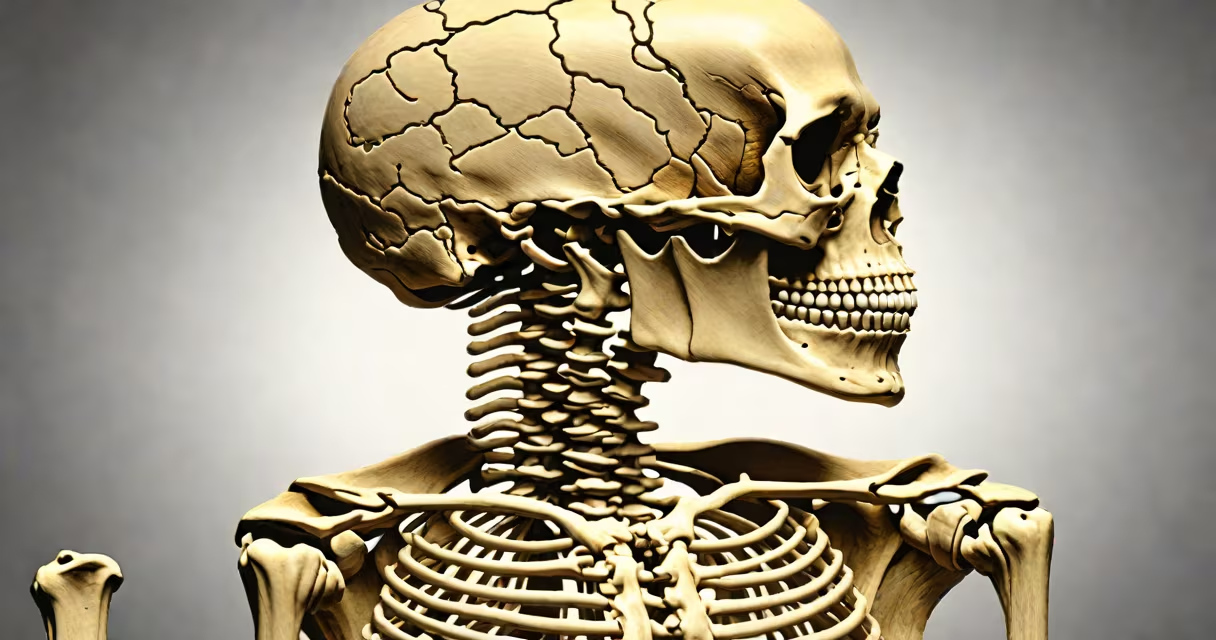
The organization of the skeleton divides the human body's bony structure into two primary regions: the axial skeleton, which supports the head, neck, and trunk, and the appendicular skeleton, which includes the limbs and girdles that attach them to the axial frame. This division enables efficient load distribution, movement, and protection of important organs.
The axial skeleton comprises 80 bones and forms the central axis of the body. It includes the skull (22 bones), vertebral column (26 bones), sternum (1 bone), and ribs (24 bones). These elements protect the brain, spinal cord, and thoracic organs. The skull encases the brain and provides attachment points for facial muscles. The vertebral column, made of cervical, thoracic, lumbar, sacral, and coccygeal vertebrae, supports the upper body and allows flexible motion. The rib cage surrounds the heart and lungs, limiting impact during trauma.
The appendicular skeleton contains 126 bones and consists of the pectoral girdle (clavicles and scapulae), pelvic girdle (hip bones), and the bones of the upper and lower limbs. The pectoral girdle anchors the arms to the axial skeleton, enabling many motion. The pelvic girdle connects the legs to the spine and supports the weight of the upper body during standing and walking. Limb bones-such as the humerus, radius, ulna, femur, tibia, fibula, and hand/foot bones-allow precise manipulation and locomotion.
| Skeleton Type | Bone Count | Primary Functions | Key Components |
|---|---|---|---|
| Axial | 80 | Protection, support, balance | Skull, vertebrae, sternum, ribs |
| Appendicular | 126 | Movement, manipulation, locomotion | Limbs, shoulder and hip girdles |
Each region functions independently yet interdependently. For example, the pelvis transfers forces from the spine to the legs during walking. The scapula rotates during arm elevation, allowing overhead reach. Without this coordinated design, complex movements like throwing or climbing would be impossible.
Confusion often arises between the axial skeleton and the entire skeleton. Some assume the axial system includes the limbs because both are involved in posture. But the limbs belong exclusively to the appendicular system. Another common error is equating bone count with function. While the axial skeleton has fewer bones, it performs critical protective roles. The skull protects the brain from impacts-its dense temporal bones absorb shock during falls. The vertebral column houses the spinal cord; damage to a single vertebra can result in paralysis.
One non-obvious fact: the sternum is not a single bone at birth. It develops from three separate ossification centers that fuse during childhood. By age 10, the manubrium, body, and xiphoid process form a unified structure. This fusion process explains why sternum fractures in children may heal differently than in adults.
Consider a person lifting a heavy box. The axial skeleton stabilizes the torso-the spine maintains alignment, and the ribcage prevents internal organ displacement. Meanwhile, the appendicular skeleton activates: the pelvis rotates slightly, the hips extend, and the arms flex at the shoulders and elbows. This integrated effort relies on the precise organization of the skeleton. Without it, such tasks would require excessive muscular effort or risk injury.
When studying anatomy, visualizing the skeleton as two linked systems improves retention. The axial skeleton acts as the foundation; the appendicular system builds upon it. This model appears in medical textbooks such as Gray's Anatomy (41st edition), which states: "The axial skeleton forms the core around which the appendicular skeleton is organized." Similarly, the National Institutes of Health notes that "the division into axial and appendicular components reflects evolutionary adaptations for bipedalism and manual dexterity."
I once observed a cadaver dissection where a student struggled to identify the clavicle until the instructor pointed out its S-shape and location between the sternum and scapula. That moment highlighted how understanding the organization of the skeleton simplifies identification. The clavicle belongs to the pectoral girdle-part of the appendicular system-and serves as a strut to maintain shoulder position during arm movement.