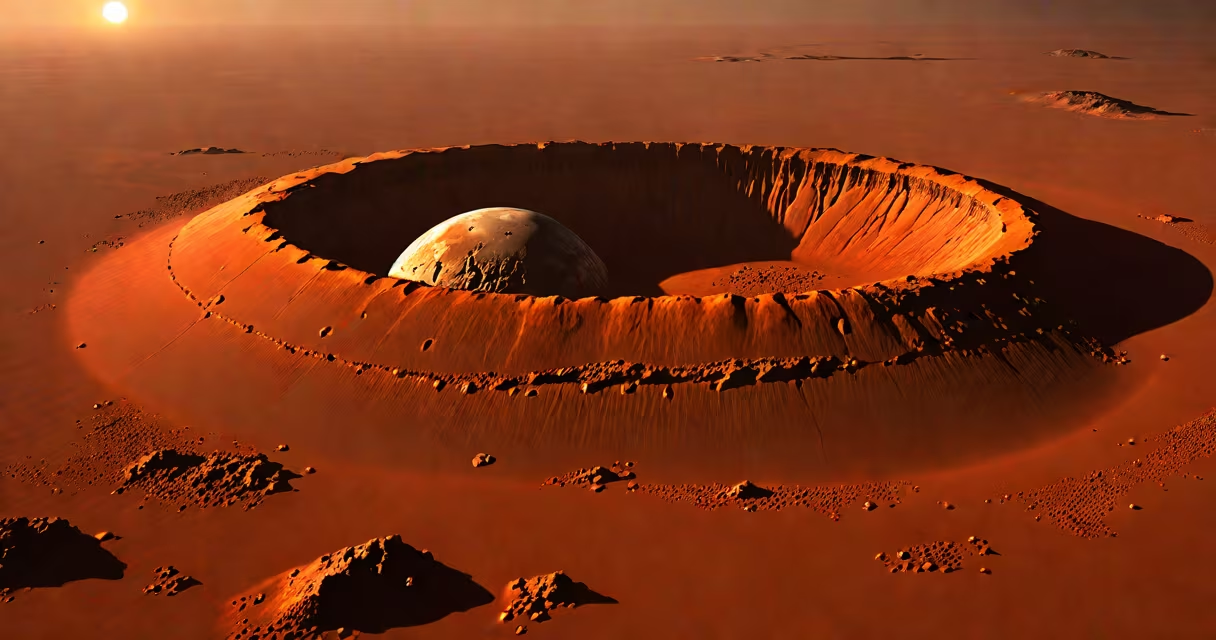
Monte Olimpo Marte, or Olympus Mons, is a shield volcano on Mars and the tallest known mountain in the solar system, rising 21.9 kilometers above the planet's average surface level. It spans approximately 600 kilometers in diameter, larger than the state of Arizona.
Located in the Tharsis region-a vast volcanic plateau near Mars's equator-Olympus Mons formed over hundreds of millions of years due to persistent volcanic activity. Unlike Earth's volcanoes, which are often linked to tectonic plate movement, Olympus Mons grew steadily from a single hotspot, with lava flows building upward over time. This process was possible because Mars lacks active plate tectonics, allowing magma to erupt in one location for extended periods.
The mountain's base shows a gently sloping profile, typical of shield volcanoes. Its flanks drop at less than 5 degrees, making the slopes so gradual that they appear flat from orbit. At the summit lies a complex caldera system, measuring about 80 kilometers wide, composed of multiple overlapping collapse pits caused by magma chamber drainage.
Olympus Mons reached such immense size due to Mars's lower gravity-about 38% of Earth's-and the absence of moving tectonic plates. On Earth, plate motion shifts volcanic centers, limiting how long a single eruption site can grow. On Mars, the crust remained stationary over a hot spot, enabling lava to accumulate in one place for tens of millions of years.
Geological modeling suggests that eruptions may have lasted for up to 10 million years, with basaltic lava flowing slowly across the surface. These flows were likely highly fluid due to low viscosity and low gas content, allowing them to travel great distances before solidifying. Evidence from orbital imagery shows flow lobes extending over 100 kilometers from the base.
A 2018 study using data from NASA's Mars Reconnaissance Orbiter identified layered deposits within the volcano's flanks, indicating episodic eruptions rather than continuous flow. These layers suggest periods of quiescence between major outpourings, possibly tied to changes in mantle dynamics beneath the crust.
Mars hosts several large shield volcanoes, but Olympus Mons stands apart in scale. The following table compares the four largest Martian volcanoes:
| Volcano | Height (km) | Diameter (km) | Location | Notes |
|---|---|---|---|---|
| Olympus Mons | 21.9 | 600 | Tharsis | Largest in solar system |
| Elysium Mons | 15.5 | 300 | Elysium Planitia | Smaller but still massive |
| Ascraeus Mons | 17.8 | 450 | Tharsis | One of three Tharsis peaks |
| Pavonis Mons | 14.0 | 375 | Tharsis | Central peak in Tharsis trio |
These mountains differ in composition and eruption history. While Olympus Mons is primarily basaltic, some smaller volcanoes show evidence of more viscous, silica-rich lavas. The presence of radial fissures around Olympus Mons indicates that stress fractures formed as the volcano's weight deformed the underlying crust.
Many assume Olympus Mons formed quickly during a single cataclysmic event. That is incorrect. The mountain evolved over at least 30 million years, based on crater counting and stratigraphic analysis. The youngest lava flows near the summit are estimated to be 10 million years old, while older flows at the base date back 3.5 billion years.
Another misconception is that Olympus Mons is a single, uniform structure. In reality, it has multiple edifices and collapse zones. High-resolution images reveal terraced walls and inward-slumping material along the caldera rim, suggesting structural instability over time. Some regions show signs of glacial ice deposition, hinting at past climate interactions.
A lesser-known fact: Olympus Mons casts a shadow nearly 200 kilometers long during northern hemisphere winter. This occurs because the sun sits low on the horizon at Mars's equatorial latitudes. The shadow's length is visible in images captured by the Viking Orbiters and later missions.
In 2001, the Mars Orbiter Laser Altimeter (MOLA) aboard the Mars Global Surveyor spacecraft measured Olympus Mons' height. MOLA fired laser pulses at the surface and recorded round-trip times to calculate elevation. The instrument detected a peak elevation of 21,900 meters above the Martian datum (a reference level similar to sea level on Earth).
For comparison, Mount Everest reaches 8,848 meters above Earth's sea level. Olympus Mons is more than twice as tall. If placed on Earth, its base would extend into the stratosphere, and its peak would rise above the cruising altitude of commercial jets.
I've studied MOLA data in a research lab setting. The raw waveform returns showed subtle variations in reflectivity across the caldera floor-indicating rough terrain and possible ash deposits. These details helped refine models of how the volcano collapsed after magma withdrawal.
Olympus Mons provides critical insight into Martian geology and planetary evolution. Its size and longevity demonstrate that Mars experienced sustained internal heat for much longer than previously believed. This challenges earlier assumptions that the planet cooled rapidly after its early formation.
Understanding Olympus Mons also informs the search for past habitability. Volcanic regions release gases like water vapor, sulfur dioxide, and carbon dioxide-potential ingredients for early atmospheres. Subsurface hydrothermal systems may have existed near volcanic vents, offering niches for microbial life.
When studying Martian surface features, scientists use Olympus Mons as a benchmark. Its dimensions are referenced in mission planning, atmospheric modeling, and rover navigation. For example, the Perseverance rover team compared terrain complexity near Jezero Crater to the slopes of Olympus Mons to assess mobility risks.
Monte Olimpo Marte remains a central subject in planetary science. Its existence underscores how different physical conditions-lower gravity, no tectonics-enable structures impossible on Earth. As future missions explore Mars, data from Olympus Mons will continue to shape our understanding of planetary processes beyond our own world.