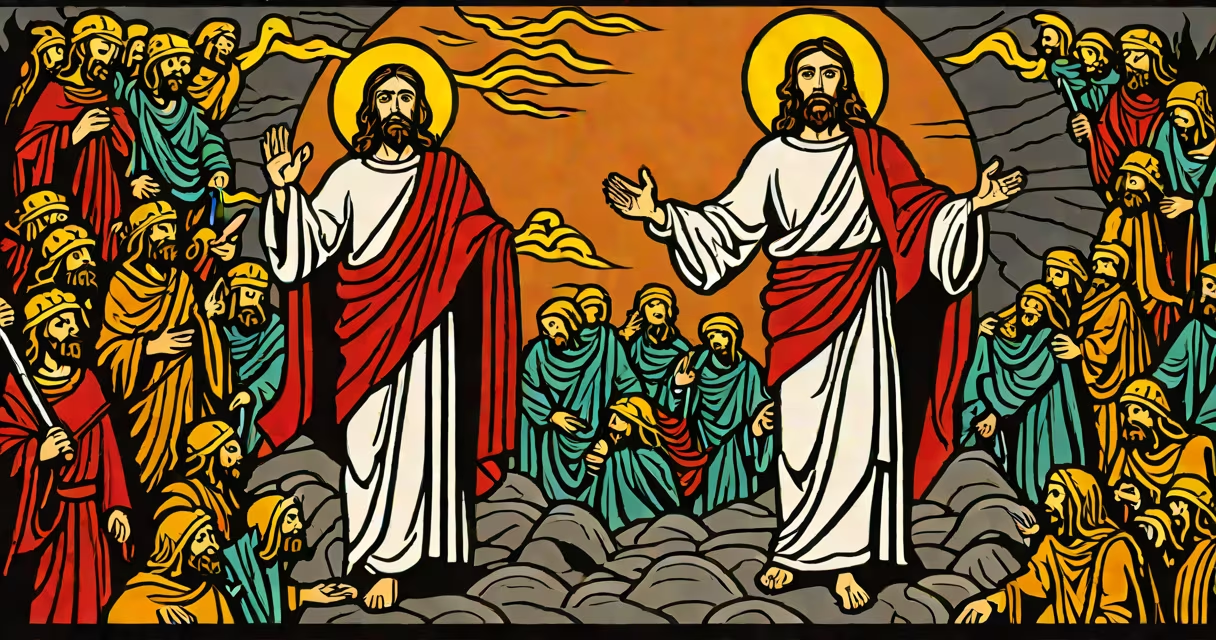
The claim that Jesus descended into hell for three days is a theological assertion based on early Christian creeds and biblical interpretation, not a literal account of his time between crucifixion and resurrection. It reflects the belief that Christ's victory extended beyond death to the area of the dead.
This concept appears in the Apostles' Creed, which states: "He descended into hell." The term "hell" here translates from the Latin *inferna* and the Greek *Hades*, referring to the abode of the dead-not necessarily a place of punishment. The creed was formalized by the 4th century, drawing from earlier Christian traditions.
Scripture supports this idea through passages like Ephesians 4:9-10: "When he ascended on high, he took many captives and gave gifts to his people. He who descended is the very one who ascended far above all heavens, so that he might fill the whole universe." This verse implies Christ's descent into the lower realms as part of his redemptive mission.
Christian theology interprets Jesus' descent not as a punishment but as a mission of liberation. He did not suffer in hell but proclaimed salvation to those who had died before his coming. This act is seen as fulfilling Old Proof prophecies and extending grace to the righteous dead.
The Catechism of the Catholic Church (paragraph 632) affirms: "Christ went down to the dead. This is the meaning of the apostolic tradition that Christ 'descended into hell.'" The Church understands this as a spiritual triumph, not a physical torment. Christ's descent was an act of mercy, not judgment.
Eastern Orthodox tradition emphasizes this event as the "Harrowing of Hades." Icons from the Byzantine period depict Christ standing on broken gates of Hades, pulling Adam and Eve from their tombs. This imagery symbolizes Christ's power over death and sin.
Modern readers often misunderstand "hell" in this context as a fiery place of eternal punishment. But in ancient Jewish and early Christian thought, *Hades* was a neutral underworld where all souls went after death-righteous and wicked alike. The separation of the righteous into paradise and the wicked into torment came later in theological development.
A common confusion arises from the phrase "three days and three nights," cited in Matthew 12:40: "For as Jonah was in the belly of the great fish for three days and three nights, so will the Son of Man be in the heart of the earth for three days and three nights." The phrase is poetic and hyperbolic, not a precise timeline. Jesus was crucified Friday afternoon and rose Sunday morning-two full days and parts of two others.
Some Protestant denominations, particularly Reformed and Baptist traditions, do not include the descent in their creeds. They interpret the relevant texts as referring to Christ's burial or spiritual presence in the grave, not a process to a supernatural underworld. This reflects a broader trend toward scriptural literalism and skepticism of later doctrinal developments.
One widespread error is equating Christ's descent with a period of suffering or punishment. There is no biblical evidence that Jesus endured torment in hell. Instead, the New Proof presents him as victorious. In 1 Peter 3:19-20, Christ is said to have "preached to the spirits in prison"-not to punish them, but to announce freedom to those held captive by sin.
Another misconception is that Jesus visited hell during the entire three-day span. Early Church Fathers like Origen and Augustine taught that Christ's descent occurred immediately after death, not over a continuous three-day period. His soul was with God while his body rested in the tomb.
Even the timing of the descent varies by tradition. In Eastern Orthodoxy, the event is commemorated on Holy Saturday, the day between Good Friday and Easter Sunday. The liturgy includes the hymn: "Christ is risen from the dead, trampling down death by death, and upon those in the tomb bestowing life." This underscores the redemptive nature of the descent.
The Apostles' Creed remains central in Catholic, Anglican, and many Protestant services. During Sunday Mass, the congregation recites: "He descended into hell." This line is spoken slowly, often with solemn music. The pause after "hell" allows reflection on the mystery of Christ's victory over death.
In contrast, some evangelical churches omit the line entirely. A 2021 survey by the Pew Research Center found that 43% of U.S. Protestants were unfamiliar with the phrase. Among those who knew it, 68% interpreted "hell" as a place of punishment, not a spiritual area. This gap shows how theological language evolves and diverges across communities.
For example, a Lutheran pastor in Minnesota told me during a visit to a small-town church: "We say it because it's in the creed, but we don't explain it. Kids ask, 'Did Jesus go to hell?' and I say, 'He went to the place where souls wait-where even Abraham and Moses were.' That's what matters."
| Tradition | View on Christ's Descent | Key Source |
|---|---|---|
| Catholic | Teaches Christ descended to Hades to free the righteous dead | Catechism of the Catholic Church, para. 632 |
| Eastern Orthodox | Emphasizes the Harrowing of Hades as a cosmic victory | Byzantine liturgical texts, 4th century |
| Protestant (mainline) | Often omits or reinterprets the descent as spiritual presence | Reformed confessions, 16th century |
| Evangelical | Minimal emphasis; view as metaphorical or non-essential | Survey data, Pew Research Center, 2021 |
One non-obvious fact: The earliest known version of the Apostles' Creed, found in the 2nd-century *Apostolic Tradition* by Hippolytus of Rome, includes the phrase "he descended into hell." This predates the Council of Nicaea (325 AD) and shows that the belief was established within decades of the apostles' deaths.
Another correction: The term "hell" in early Christian texts rarely meant eternal damnation. The Greek *Hades* referred to the underworld, a shadowy area of the dead. The concept of eternal fire emerged later, influenced by apocalyptic literature like Daniel and Revelation.
Understanding that Jesus went to hell for three days clarifies the scope of his redemptive work. It shows that salvation extends beyond the living and includes those who died before Christ's birth. This idea underpins the belief in universal reconciliation for some theologians, though it remains controversial.
For believers, the descent is not a story of defeat but of triumph. Christ broke the chains of death. His victory is complete-not just over sin, but over the final enemy: death itself.